If an oven trips a breaker, leave the tripped device off until you have recorded when it operated. The timing matters: an immediate trip on connection differs from a trip when a heating mode starts, after several minutes of heat, or only during pyrolytic cleaning. Do not keep resetting protection to “see if it holds.” A breaker or residual-current device is responding to an electrical condition; repeated attempts can worsen heat damage and erase useful evidence.
Stop using the oven for these warning signs
Keep the circuit isolated and arrange qualified help if you smell burning insulation, see discoloration at the outlet or isolation switch, hear arcing, find a hot plug or cable, see moisture near electrical parts, or the protective device trips again. Do not remove a built-in oven, terminal cover, rear panel, or heating element. Ovens can be hardwired, are heavy, have sharp edges, and contain mains-voltage wiring.
If the circuit board is in a wet or unsafe location, do not touch it. Use the main isolator only from a dry position or contact an electrician. Never fit a larger fuse or breaker, bypass an RCD, hold a switch on, or use an extension lead to defeat the symptom.
Identify what actually tripped
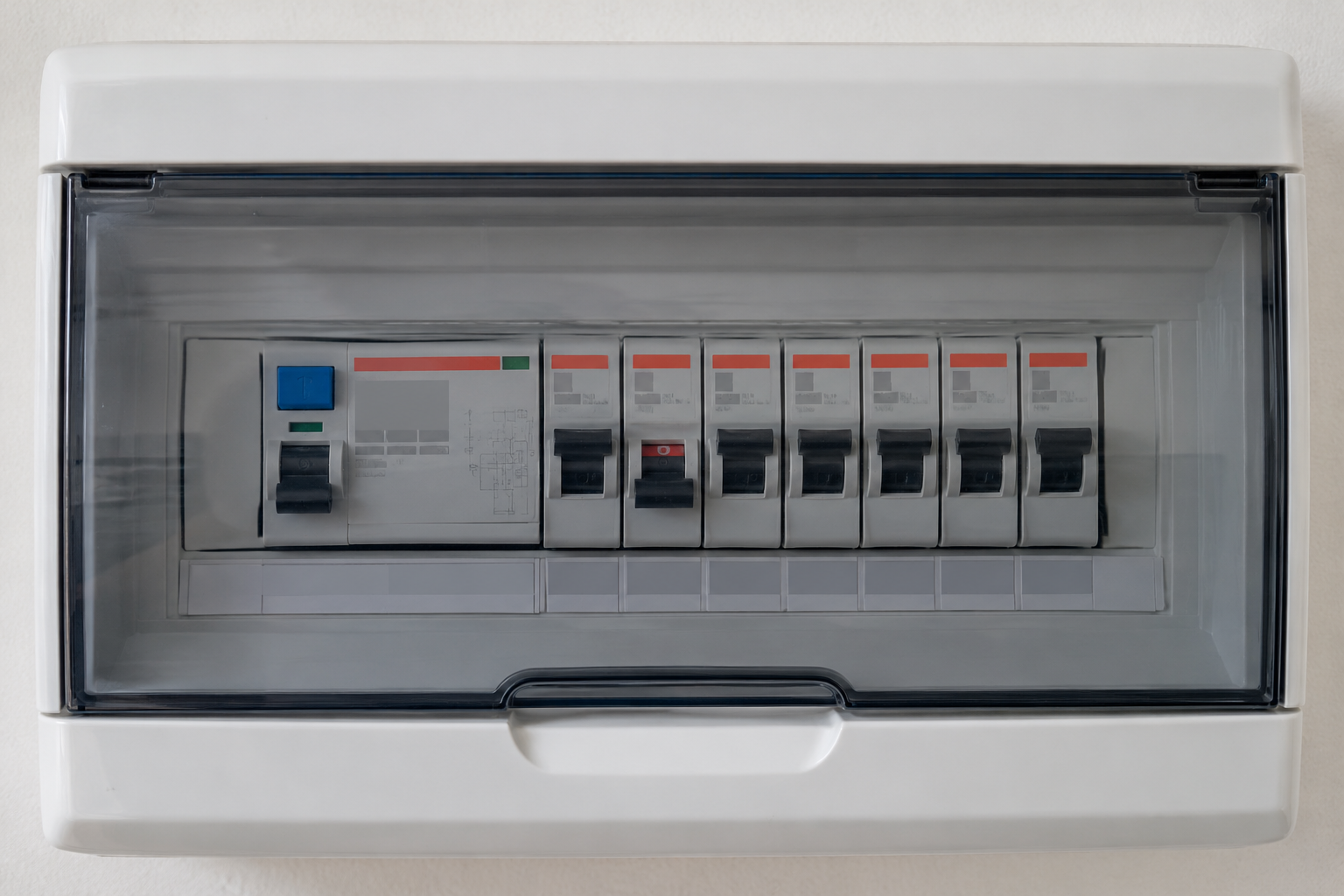
People use “the oven blew the fuse” for several different devices. Record the marking and position without opening the consumer unit. A narrow circuit breaker usually protects one circuit against overcurrent. A wider residual-current device may protect several circuits and often has a test button. Some installations combine both functions in one RCBO. Names, layouts, and operating characteristics vary by country, so do not diagnose solely from appearance.
| Observed device or effect | Condition it may indicate | What it does not prove |
|---|---|---|
| Oven circuit breaker trips | Overcurrent, short circuit, appliance fault, cable fault, or incorrect circuit arrangement | It does not identify a heating element by itself |
| RCD protecting several circuits trips | Leakage to earth from the oven or cumulative leakage on protected circuits | It does not prove the oven is the only contributor |
| RCBO for the oven trips | Overcurrent or residual-current operation depending on device indication | The handle position alone may not show which function operated |
| Main switch turns off but no protective handle moved | Supply interruption, local isolator, loose connection, or another issue | Do not call it a breaker trip without checking |
| Plug fuse opens on a plug-connected model | Fault, overload, wrong fuse/application, or damaged connection | Replacing it repeatedly is not a repair |
Write down the exact trigger moment
Before any reset, note whether the oven was cold or hot, the selected function, temperature, elapsed time, and other appliances operating. Photograph the control settings and the tripped device. This timeline is the most useful safe test available to a homeowner.
- Isolate the oven. Put its controls to off and leave the protective device off.
- Record the device. Note whether the oven branch, an RCD group, an RCBO, or a plug fuse operated.
- Record the phase. Connection, clock/display, mode selection, warm-up, thermostat cycling, fan operation, or cleaning.
- Check only external evidence. Look for heat damage, moisture, a crushed cable, or an overloaded shared circuit without removing covers.
- Stop at the boundary. Internal insulation and wiring tests require an electrician or appliance technician.
Trip immediately when power is restored
If protection operates before any cooking function is selected, possibilities include the supply cable, terminal block, mains filter, internal wiring, control power supply, installation connection, or severe earth fault. Recent installation, cabinet work, or appliance movement makes a trapped cable or incorrect connection especially relevant. Electrolux lists damaged cables, water, faulty installation, and overloaded circuits among causes of fuse or breaker operation.
Do not try individual oven functions in this state. Leave it isolated and give the installer or technician the model, circuit details, and event history. If other unrelated circuits also fail, an electrician should assess the installation rather than treating the oven as the confirmed cause.
Trip as soon as a heating mode is selected
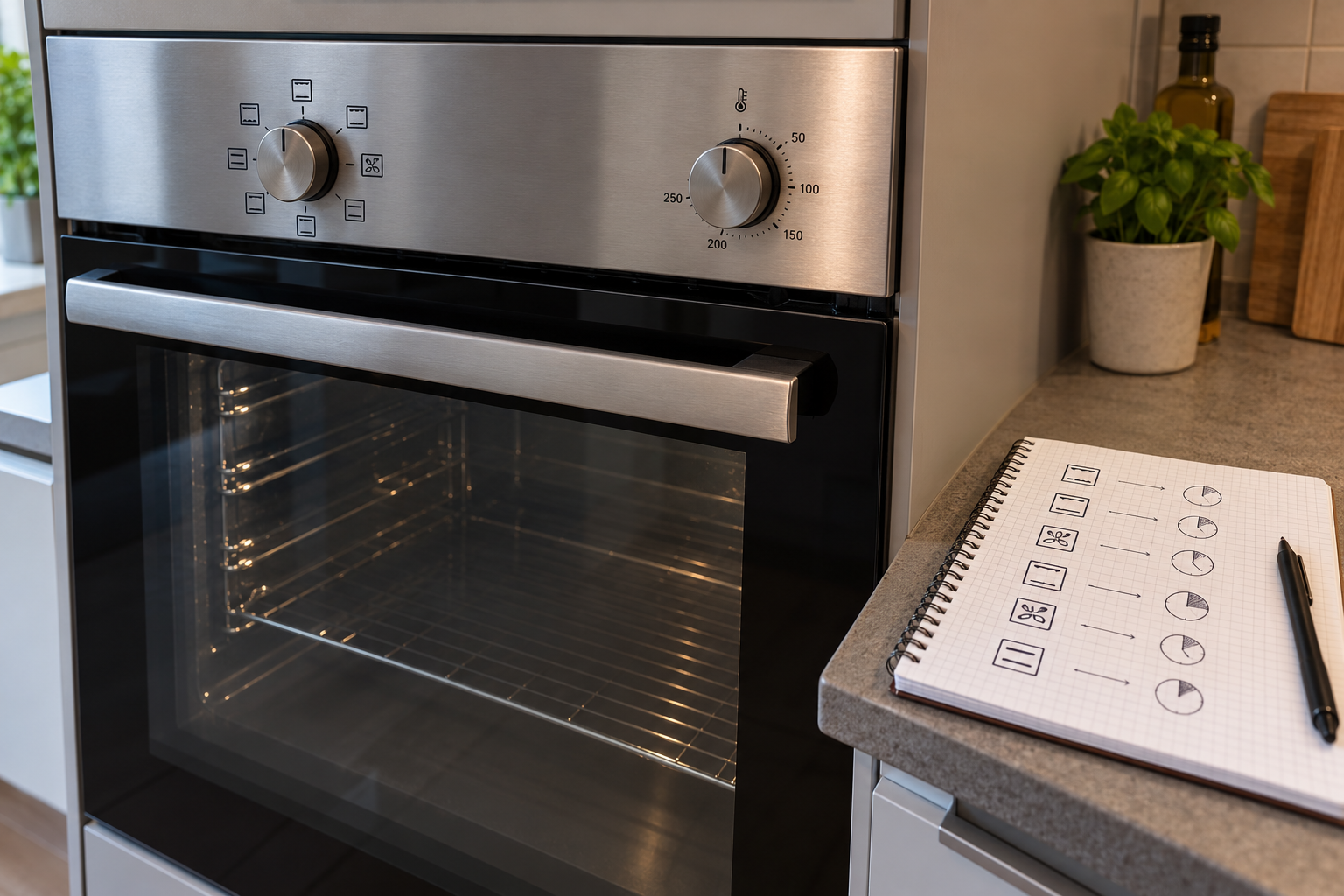
A fault that follows a particular cooking function is valuable evidence. Conventional heat may energize upper and lower elements; fan cooking commonly uses a circular element and fan; grill mode energizes an upper element. The exact combination is model-specific. If one mode consistently precedes the trip, a component used by that mode becomes a suspect, not a confirmed diagnosis.
Do not run a sequence of modes to force repeated trips. One documented event plus the model’s function chart is sufficient for a professional to plan isolation-resistance tests. Relays, wiring, selectors, and connections can mimic a failed element, so replacing an element based only on mode correlation remains guesswork.
Trip after several minutes of heating
Delayed operation can occur when insulation leakage increases as a heating element becomes hot, when a damaged connection heats and moves, when moisture migrates, or when another component energizes later in the cycle. A thermostat cycle can also make the fault appear intermittent. Note the elapsed time and whether the oven had been unused for a long period, recently cleaned, or exposed to a spill.
Advice sometimes suggests repeatedly heating a damp element to “dry it out.” That is not appropriate when protection trips. The device is already reporting an unsafe condition. Keep the oven isolated and allow a professional to measure insulation cold and, where their procedure requires it, under controlled conditions.
Trip only when the fan or light starts
If the trip coincides with the cooling fan, convection fan, lamp, rotisserie, steam function, or another accessory, record that event. Do not assume the most visible component is at fault. Its wiring, connector, shared neutral, control relay, or moisture path can produce the same timing. A lamp that fails without tripping and a circuit that trips when the lamp is switched are different symptoms.
Trip during pyrolytic cleaning
Pyrolytic cleaning operates at much higher temperature than normal cooking and may use door locking, cooling fans, and prolonged element duty. Stop the cleaning cycle if protection operates. Keep the door closed until the lock releases normally and the oven cools; never force it. Residue, damaged insulation, a hot-only element fault, fan problem, wiring, or installation issue may be involved. Do not repeat pyrolysis as a diagnostic test.
Could the household circuit be overloaded?
Electrolux notes that several appliances on the same protected circuit can cause operation and advises verifying that protection is sufficient for the power load and that the appliance is correctly connected. An oven may share upstream RCD protection while having a dedicated branch breaker; this is not the same as sharing the branch circuit. Record which other appliances stopped and which were running.
Do not calculate a new breaker size and install it from appliance wattage alone. Cable cross-section, installation method, ambient temperature, circuit length, protective-device curve, local rules, and terminal ratings all matter. A qualified electrician must verify the circuit against the oven rating plate and installation instructions.
| Timing pattern | Useful interpretation | Next action |
|---|---|---|
| Immediately on energizing | Common supply, connection, filter, wiring, or severe leakage path | Do not select modes; installer/electrician diagnosis |
| Immediately on one cooking mode | Component group specific to that mode becomes relevant | Record mode once; technician tests elements and associated wiring |
| After a repeatable warm-up time | Heat-dependent insulation or connection fault is possible | Record time and temperature; do not keep reproducing |
| When fan, lamp, or accessory starts | That branch, its control, or shared wiring becomes relevant | Record the event; avoid component substitution by guess |
| Only with several high-load appliances | Shared-circuit load or installation capacity may be involved | Electrician verifies circuit design and connections |
| RCD trips even with oven controls off | Persistent leakage, cable, filter, or installation issue possible | Leave isolated; professional insulation testing |
Why a multimeter continuity test is not enough
A heating element can have plausible resistance between its terminals yet leak current to its metal sheath or chassis, especially when hot. A basic continuity beep may miss insulation degradation. Professionals use the manufacturer’s service procedure and suitable insulation-resistance equipment after fully disconnecting the component and proving the appliance dead. Test voltage, disconnected electronics, limits, and interpretation are model- and component-dependent.
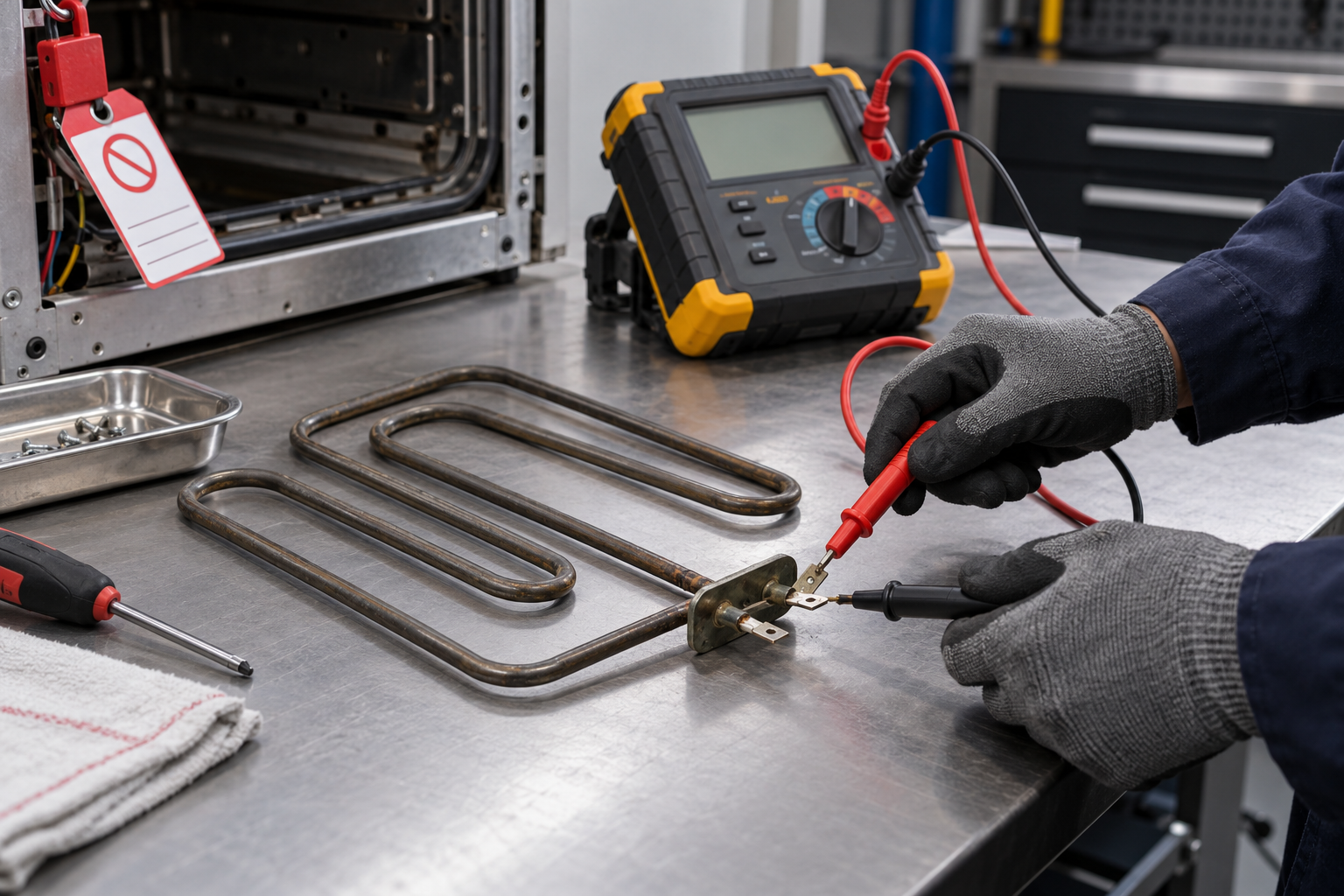
Do not connect an insulation tester to an assembled electronic oven. High test voltage can damage control boards if circuits are not isolated correctly. Live-current measurements, terminal-block inspection, and earth-continuity verification also require training and appropriate instruments.
Moisture after cleaning, storage, or a spill
A trip after steam cleaning, heavy spray, a spill, long storage, or installation in a damp environment can be moisture-related, but that observation does not make repeated resets safe. Switch off, ventilate the room, and allow the appliance to remain isolated. Do not use a heat gun, portable heater, or open panels to accelerate drying. A technician should inspect if the event repeats or water may have entered controls, connectors, insulation, or the terminal area.
External checks that remain safe
- Read the model and rating label only where accessible without moving the built-in appliance.
- Check whether the oven has a dedicated wall isolation switch and whether it shows heat damage.
- Look for cabinet moisture, a recent plumbing leak, or foil touching an exposed element inside the cold cavity.
- Remove loose foil or cookware from the cold oven only after isolation; never cover cavity vents or the oven floor unless the manual permits it.
- Check the manual for the functions used by each mode and the manufacturer’s installation requirements.
- Record other appliances affected by the same protective device.
These observations organize the service call. They do not authorize opening the appliance or resetting protection repeatedly.
Actions that can hide or worsen the fault
Do not swap the oven onto another outlet, feed it from an extension, disconnect the protective earth, or temporarily remove other protective devices. Do not replace a plug fuse with foil or a higher rating. Avoid spraying cleaners into controls and do not use the oven to dry its own electrical insulation. Component replacement by trial can introduce loose terminals and still leave the original cable or circuit fault in place. The safe objective is not to make the oven run long enough to finish a meal; it is to preserve the trip pattern and establish whether the fixed installation or appliance needs repair.
What the technician or electrician needs
Provide brand, model, product number, installation date, whether the oven is hardwired or plug-connected, the exact protective device, its rating and test-button presence, the cooking mode, set temperature, elapsed time, hot/cold state, other loads, recent cleaning or spills, and any smell, sound, code, or visible damage. State whether it began after installation, a power outage, cabinet work, or moving the oven.
An appliance technician usually evaluates internal components and wiring; an electrician evaluates the fixed supply, protective devices, cable, connections, and circuit capacity. Some cases require both. Use the ElectronixLab error-code finder if a code is displayed, but treat protection operation as the primary safety symptom.
Frequently asked questions
Can I reset the breaker once?
If there was no smoke, heat damage, water, or arcing, local guidance may allow one reset after every oven control is off. If it trips again, leave it off. When uncertain, do not reset it.
Does tripping on fan mode prove the circular element is bad?
No. It makes the fan-mode circuit relevant, but the element, motor, relay, selector, connector, or wiring may be responsible.
Will replacing the RCD solve nuisance tripping?
Not without testing. The device may be correctly responding to leakage. An electrician must test the circuit, appliance, cumulative leakage, and protective device.
Can I use the oven on a mode that does not trip?
Do not continue using an appliance with an unresolved protective-device operation. Different modes share wiring and controls, and the fault may worsen with heat.
Why did it start after the oven was unused?
Moisture absorption is one possibility, but cable, connection, element, or installation faults remain possible. The history guides testing; it does not confirm a safe cure.
Technical sources
- Electrolux UK, Oven trips fuses or circuit breaker, accessed October 30, 2026.
- Electrolux UK, Too much load on the circuit, accessed October 30, 2026.
- Electrolux UK, Faulty fuse, accessed October 30, 2026.
Be the first to leave a comment.