Choose electronics soldering flux by exact part number and data sheet, not only by the words “RMA,” “no-clean” or “water-soluble.” These terms describe different properties: RMA refers to a family of mildly activated rosin fluxes, no-clean describes residue/process conditions intended to avoid cleaning when specified criteria are met, and water-soluble flux is removed by a suitable wash when its documentation requires it. A no-clean label does not mean “no residue” or “harmless in every application.”
Understand the categories
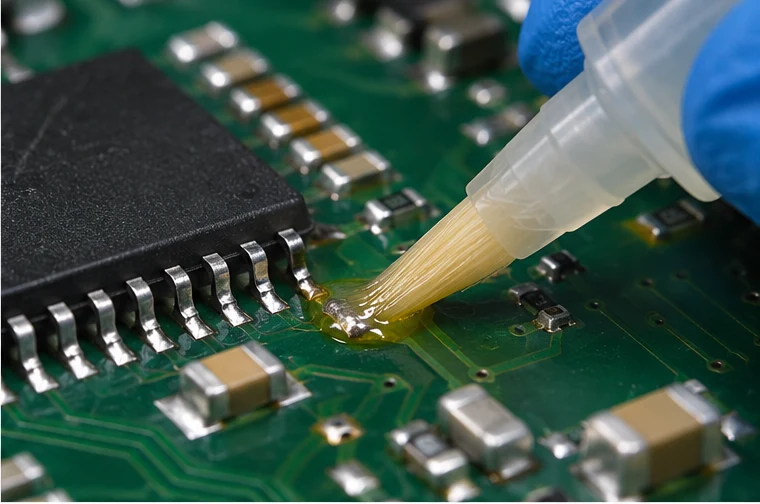
No-clean. Under the specified process, the residue may remain on an assembly when manufacturer and product requirements are met. Amount applied, alloy, temperature, contamination, humidity and reliability requirements can change the decision. Visible residue can obstruct inspection or coating even when a product is rated no-clean.
RMA (rosin mildly activated). The term describes a rosin-based flux family with moderate activation under the applicable classification. It does not by itself tell you whether every product may remain on a board or which cleaner works. Kester 186, for example, is documented as RMA; use its own data sheet and assembly requirements rather than inferring its treatment from another product in the family.
Water-soluble. Organic-acid products can provide higher activity, but residues may remain conductive or corrosive if not removed properly. Kester’s 2331-ZX documentation calls for aqueous cleaning to remove its residues. “Water-soluble” does not mean an improvised tap-water rinse is suitable for an assembled board: components, connectors, coils, displays, cavities and drying matter.
Choose for the job
| Need | Possible starting point | Check before use |
|---|---|---|
| Routine hand rework with clean joints and flux-cored solder | Often no added flux; otherwise a compatible product in a small amount | Alloy compatibility, residue, cleaning and safety data |
| Residue must remain under documented conditions | Product explicitly specified as no-clean for the process | Amount, thermal profile, cleanliness, humidity and insulation requirements |
| Controlled aqueous cleaning is available | Water-soluble flux matched to the assembly | Water quality, rinse, time, compatibility and drying |
| Rosin RMA rework flux | RMA product whose data sheet allows the process | Actual residue, customer requirements and cleaning method |
Avoid plumbing acid flux on electronics. Do not use pipe soldering flux because it “cleans better”; its chemistry and residues are not designed for circuit boards. Extract fumes, avoid skin/eye contact, close containers and follow the safety data sheet.
Clean without damaging the board
- Identify the product and read both data and safety sheets. Confirm whether it must be cleaned, with which agent and within what time.
- Remove power and protect parts that cannot tolerate liquid or solvent. Shielded connectors, relays, microphones, switches and cavities can trap fluid.
- Choose a cleaner compatible with the flux, solder mask, plastics and markings. Isopropyl alcohol is not universal for every flux; some residue may spread instead of dissolving.
- Use only enough cleaner and a suitable brush. For water-soluble flux, follow the maker’s wash process, including water quality and rinsing if specified.
- Dry completely, including under parts and connectors, before power-up. Inspect under magnification; a clean-looking surface can hide ions or residue.
Decide whether residue may remain
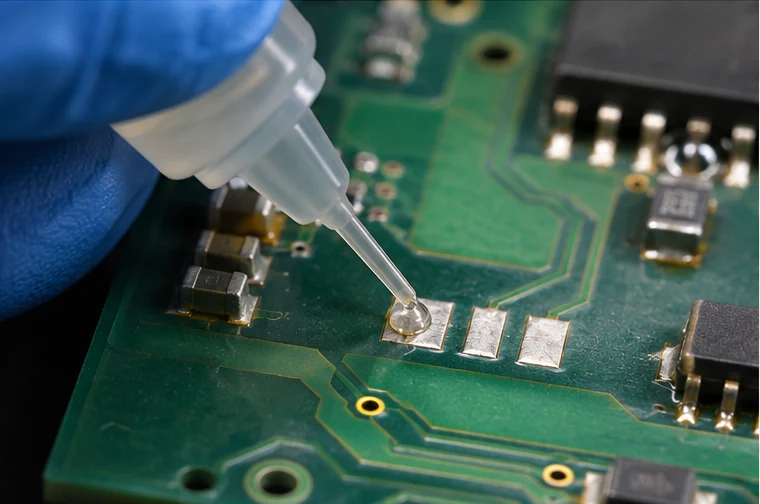
The decision depends on the whole assembly: operating voltage, node impedance, humidity, surface cleanliness, conformal coating, automotive/medical requirements and quality specification. Residue acceptable on a bench prototype may not be acceptable near a very high-impedance input or a board exposed to condensation. RMA and no-clean are product/process classifications, not universal life guarantees.
A flux data sheet may specify solids, activity, classification, surface insulation, process and cleaning method. A safety sheet answers a different question: exposure risks, ventilation, PPE and disposal. Keep both. If a flux pen label gives no cleaning method, find the full data sheet before leaving residue on a product expected to last.
Quick decision and common mistakes
- Poor wetting? First check tip, contact temperature, oxidation and alloy compatibility. A more active flux is not always the first fix.
- Flux says no-clean? Check allowed amount, thermal profile and cleanliness criteria. Do not assume excess residue can stay.
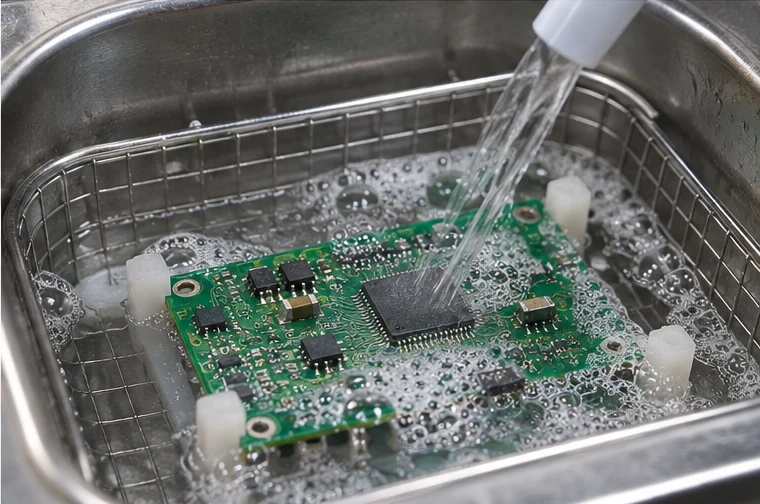
- Flux is water-soluble? Plan the wash before applying it: equipment, water, rinse, drying, access below parts and inspection.
- Flux is RMA? Treat it according to the exact data sheet; RMA is not automatically synonymous with no-clean.
- Flux pen has no identifiable maker? Without a manufacturer, lot and data sheet, do not use it on an important or hard-to-clean board.
If a solder joint fails, correct it with a suitable alloy and method; the through-hole desoldering guide covers braid and pump handling.
Must RMA flux always be cleaned?
The family name alone is not enough. Follow the exact product data sheet, intended use and board requirements. Do not copy a rule from another product.
Does isopropyl alcohol remove all flux?
No. Solubility depends on formulation and how the residue was heated. IPA can move some deposits or leave a film. Use a cleaner explicitly compatible with the residue.
Is no-clean residue harmless?
Not under every condition. Excess, contamination, humidity, potential difference or insulation requirements can change the risk. Documentation and process determine acceptability.
Before changing flux on a repeated assembly, trial it on a representative area or coupon: access under components, solder mask, connectors and final coating can make a theoretically compatible cleaning process impractical. Keep the product, lot, applied amount and cleaning process traceable.
Technical sources
- Kester 951 — product data for a liquid flux classified no-clean.
- Kester 186 — rosin RMA liquid flux and its technical data.
- Kester 2331-ZX — water-soluble organic-acid flux and wash guidance.
- Chemtronics, flux remover selection — cleaner compatibility by residue family.
Sources consulted November 2, 2026. Formulations and instructions can change; check the current data sheet for the product actually used.
Be the first to leave a comment.