If a dishwasher finishes with water covering the tub floor, first distinguish a shallow film in the sump from standing water that covers the filter or does not decrease during the drain phase. A small amount around the filter can be normal on some models; deep or dirty water that remains after the machine’s drain programme is a different symptom. Do not assume the pump has failed. Food debris, a kinked hose, a blocked sink trap, an interrupted cycle or a model-specific safety condition can produce similar results.
Observe the water and the last part of the cycle
- Note whether water covers the filter or sits only in the recessed sump.
- Record any code, beeps, flashing pattern and whether a drain sound occurs.
- Check whether the kitchen sink drains normally before changing dishwasher plumbing.
Do not run repeated cycles if water is near the door seal or leaking onto the floor. Switch the appliance off at its normal control. If there is a leak, water near electrical parts, smoke or a burning smell, isolate power only if it is safe and request service. Keep children away from standing water and broken glass.
| Observation | What it suggests | Next step |
|---|---|---|
| Small amount only in the filter well | May be the model’s normal residual water | Compare with the manual; watch the next drain stage |
| Dirty water covers the filter | Restricted filter, sump, hose or household drain possible | Isolate power, inspect user-accessible filter |
| Sink also drains slowly | Shared trap or household waste line may be restricted | Address plumbing; do not blame the dishwasher pump yet |
| Drain hum but no water moves | Obstruction or pump issue remains possible | Stop after safe checks; service if it persists |
Cancel the cycle only as the manual describes
If the dishwasher stopped mid-programme, the controls may be paused or waiting for the door to latch. Some models drain when Cancel/Drain is held; others use a menu or a separate programme. Follow the exact model instructions rather than pressing a guessed button combination. Listen from outside: a short pump sound and falling water level show that some water moved, but do not prove the drain path is fully clear.
If the control displays a code, record it exactly before cancelling. Manufacturer code meanings are not universal. For example, Electrolux groups certain i20-family indications with drainage faults, but that does not mean every dishwasher’s code has the same meaning. Use the model-specific support page and do not erase a recurring code before noting it.
Clean the user-removable filter safely
Turn the dishwasher off and disconnect it from power using the plug only if safely accessible; otherwise use the circuit breaker when appropriate. Let hot wash water cool. Wear gloves if glass may be present. Remove racks only as needed, then unlock and lift the filter assembly in the direction shown by the manual. Do not reach blindly into the sump: sharp fragments can be hidden beneath cloudy water.
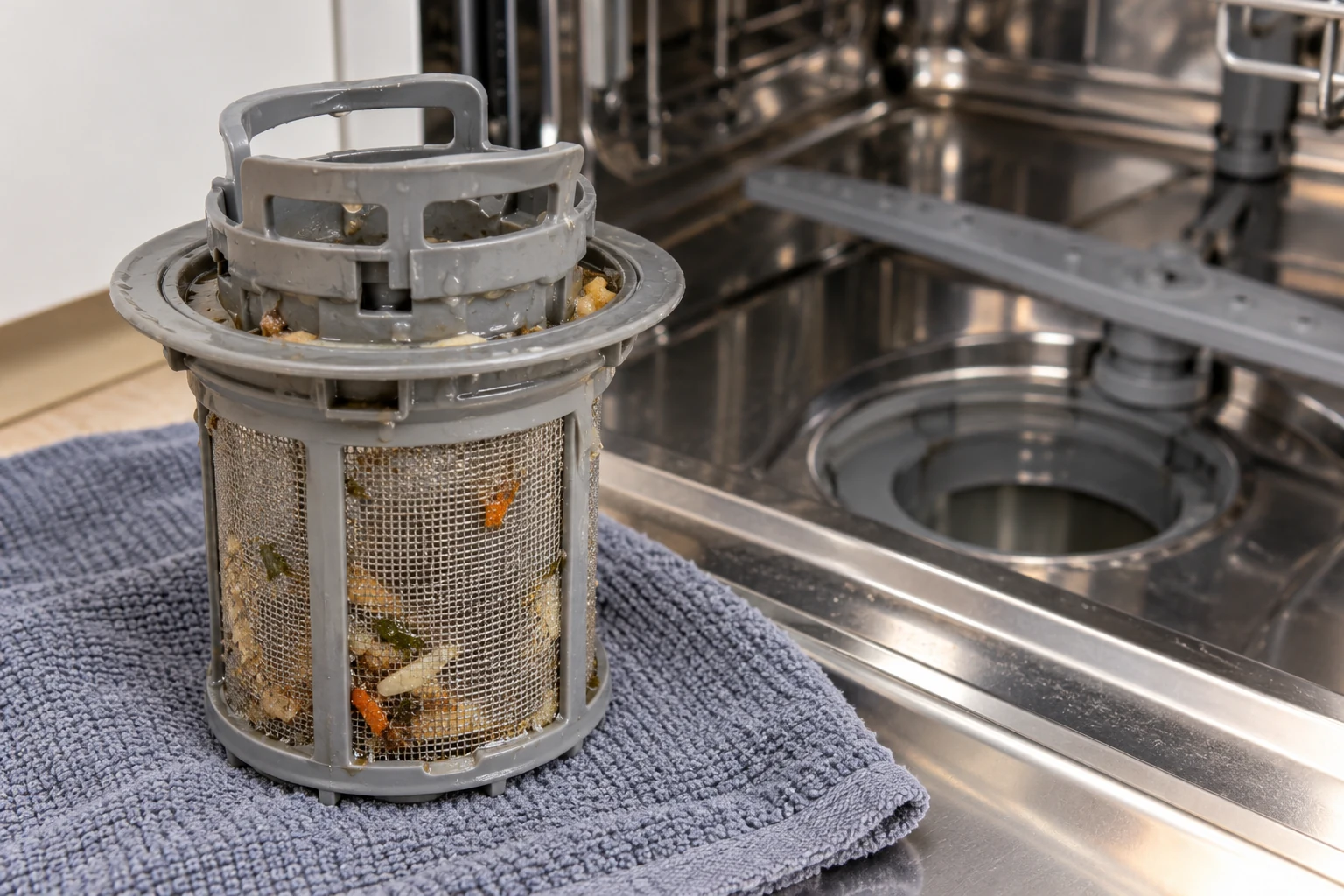
Rinse the removable filter under running water and use a soft brush if the manual permits. Do not use a knife, screwdriver or wire to clear the mesh, and do not force a filter that will not turn. Check the seating surfaces for visible food scraps, labels or broken pieces without reaching into an unseen impeller. Refit the filter fully; a poorly seated filter can let debris pass toward the pump. If the model has a separate pump cover intended for users, open it only by the illustrated procedure and after safe isolation. Otherwise leave the cover in place.
After reassembly, run the model’s short drain or rinse option while standing nearby. If the water level falls and the code does not return, the filter restriction may have contributed. If the pump only buzzes, stops, or the water remains, do not repeat the test: a fragment may be lodged deeper, or another fault may exist.
Inspect the visible drain hose and sink connection
Look under the sink for a crushed, sharply bent or trapped section of the dishwasher drain hose. Check that storage items are not pressing against it and that the connection has not slipped. Do not pull a built-in dishwasher forward unless the installation permits it and the hose, power cord and water line have slack. A strain or leak created during inspection can make the problem worse.
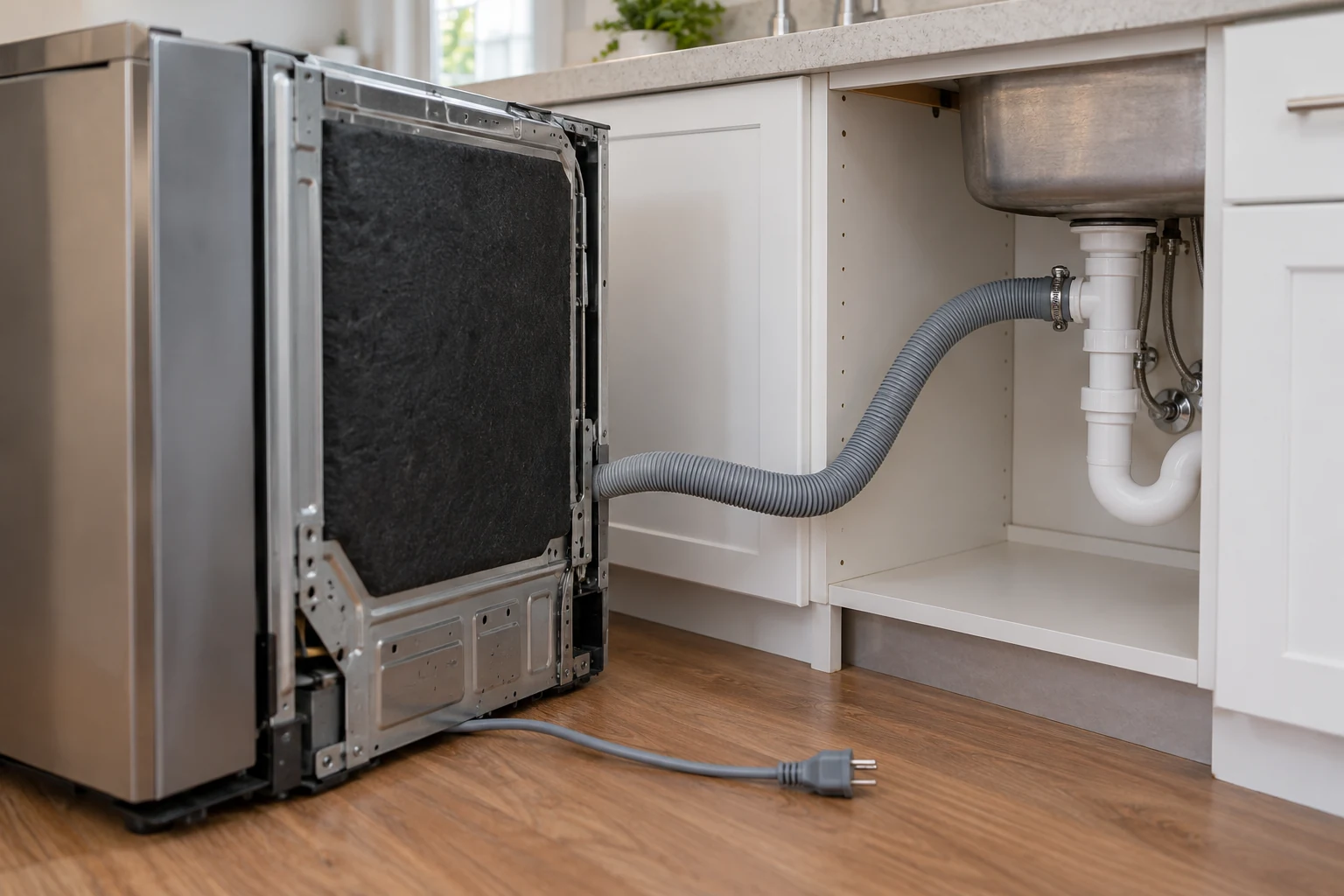
If the dishwasher was recently installed or the sink waste was replaced, compare hose routing and high-loop or air-gap requirements with the installation manual. The required arrangement depends on local plumbing and model. An incorrect connection can allow sink water to flow back or cause siphoning, even when the drain pump itself works. Do not cut, extend or lower a hose based on a generic diagram.
Look at the sink trap connection without undoing it. A blocked disposer inlet plug on a new installation, grease or a household drain restriction can interfere with discharge. If the sink is slow, backs up or gurgles when the dishwasher drains, the shared plumbing deserves attention. Do not pour chemical drain cleaner into the dishwasher or its hose; it can damage seals and expose a technician to caustic liquid.
Use the sink as a separate comparison
Run water in the sink and observe its own drainage. A freely draining sink does not prove that the dishwasher hose or pump is clear, but it makes a broad household blockage less likely. A slow sink, bubbling trap or water backing up at the dishwasher connection points toward a shared waste path. If plumbing work is required, keep the dishwasher off until the connection is restored and leak-checked.
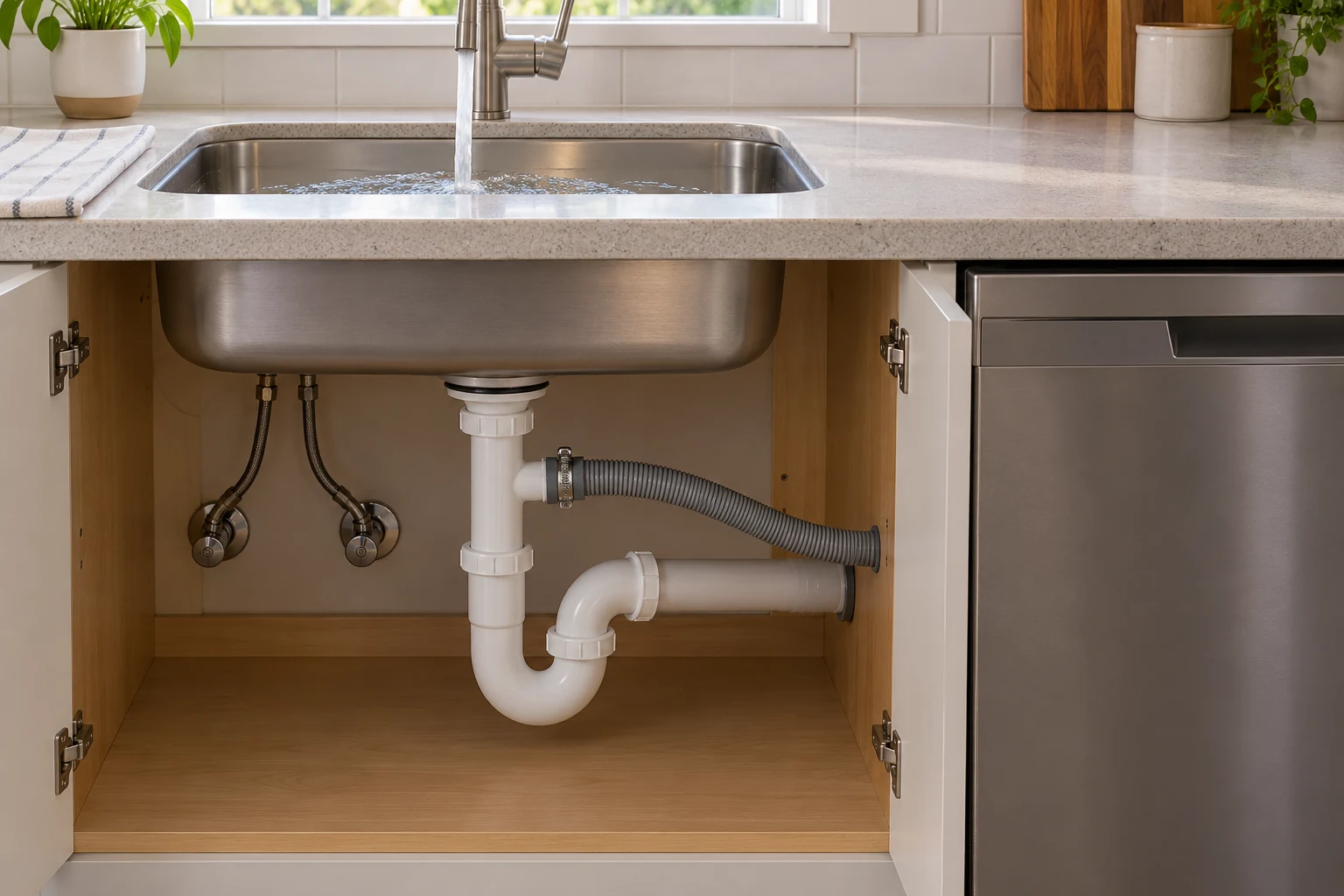
When a dishwasher and sink share a trap, note whether the symptom happens only when the dishwasher pump runs or also when the sink is used. This timing helps separate an appliance-side restriction from a downstream pipe problem. Do not disconnect a hose full of dirty water without a container and a safe procedure; if access is awkward or water is hot, call a plumber or appliance technician.
Interpret the pump sound without guessing the part
| Sound/result | What you can infer | Limit |
|---|---|---|
| No sound during the documented drain command | Drain stage may not be commanded, or an electrical/control condition may exist | Does not identify a failed board or pump |
| Steady hum, water level unchanged | Pump may be obstructed or unable to move water | Internal inspection is not a user test |
| Water moves but returns later | Hose routing, backflow or sink connection may matter | Check installation guide and plumbing |
| Rattle or grinding after filter cleaning | Debris or mechanical contact may remain possible | Stop; do not reach for the impeller |
A pump can make sound while blocked; silence can also have more than one explanation. These observations help describe the fault, not certify the pump. Avoid testing a live pump with a meter or applying power directly. Such work involves mains voltage, water and model-specific wiring and belongs to a qualified technician.
When to stop and call for help
Request service if the same drain code returns after the accessible filter and external hose checks, the pump repeatedly hums without lowering the water, a leak appears under the cabinet, the filter cover is damaged, or a fragment is lodged beyond the user-accessible area. Stop immediately for smoke, burning smell, sparks, water at electrical connections or a breaker that trips repeatedly. Do not remove panels or bypass a float switch.
Before calling, note the model number, exact code, whether the sink drains, the water depth after the drain command, and what sound occurred. Mention any recent installation or plumbing work. This evidence narrows diagnosis without assuming a part replacement.
Frequently asked questions
Is a little water under the dishwasher filter normal?
Some designs retain a small amount in the sump to protect seals. Compare the amount and location with the user manual. Water covering the filter or remaining across the tub after a drain attempt is a different observation.
Can I scoop out standing water?
Only if it is cool and safe, using a cup or sponge without reaching into the sump. Isolate the appliance first and watch for sharp debris. Do not use a wet vacuum near powered equipment.
Does a humming sound mean the drain pump is broken?
No. It indicates a sound during operation, not the cause. A blockage, restricted hose or pump fault can sound similar; model-specific service may be needed.
Can I pour drain cleaner into the machine?
No. Household drain chemicals can attack appliance materials and create a hazard during service. Treat the sink plumbing separately using an appropriate professional method.
Sources consulted
- Electrolux France: dishwasher will not drain (consulted 1 November 2026).
- Bosch: dishwasher water does not drain (consulted 1 November 2026).
- Whirlpool France: dishwasher no longer drains (consulted 1 November 2026).
- Electrolux: i20 family drainage code (consulted 1 November 2026).
Soyez le premier à laisser un commentaire.