When a cooker hood no longer extracts, first distinguish a fan that does not run from a fan that runs but cannot move enough air. Then identify whether the hood exhausts outdoors or recirculates through an odour filter. These two observations prevent replacing a motor for a blocked filter, a crushed duct or an incorrectly configured installation.
This guide concerns weak capture of cooking vapour and loss of extraction on domestic hoods. It covers accessible filters, visible ducting, controls and interpretation. It does not provide a universal capacitor test: some motors use a starting or running capacitor, while other designs use electronic control. The full model and its wiring information are needed before any internal diagnosis.
Choose the right starting branch
With no cooking in progress, select a normal manual fan speed and listen. Check whether changing speed changes the sound. Do not put a hand or tool through the grille. A working light proves only that the lighting circuit works; it does not confirm power or a command at the fan. Likewise, a humming noise does not demonstrate that the impeller is rotating or producing useful flow.
| Observation | What it narrows down | Next action |
|---|---|---|
| No lights and no fan | Supply or shared control path | Check accessible supply and manual |
| Light works, fan silent on every speed | Fan command, motor supply or motor path | Confirm manual mode; arrange service if unchanged |
| Fan audible, little capture | Filters, duct, configuration or capture conditions | Identify extraction mode and inspect accessible route |
| Good airflow, persistent odours in recirculation | Odour filtration or an unsuitable expectation | Check the correct charcoal filter and its service interval |
| Hum, scraping or burning smell | Possible stalled or damaged fan assembly | Switch off; do not keep restarting |
Extraction and recirculation need different checks
A ducted hood sends air outside
Follow the route in the installation guide and any visible duct above the hood. In extraction mode, filtered cooking air travels to an outdoor discharge. A pipe disappearing into a cabinet is not proof that the route reaches a suitable outlet. An installation that has always performed poorly deserves a check of its configuration before an assumption of component failure.
A long, narrow, sharply bent or crushed route increases resistance to airflow. The manufacturer's specified duct diameter matters; there is no single suitable diameter for every hood. Hidden joints, a stuck backdraft flap or an obstructed outdoor terminal may require an installer. Do not dismantle a chimney cover or reach an elevated outlet simply to complete a first-line check.
A recirculating hood returns air to the room
In recirculation, a grease filter captures grease and a compatible odour filter treats smells before air returns to the kitchen. It does not transport the room's moisture outdoors in the way a ducted hood does. Persistent humidity therefore does not by itself establish a broken motor. Check that the return-air openings are not covered by a cabinet or decorative panel.
Confirm the correct conversion kit and filter reference from the model documentation. An odour filter that is missing, saturated, unsuitable or incorrectly seated can explain poor odour control. Changing it will not correct a crushed extraction duct on a differently configured hood. Keep airflow performance and smell reduction as separate observations throughout the investigation.
Safe inspection before cleaning
Turn the hob off and let it cool. Switch off and isolate the hood's electrical supply before removing any user-serviceable filter. Use a stable position from the floor; do not stand on the cooking surface or stretch over cookware. Support the filter with both hands because grease makes frames slippery. Wear suitable gloves if edges are sharp.
Do not spray cleaner into the motor, switches, lights or electrical areas. Never use a flame, smoke pellet, burning paper or incense to test suction. Keep the hood out of service for a hot electrical smell, repeated protective-device operation, damaged cable, loose mounting or severe scraping. Internal electrical access and fan removal require a competent professional.
Restore the filter path methodically
- Record the configuration. Note the model, extraction or recirculation mode, affected speeds and whether the problem appeared gradually or after installation work.
- Remove the grease filter as instructed. Photograph its orientation and latch position before releasing it. Stop if removal requires force or exposes an unfamiliar assembly.
- Inspect for grease loading and damage. Compare the two faces and frame. A damaged filter must not be reshaped in a way that prevents secure seating.
- Clean using the permitted method. Follow the manual on water temperature, detergent and dishwasher suitability. Do not mix cleaning chemicals or assume every filter is dishwasher-safe.
- Deal with the odour filter separately. Identify whether it is disposable or a regenerable design. Apply only its stated replacement or regeneration procedure.
- Dry and reinstall. Refit all parts securely before restoring power. Do not run the hood unguarded to compare its suction without filters.
- Compare the same speeds. With the installation complete, listen and observe capture during ordinary safe use. Record improvement rather than claiming a measured airflow.
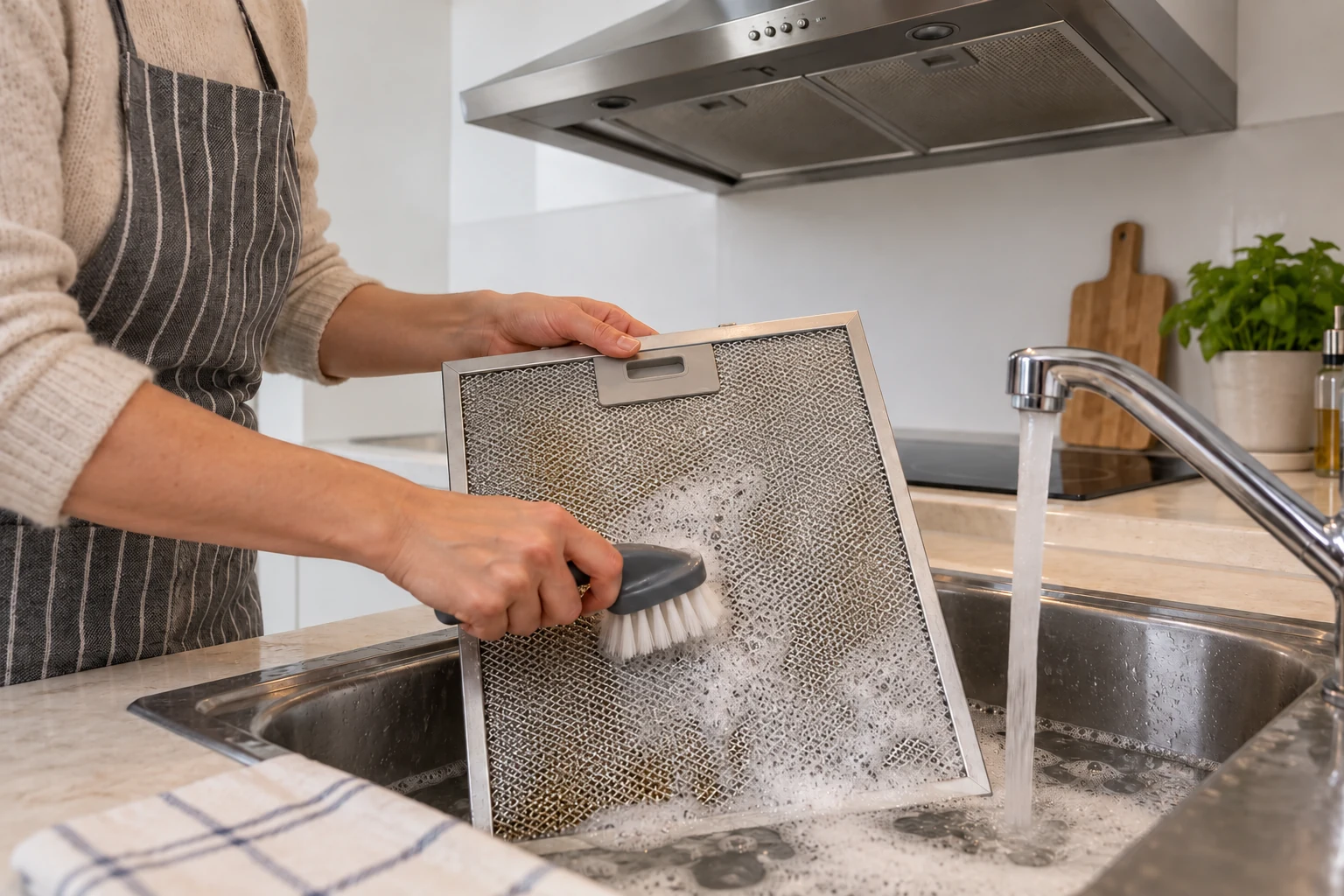
A visible layer of grease is a reason to clean, but appearance alone cannot quantify restriction. Conversely, a clean outer face does not guarantee that the filter's inner layers are clear. Preserve the manufacturer's filter arrangement: adding an extra sheet or an improvised pad changes resistance and can affect secure mounting. Use compatible replacement parts when the mesh or retaining mechanism is damaged.
Check the visible duct without creating another fault
If the route is accessible without removing a panel or climbing, look for a flattened flexible section, a tight turn immediately above the outlet, a disconnected joint or a cabinet pressing on the duct. Do not pull on the hood to gain room. Photograph the accessible defect and compare the installation against the specified diameter and routing requirements.
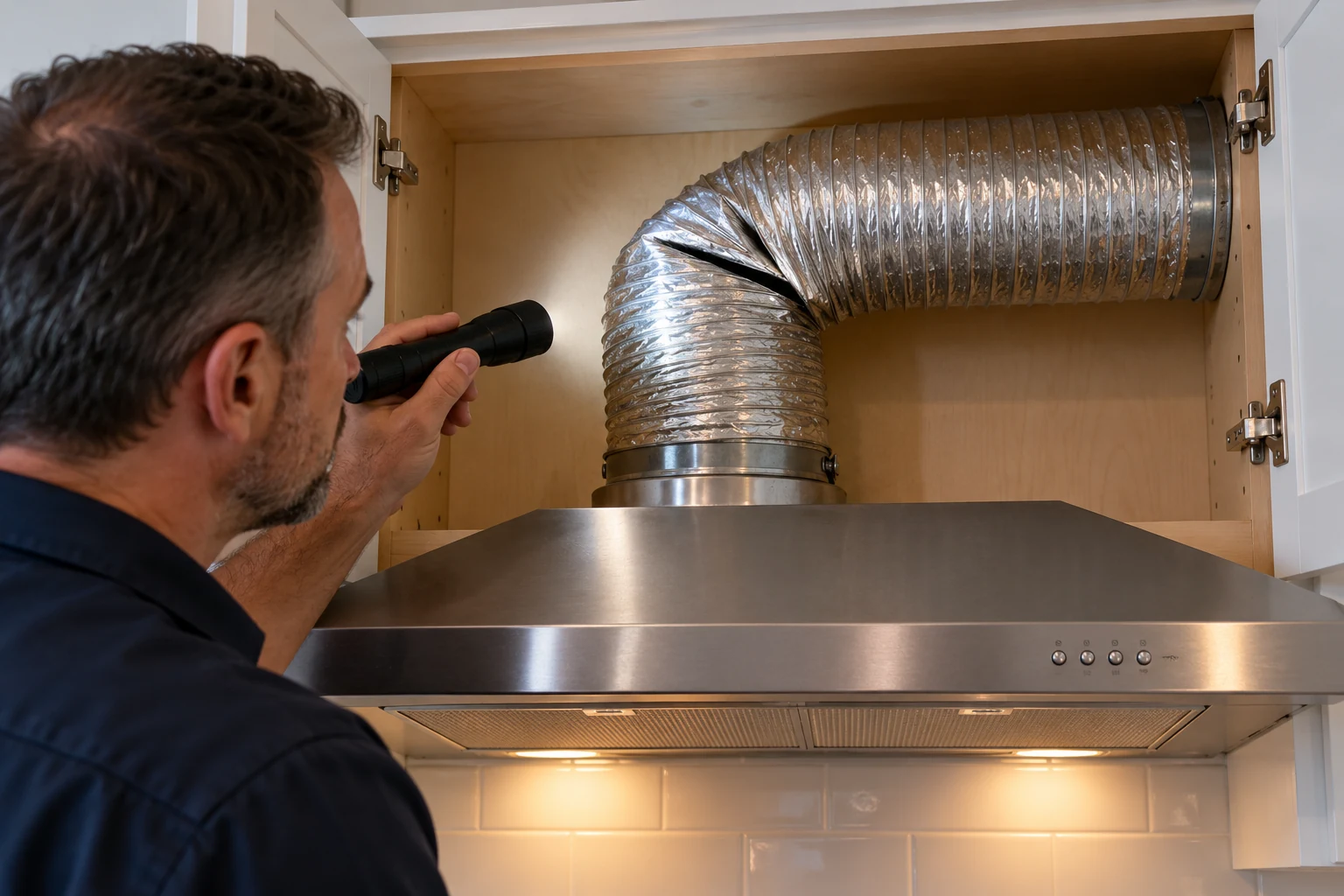
A duct change is an installation correction, not merely a cleaning task. Its material, fire considerations, connections and final outlet must remain suitable for the appliance and building. Never connect a kitchen hood to a flue serving a combustion appliance. A professional should evaluate an uncertain shared route or any arrangement involving a fuel-burning appliance and room depressurisation.
Do not infer airflow from fan loudness. A restricted fan can sound busy while moving little useful air, and a loose duct can transmit vibration. A change in sound after cleaning is an observation, not a calibrated flow test. If a quantitative result is required, an installer needs an appropriate measurement method and the installation's operating conditions.
Room air and capture geometry
A hood can only exhaust air if replacement air can enter the space. In a tightly closed room, performance may differ from the original installation conditions. A modest change to a permitted ventilation opening can be an observation during ordinary use, but it is not a remedy for a combustion-safety problem. Do not cover permanent vents to reduce noise or draughts.
Capture also depends on where vapour rises relative to the hood. A pan at a front zone, cross-draught from a nearby window or installation height outside the model's permitted range can allow vapour to escape even with a running fan. Compare similar cooking conditions and the recommended speed. Do not lower a hood, modify its mounting or create steam deliberately as an improvised performance experiment.
Odour filter: avoid a universal replacement rule
Conventional disposable charcoal filters and long-life regenerable filters have different maintenance instructions. Some cannot be washed; some special products have a documented cleaning or oven-regeneration procedure. Do not heat an unknown charcoal filter because another brand's video shows it. Find the part reference and follow its own instructions.
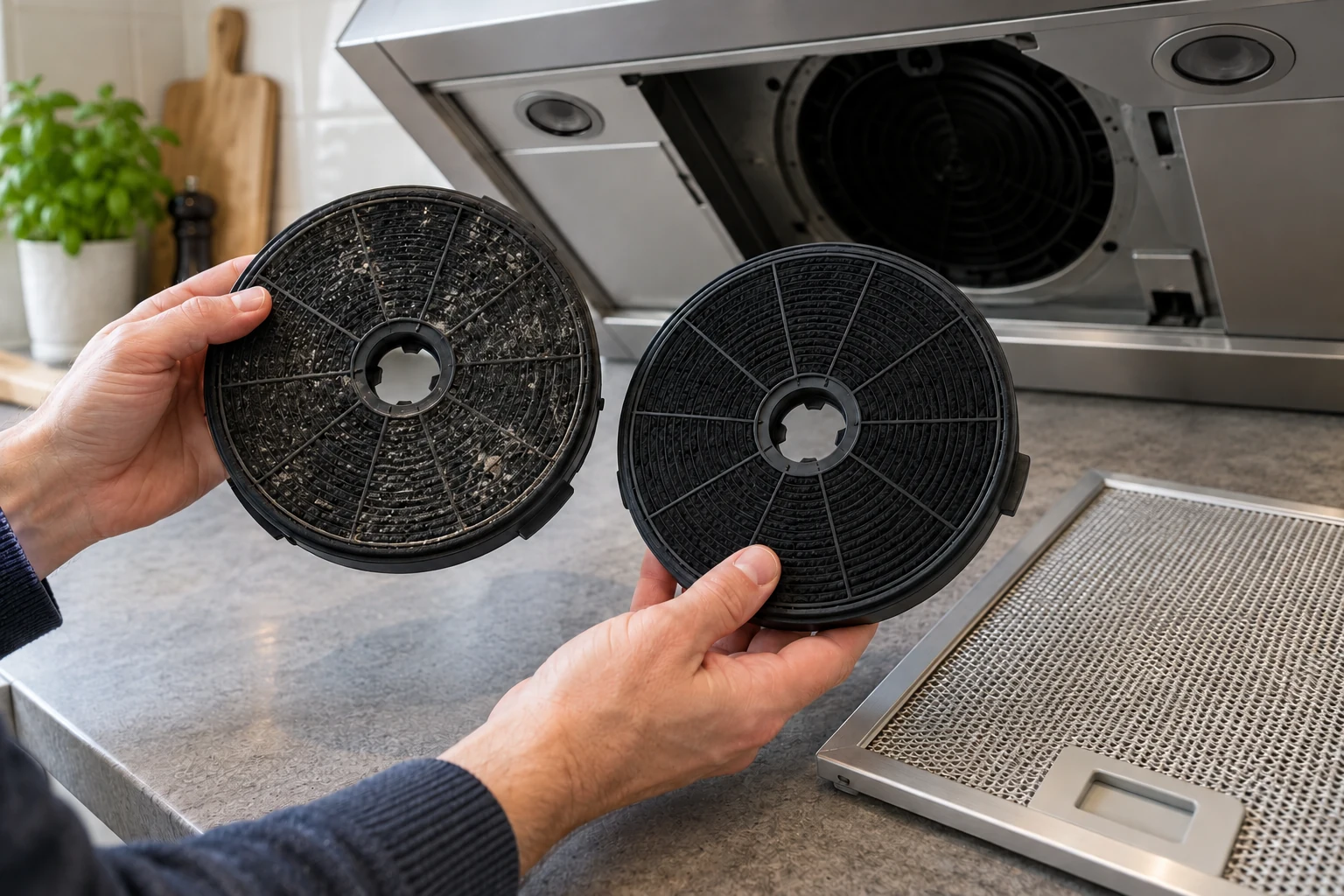
Service intervals vary with filter design and use. Frequent frying and long operation are different conditions from occasional light cooking. Use the hood's manual and any filter indicator as intended rather than applying a fixed interval to every appliance. Reset the reminder only after completing the relevant maintenance; clearing a symbol does not restore a saturated filter.
What motor and capacitor symptoms can establish
A silent fan with working controls can still involve wiring, control electronics, thermal protection or the motor. A hum with no useful extraction can involve a stalled assembly, mechanical restriction or an electrical starting problem. These patterns help describe the fault but cannot identify the failed component without access and model-specific checks.
Do not push the impeller to start it, bridge a switch or fit a capacitor chosen only by physical size. Capacitor arrangements, ratings and discharge precautions differ. A technician should first identify the motor design and check mechanical condition, connections and command path. Replacing the entire hood or control board solely because the light works and the fan does not is also premature.
Use the history to narrow the next decision
Poor extraction from the first day
Prioritise configuration: wrong mode, missing recirculation kit, blocked return outlet, unsuitable duct or installation geometry. Give the installer the model and photographs of the accessible route. A new motor will not correct an installation that prevents the intended air path.
A gradual loss over several months
Filter loading and contamination become sensible first checks. After permitted cleaning, compare the same manual speeds. If smell improves but vapour capture does not, the odour filter and airflow branches have produced different results; do not combine them into one claim of success.
A sudden loss after cabinet work
Look for a visible duct displacement, a blocked return grille or a changed control connection. Do not open the electrical compartment. The timing is useful evidence for the installer, but it does not prove which connection was disturbed.
Compare capture without pretending to measure airflow
Use an ordinary cooking task that you already perform safely, with the same zone, pan position and manual fan speed. Start the hood as the manual recommends, then observe from a normal standing position whether vapour escapes at the front or side. Do not lean into the rising plume or create excess steam for the test. The purpose is to locate the escaping path, not to demonstrate maximum suction.
Suppose permitted filter cleaning reduces odour but vapour still escapes mainly from a front pan. That illustrative result leaves two distinct findings: filtration changed, while capture at that position remains poor. Installation geometry, speed selection and cross-draught still need consideration. It does not prove that the motor is weak or that a larger motor is needed.
In another scenario, poor extraction starts immediately after a cupboard is refitted and a visible flexible duct is now flattened. Photograph the changed section without disturbing connections. That is a concrete installation observation for the fitter. Do not keep bending the duct while the hood runs to find a favourable sound, and do not report an airflow percentage that was never measured.
After a justified correction, repeat only the relevant normal-use observation. A stable improvement with all guards and filters fitted is the practical outcome to monitor. Persistent failure requires an installation or appliance assessment rather than increasingly elaborate home experiments.
Questions before booking a repair
Can a sheet of paper prove the hood works?
No. A paper demonstration is not a flow or capture measurement and should not replace the checks above. Do not put loose objects near an inlet or run without filters. The relevant outcome is capture under the installation's intended conditions.
Should the hood remove all condensation in recirculation?
No. Returning treated air to the room differs from exhausting it outside. Check room ventilation and the intended installation mode before describing remaining moisture as a fan failure.
When is a technician necessary?
When the fan remains silent or hums, permitted filter maintenance changes nothing, the duct is inaccessible, mounting is uncertain or electrical symptoms appear. Provide the exact model, mode, speed behaviour, start date and maintenance results. If the controls display a warning, record it before consulting the appliance error-code finder and confirm its meaning in the exact hood manual.
Technical references
- Bosch: fan running with poor extraction.
- Bosch: hood installation and ducting.
- Bosch France: grease and odour-filter maintenance.
- Bosch France: recirculation versus extraction.
Sources consulted 31 October 2026.
Be the first to leave a comment.