If your freezer is no longer freezing, protect the food and confirm its actual temperature before guessing a failed compressor. An illuminated display, a cold-feeling shelf or a quiet motor does not establish whether frozen storage is being maintained. Start by distinguishing a recent recovery period, an incorrect operating mode and a persistent loss of cooling.
This guide covers owner-accessible checks on domestic upright freezers, chest freezers and freezer compartments. It does not include live electrical testing, compressor terminal checks or opening the refrigerant circuit. If a combined appliance’s freezer really holds its target while only the fresh-food compartment warms, the separate fridge warm but freezer cold guide addresses that different symptom.
Protect food before waiting for a recovery
Keep the door or lid closed while arranging suitable alternative frozen storage. Move food that is still frozen promptly to a working freezer without overloading it. An insulated cooler only protects frozen food if its contents and cooling packs actually maintain the required conditions; it is not a replacement freezer for an indefinite repair. Record when the fault or power interruption was first noticed.
Do not refreeze food that has thawed simply because the appliance starts cooling again. The French Ministry of Agriculture advises against refreezing a thawed product. Follow the food’s instructions and the relevant public food-safety advice; if its temperature history is unknown, do not taste it to decide whether it is safe. An alarm reset, a hard surface or restored cold cannot reconstruct that history.
The diagnosis below concerns the appliance, not a declaration that its contents are safe. Transfer and assess the food before defrosting, prolonged testing or an extended power-off period. Do not leave it on the kitchen counter while waiting for frost to melt. This separates the urgency of food storage from the time needed for a meaningful cooling check.
Know when to stop the appliance checks
Stop using the freezer if there is a burning smell, damaged cable, repeated breaker trip, smoke or water at an electrical connection. Avoid the wet area and isolate power from a safe dry position if possible. Do not repeatedly reset a protection device or fit an extension lead as a workaround. Electrical damage requires competent assistance.
Disconnect before cleaning the permitted grilles or handling accessible maintenance parts. Do not pull an integrated cabinet out by its door, strain a connected water line or remove a fixed electrical cover. If a refrigerant tube has been punctured or damaged, stop, avoid flames and other ignition sources, ventilate where safe and contact service according to the appliance’s safety instructions. Never try to find a refrigerant leak with a flame.
Separate the setting from the measured temperature
A usual frozen-storage setting is −18°C, but a display may show the selected target rather than the current compartment temperature. Check the manual to identify what its number and alarm mean. A warning can follow an open door, fresh loading or a power interruption; it is not a compressor fault code by itself. Silencing the buzzer does not make the compartment colder.
- Record the displayed value, mode, alarm symbol and time before changing anything. Note a recent delivery, move, power cut or large fresh-food load.
- Use a thermometer intended for freezer temperatures. Position it according to its instructions, typically among stored packages rather than against a cooling surface or in the door opening.
- Close the door and leave the instrument to stabilise for its stated period. Opening repeatedly to watch it makes an air reading harder to interpret.
- Record the measurement and time, together with the room temperature and selected target. If it is safe to monitor recovery, compare readings taken under similar conditions.
- Protect food independently. A later measurement describes that later condition; it does not prove how warm food became earlier.
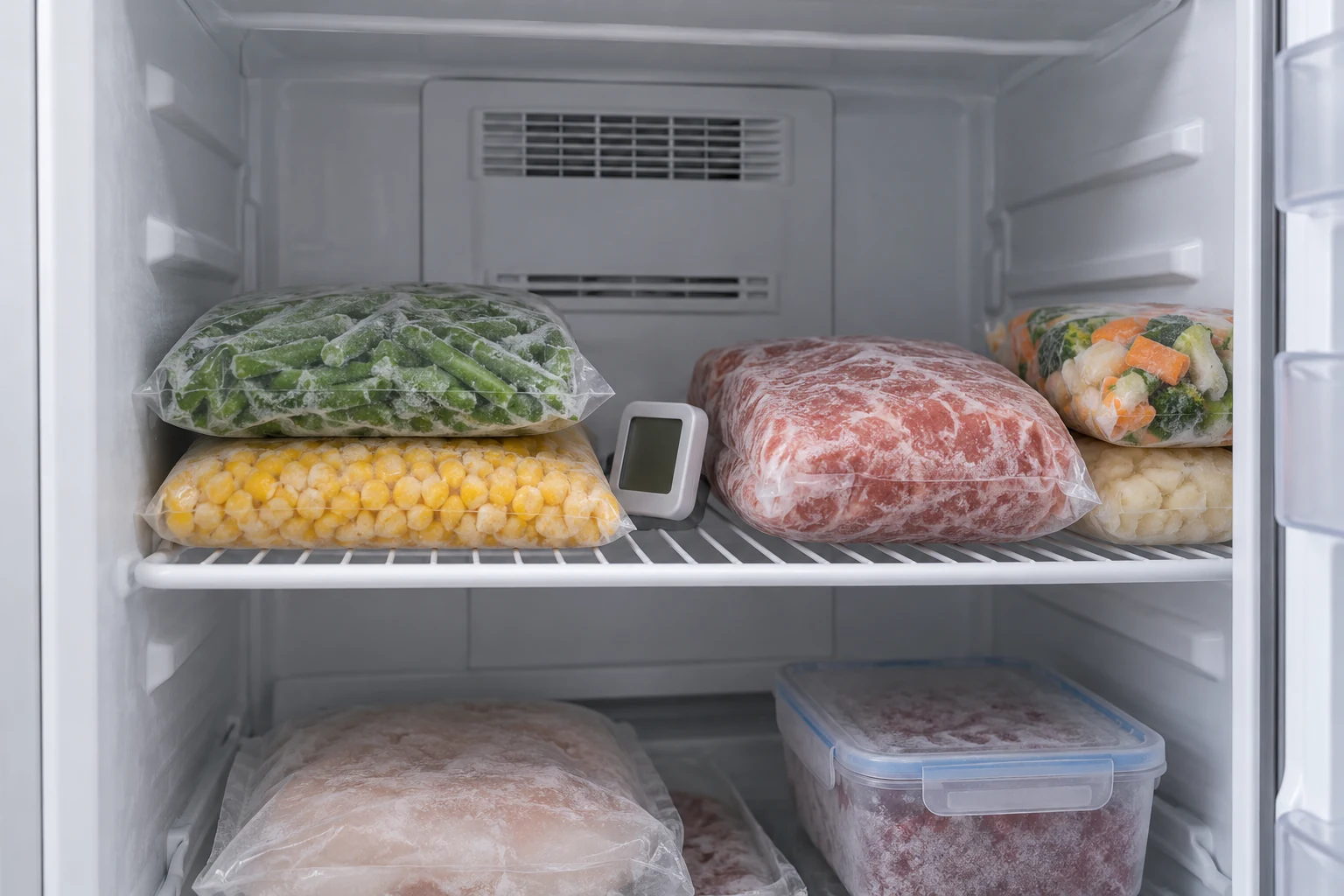
Do not put a glass of water in the freezer for this test: freezing water can damage an unsuitable container, and the fridge measurement method is not automatically transferable. Likewise, ice cream texture varies by recipe and is not a calibrated thermometer. A package remaining solid while the compartment warms can reflect its thermal inertia rather than satisfactory freezer performance.
| Observed state | First useful check | Limit of the observation |
|---|---|---|
| No display or other sign of power | Accessible supply connection and household power status | A dark lamp alone does not identify an electrical fault |
| Panel works but cooling is disabled | Off, demonstration or convertible-compartment mode in the manual | A lit panel does not establish refrigeration |
| Temperature rises after a door or loading event | Closure, load limits and stated recovery conditions | Not every warm reading after loading means a failed part |
| Freezer remains warm with heavy visible frost | Safe defrost/airflow branch for the exact design | Frost does not distinguish heater, sensor, fan or control |
| Warm compartment despite corrected accessible conditions | Model-specific appliance service | Sound and temperature alone do not name the failed component |
Power and operating modes: begin outside the cabinet
If the connection is dry, safe and reachable, check that the plug is fully seated and the dedicated switch is on. Check whether a household outage affected other appliances. A damaged, hot or loose socket is a stopping point for an electrician. Do not remove the socket front or probe the appliance’s power supply. Some models have no interior lamp, so use their actual indicators rather than assuming every freezer should light up.
Check the freezer’s own On/Off control and the instructions for its operating modes. Some convertible compartments can be set to refrigerator operation; a setting intended for chilled food cannot provide frozen storage. Some appliances also have a showroom mode that leaves lights or controls active while disabling cooling. Samsung documents this behaviour on specific models, with indications such as OF OF or O FF.
Use only the exit procedure for the complete model reference. Do not try unrelated service-button combinations or assume an unfamiliar symbol means demonstration mode. If a reset is prescribed, record alarms first and follow its interruption and restart instructions once. Repeated unplugging interferes with observation and does not repair a defective start device or control.
A recent restart needs context, not blind waiting
A newly installed or restarted freezer needs time to pull down to storage temperature. The permitted fresh-food freezing capacity and any fast-freeze preparation are specified in its manual. Do not fill it with a large warm load while using that same load to judge recovery. After transport, follow the manufacturer’s standing time before connection; there is no universal waiting period for every transport position and compressor design.
Manufacturer guidance for some appliances allows up to about 24 hours for temperature stabilisation after adjustments. That is not permission to leave thawing food inside or to wait through an electrical warning. Use the exact manual, keep doors closed and look for the expected temperature trend. If there is no cooling trend, the alarm persists beyond the stated conditions or the situation worsens, arrange service instead of starting another waiting period.
Check closure before replacing a thermostat
Inspect the door or chest lid for a packet, drawer or basket preventing full closure. Check that removable fittings are seated correctly and that packaging does not bridge the seal. A lid can appear closed while a bag trapped at one corner holds a gap. Correct the obstruction and inspect the visible seal for dirt, tears or distortion.
Clean the gasket only with the method recommended for its material. Do not heat it with a hairdryer or glue a loose section without the model instructions. Installation and levelling can affect door alignment; use the stated method and get help with a heavy appliance. A visibly damaged gasket needs an appropriate repair, while an apparently clean seal does not certify airtightness everywhere.
Distinguish internal airflow from room ventilation
On a frost-free upright freezer, identify air outlets and returns in the manual. Move packages away without blocking a different opening, and leave the intended circulation space around stored food. A fan guard must remain installed. Do not reach through it, force a hidden flap or defeat a door switch to make the fan run. Fan operation can change with the door state and the control cycle.
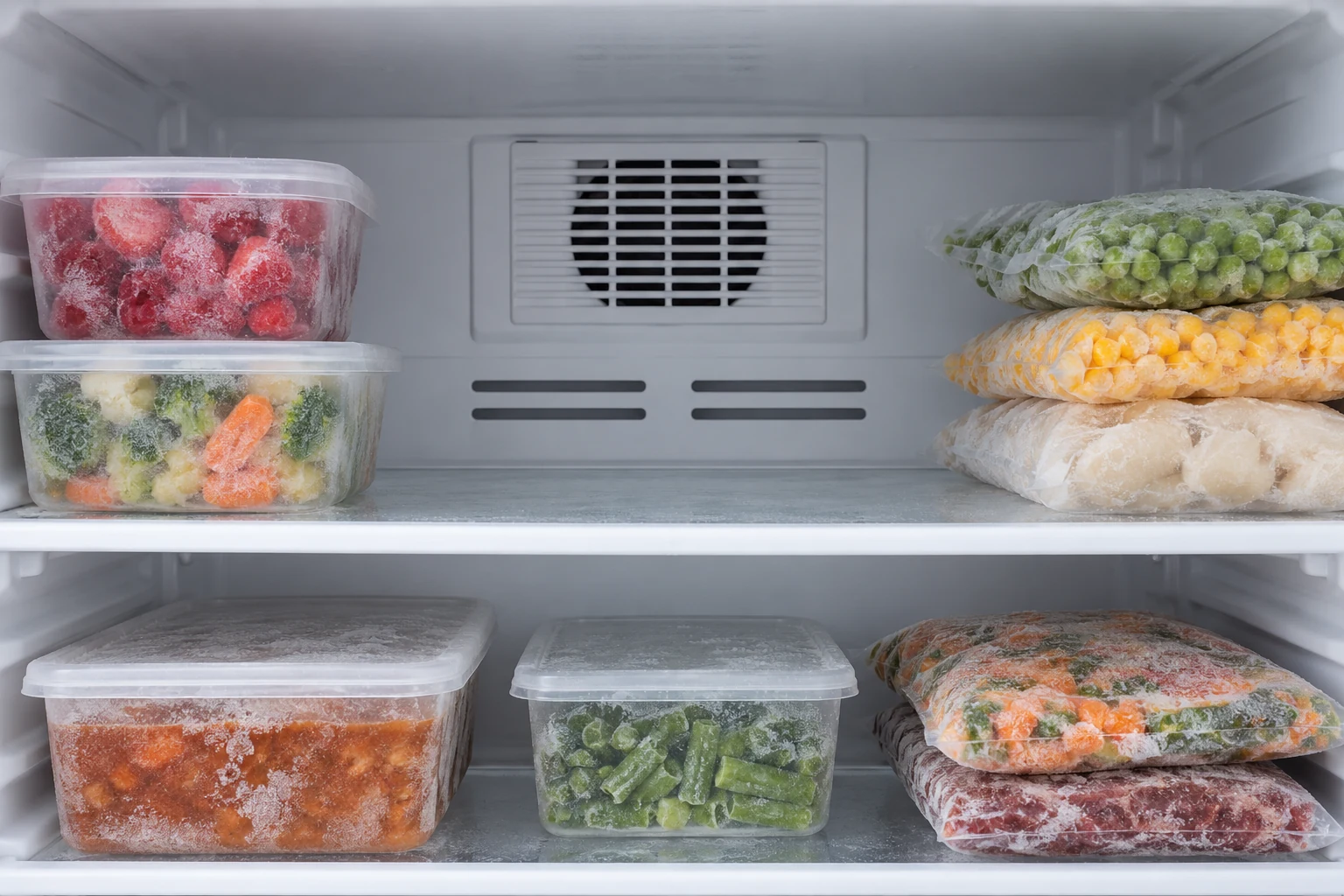
A static chest freezer may have cooling surfaces in its walls and no circulation fan. Absence of a fan sound is therefore not a universal fault sign. The useful check is whether its storage arrangement respects baskets, loading marks and the model’s design. Do not scrape its walls to search for an evaporator or convert a storage limit into extra loading space.
Outside the cabinet, keep the specified intake and exhaust grilles clear. Check that furniture, dust or objects have not obstructed them. Clean only the condenser or grille the manual identifies as owner-accessible, with power disconnected and the approved tool. Some heat-exchange surfaces are built into the walls; there may be no exposed rear coil to brush. Do not remove a fixed cover merely because another model has accessible coils.
Room temperature can be wrong in either direction
Compare the installation room with the climate range stated for the exact appliance. A hot utility room can increase the load; an unheated garage may also be outside its approved range. Liebherr lists ambient temperature among the causes of a warm compartment and markets specific low-ambient-capable freezers. That capability must be verified for the actual model, not inferred from the brand or the word “freezer.”
If the problem appears only during cold weather in a garage, report that pattern and the measured room temperature. Do not cover the appliance with insulation or improvise a heater around it. On a combined fridge-freezer, the relationship between room temperature, controls and compartments also depends on its architecture. An unsuitable location needs an installation solution rather than a guessed sensor replacement.
When frost makes a defrost branch relevant
Some frost is expected on a manual-defrost freezer. Thick accumulation that restricts usable space or closure needs the maintenance specified for that design. A frost-free model with persistent ice around a guarded air opening needs a different assessment. Inspect only what is visible; do not remove an ice-bound rear panel to examine a hidden frost pattern.
If the manual permits a full passive defrost, transfer food to suitable storage first. Disconnect power, arrange meltwater collection and follow its drainage procedure. Leave fixed panels in place and wait for ice to release naturally. Do not use a knife, screwdriver, heat gun or added electrical heater; concealed tubing and plastic can be damaged. Manage water well away from the disconnected plug and socket.
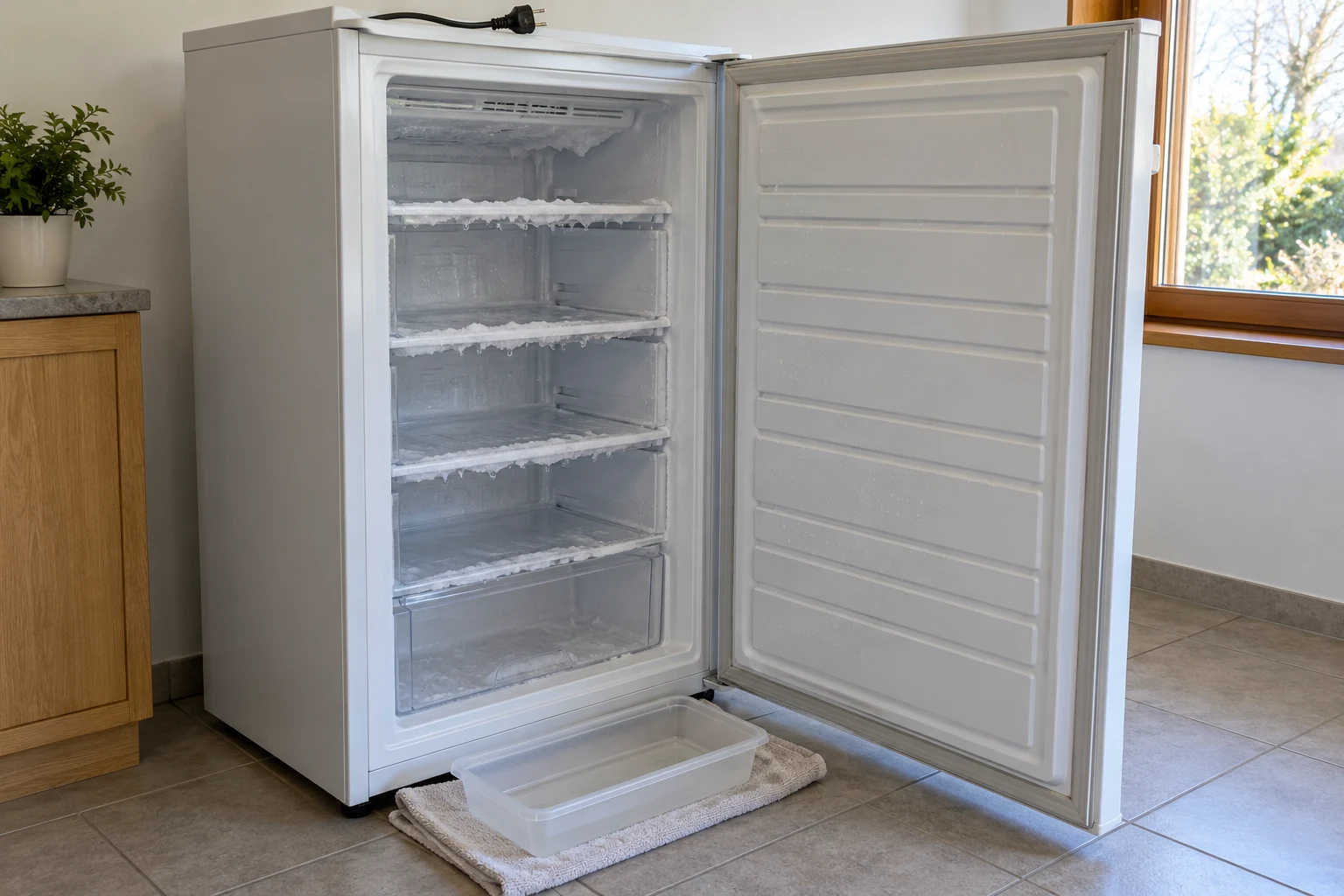
Dry and reassemble the authorised parts before the prescribed restart. Recovery after defrost suggests that ice contributed to the symptom, but it does not identify why it formed. If the same ice and temperature problem returns, repeated defrosting is temporary relief. Door leakage, airflow or automatic-defrost components may still require assessment. The separate fridge back-wall frost guide concerns a different exposed-wall symptom and should not be used as a freezer heater test.
What running, silence and clicking cannot establish
A motor-like hum is useful context, not proof that the compressor is pumping correctly. Silence can occur during a pause, defrost or control delay, and some static freezers have no fan to hear. Note when the sound occurs and whether the measured compartment temperature is changing. Listen from outside with guards fitted rather than touching a hot compressor.
A repeated start attempt followed by a click, with no useful cooling, warrants service after the accessible supply and settings have been checked. Do not conclude that the relay alone is faulty, bridge its protection or fit a generic “hard-start” device. Compressor, start components, control and supply conditions must be distinguished for the model; inverter-driven systems use different electronics.
Continuous running with persistent warmth is also not proof of low refrigerant. Door leakage, heat rejection, icing, loading and internal faults can overlap. Refrigerant is not a routine consumable to top up whenever cooling weakens. Circuit work requires qualified diagnosis, leak assessment where relevant and the correct refrigerant procedure. Avoid choosing a compressor or control board from these observations alone.
Use the result to choose a next action
| Finding | Supported conclusion | Next action |
|---|---|---|
| A documented cooling-off mode was active | Cooling was deliberately disabled | Exit it by the model procedure and verify temperature recovery |
| A packet prevented closure | An actual closure obstruction was found | Remove it, inspect the seal and monitor under stated conditions |
| Ice restriction clears after the permitted defrost, then returns | The underlying cause remains unresolved | Arrange service rather than scheduling repeated defrosts |
| No adequate recovery after settings and installation checks | Owner-accessible corrections were insufficient | Keep food elsewhere and request a cooling-system diagnosis |
| Electrical warning or damaged refrigerant tubing | Continued testing is inappropriate | Stop and follow the safety/service procedure |
For service, provide the full model and serial reference, selected mode, displayed alarm, thermometer readings with times, room temperature and recent events. Say whether frost was present and whether an authorised defrost changed the behaviour. Keep the original code before resetting and use the error-code finder with the exact model. This gives the technician a starting condition rather than a preselected part to replace.
A practical question
Does a working ice maker prove that the freezer is cold enough?
No. Old ice can remain after cooling has deteriorated, and an ice-making compartment may have separate controls. Judge frozen-storage performance with the appropriate thermometer and the appliance instructions. Do not use ice production as a substitute for checking a temperature alarm.
Sources and model limits
References consulted on 31 October 2026.
- Bosch: freezer not working and accessible checks.
- Whirlpool: freezer cooling and frost concerns.
- Whirlpool: frozen-storage setting and airflow.
- Samsung: cooling concerns and operating modes.
- Samsung: temperature recovery after adjustments.
- Liebherr: loading, ventilation and ambient conditions.
- Liebherr: specific freezer ranges for low ambient temperatures.
- Bosch: defrost preparation and water collection.
- French Ministry of Agriculture: do not refreeze thawed food.
Be the first to leave a comment.