When the freezer still keeps food frozen but the refrigerator compartment becomes too warm, the cooling system may still be producing cold: the problem is often how that cold air reaches and returns from the fresh-food section. Start by protecting perishable food and measuring both compartments. Then check blocked vents, loading, door sealing, frost on the freezer rear panel, fan behavior, and model-specific damper controls. Do not begin by adding refrigerant or replacing the compressor.
This symptom is most meaningful on a combined fridge-freezer that shares an evaporator and circulates cold air from the freezer. Some dual-evaporator models cool the compartments separately, so their diagnostic path differs. The full model number and manual determine which architecture applies. A freezer that feels cold is not proof that it is at the correct temperature, and an illuminated display is not a food-temperature measurement.
Protect food before diagnosing the appliance
Minimize door opening and move high-risk refrigerated foods to another refrigerator or an insulated cooler with enough ice packs to hold 4°C or below. ANSES recommends a maximum of 4°C at the coldest point of the refrigerator. FoodSafety.gov advises discarding perishable food that has been above 4°C for two hours or more; never taste food to decide whether it is safe. If the time and temperature history is unknown, use conservative food-safety guidance rather than the smell test.
Keep the freezer closed while it remains cold. Frozen food that still contains ice crystals or measures 4°C or below can generally be refrozen, although quality may decline. These emergency rules protect food; they do not diagnose the refrigerator.
| Measured condition | Immediate meaning | Priority |
|---|---|---|
| Fridge at or below 4°C and stable | Fresh-food storage remains within the usual target | Monitor before declaring a fault |
| Fridge above 4°C and rising | Food-safety margin is being lost | Protect perishables and continue diagnosis |
| Freezer near its target but fridge warm | Air distribution, damper, fan, sensor, or local control is plausible | Check shared-air path and frost pattern |
| Both compartments warming | Broader cooling, power, compressor, condenser, or sealed-system issue | Use a whole-appliance no-cooling diagnosis |
| Burning smell, damaged cord, or repeated breaker trip | Potential electrical danger | Disconnect and arrange service |
Measure temperatures instead of touching the air
Opening the door releases cold air immediately, so a hand check is unreliable. Place an appliance thermometer in a glass of water near the middle of the refrigerator, away from the wall and vents. Place a freezer thermometer between frozen packages. Keep the doors closed and follow the thermometer and appliance manufacturer’s stabilization period. Record time, fridge temperature, freezer temperature, displayed setting, room temperature, recent power interruption, and whether a large warm load was added.
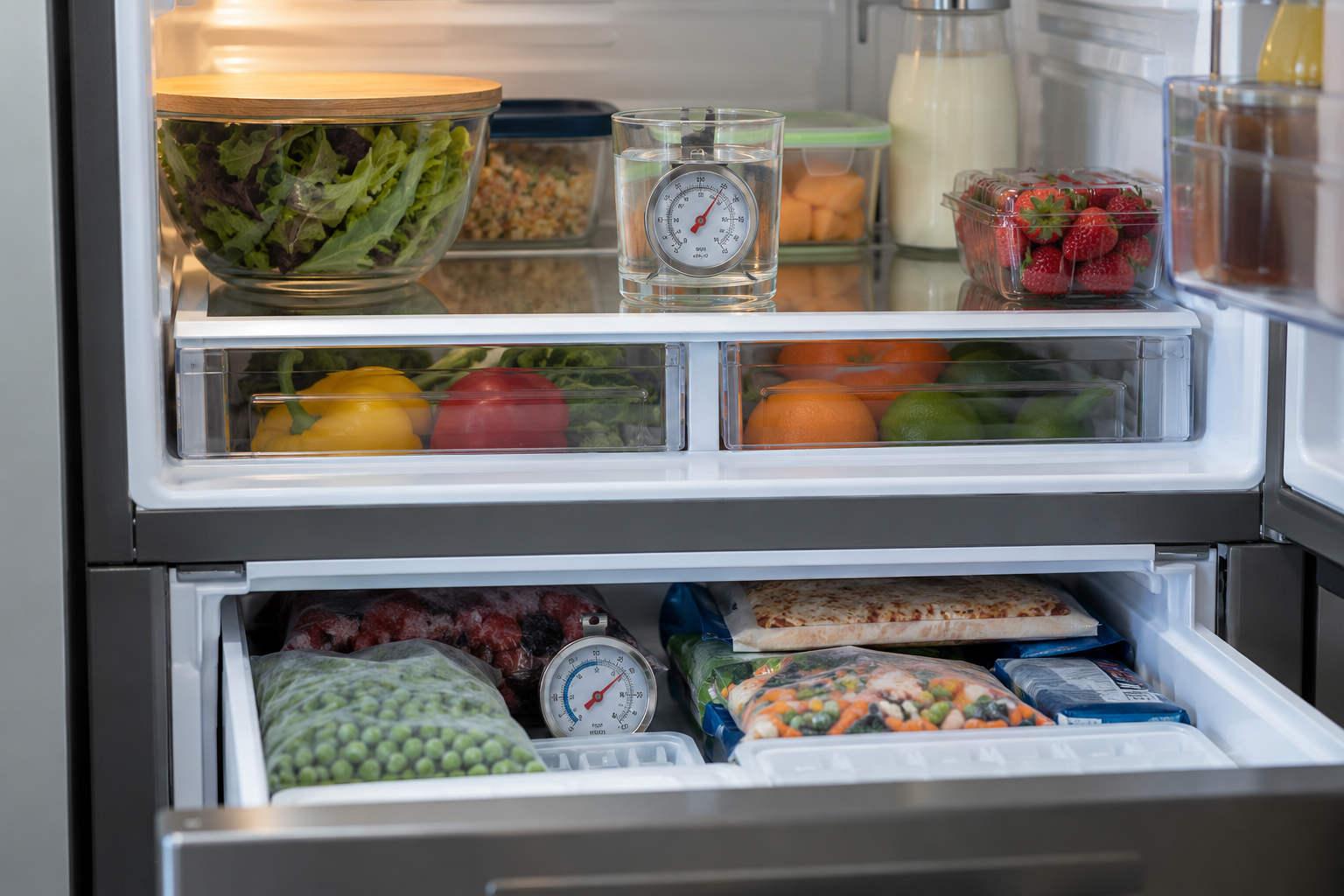
Do not turn the control repeatedly toward its coldest setting. Whirlpool recommends allowing about 24 hours between temperature adjustments on relevant models. A colder setting cannot clear an obstructed vent or a frozen evaporator, and rapid changes make the evidence harder to interpret.
Confirm the symptom and appliance architecture
Record the model number, usually found on a label inside the fresh-food compartment, behind a drawer, or around the door frame. Check whether the manual describes a single cooling system with a freezer evaporator and air damper, or separate evaporators. In a common single-evaporator design, the evaporator fan moves cold freezer air through a supply duct into the refrigerator and back through a return path. Any blockage in that loop can leave the freezer cold while the fridge warms.
| Observation | Possible mechanism | What it cannot prove |
|---|---|---|
| No airflow felt at the fridge supply vent during an active cooling period | Blocked duct, closed damper, stopped fan, heavy frost, or no current cooling call | It does not identify which component failed |
| Airflow returns after moving packages | Loading obstructed supply or return vent | It does not rule out a separate intermittent problem |
| Uniform frost or snow on the freezer rear panel | Evaporator airflow or automatic-defrost problem is plausible | Frost alone does not name heater, sensor, fuse, or control |
| Fan noise changes when the door switch is pressed | A fan may be operating | Sound does not prove correct speed or airflow |
| Freezer also softens or warms | The original airflow-only hypothesis is weaker | It does not automatically prove a compressor fault |
Clear supply and return vents
Find the refrigerator air outlets and return vents using the manual. They may be at the upper rear, side wall, or behind drawers. Move tall containers, bags, and boxes away from them and leave gaps between items. Whirlpool explains that many combined units generate cold in the freezer and circulate it through both compartments; blocking either supply or return breaks the loop and creates warm zones.
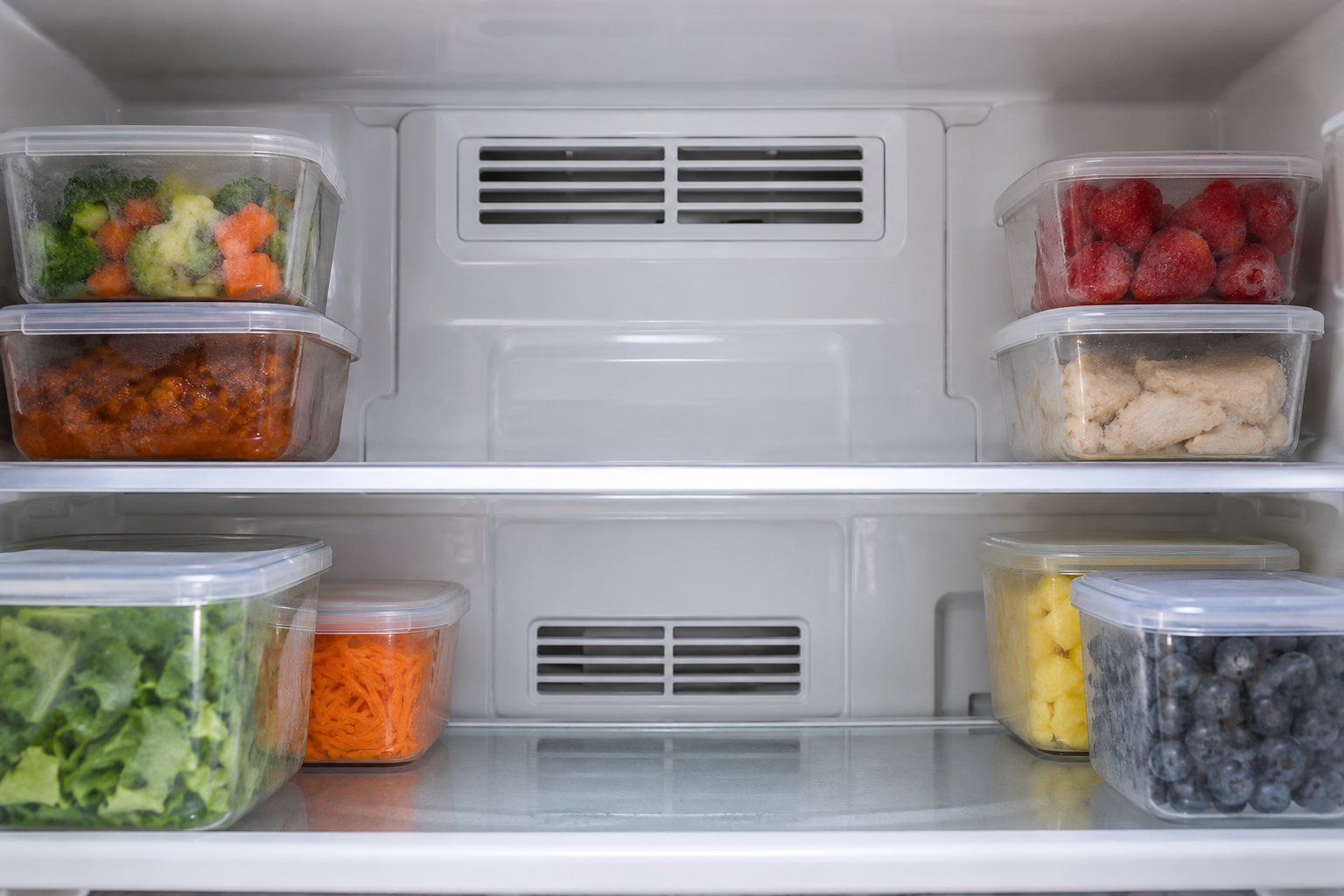
Check that drawers and shelves are fully seated and that food does not press against the rear wall. Do not chip ice from a duct with a knife, screwdriver, or hair dryer. Sharp tools can puncture a concealed refrigerant line, and uncontrolled heat can deform plastic. If a visible duct is iced, follow the model’s safe defrost procedure or arrange service.
Check door sealing and recent operating conditions
Inspect the refrigerator door gasket for crumbs, folds, tears, and packages preventing closure. Clean it with the method in the manual. Confirm that the cabinet is level enough for proper closing and that bins are not pushing the door outward. Frequent opening, a hot kitchen, a newly installed appliance, or a large warm food load can raise temperature temporarily. Document these factors and allow the manufacturer’s stated recovery time with doors closed.
A paper-strip test can reveal an obvious loose area: close the door on a clean strip at several positions and compare the resistance when pulling. This is only a comparison. It cannot measure gasket compression or prove that every corner seals under normal loading. A visibly torn or deformed gasket needs model-specific replacement.
Interpret frost on the freezer rear panel
A light trace of frost on packages after door opening differs from a broad, uniform frost sheet covering the interior rear panel. On many frost-free models, the evaporator sits behind that panel. When automatic defrost fails or airflow stops, ice can progressively block the evaporator and the duct feeding the refrigerator while enough cold remains in the freezer to mislead the user.
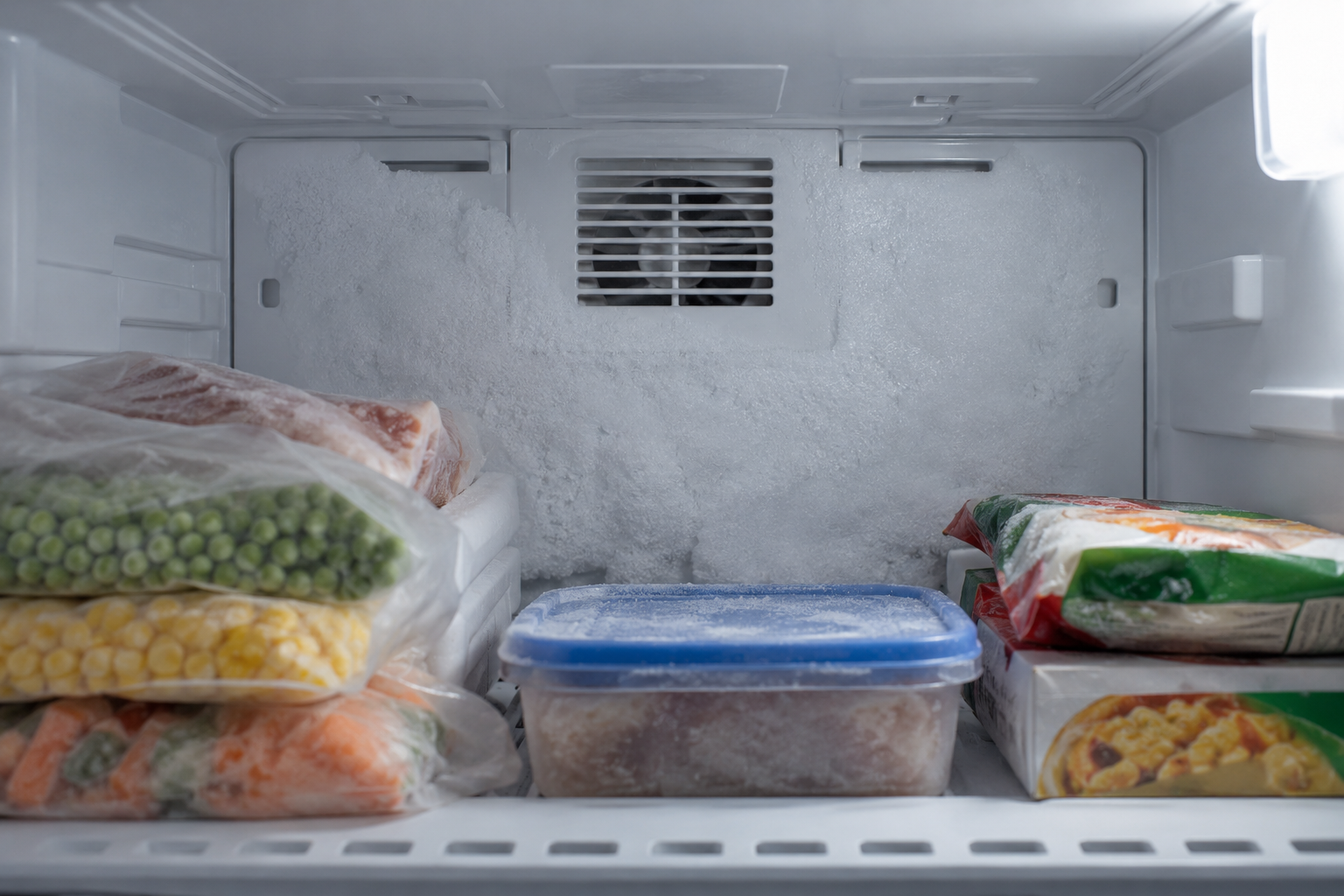
Do not remove the evaporator cover while the appliance is connected. Behind it may be a fan, defrost heater, thermal fuse, sensor, sharp fins, and refrigerant tubing. A complete manual defrost may temporarily restore airflow and provide evidence, but it is not a repair if frost returns. Protect food, unplug the appliance, manage meltwater, leave doors open for the period specified by the manufacturer, and never accelerate defrost with flame, boiling water, or sharp objects.
Observe the evaporator fan safely
Some refrigerators stop the evaporator fan when a door opens. During an active cooling period, listen before opening, then briefly operate the door switch only if the manual identifies it and your fingers remain clear of moving parts. A change in sound or airflow suggests fan operation. Silence can mean the fan is stopped, but it can also mean the control is not currently requesting cooling or the model uses different logic.
A fan that scrapes ice, starts intermittently, or stops again after frost returns points toward a condition requiring internal inspection. Do not remove guards or reach through a grille. The fan motor, wiring, door switch, sensors, control, or ice obstruction must be distinguished with model-specific documentation.
Damper and temperature-sensor clues
The damper is a controlled flap that meters freezer air into the refrigerator on many designs. A stuck-closed or iced damper can warm the refrigerator while the freezer remains cold. Some models allow the user to see or hear the damper move during a setting change or diagnostic routine; others conceal it. Do not force the flap. A damper command can be wrong because of the actuator, sensor, wiring, or control, so replacing the visible flap without confirming the cause can waste a part.
Keep food away from temperature sensors identified in the manual. A container pressed against a sensor can bias its reading. A sensor error may produce a code; record it before resetting the appliance and use the ElectronixLab error-code finder with the complete brand and model.
Condenser and room conditions
Dirty accessible condenser coils, blocked base grilles, insufficient clearance, or extreme room temperature reduce overall capacity. They are less specific to “freezer cold, fridge warm” than a blocked air path, but can make a marginal system fail first in the refrigerator section. Unplug before cleaning. Service only the condenser area the manual marks accessible, using a soft vacuum brush. Some modern condensers are enclosed and require a technician.
If the compressor runs almost continuously and both compartments gradually worsen after vents and frost are checked, the diagnosis is broader: condenser fan, compressor, refrigerant circuit, sensors, or control may be involved. Refrigerant work, live electrical tests, and compressor diagnosis require qualified service.
A decision sequence that avoids random parts
- Protect food and record temperatures. This establishes urgency and confirms whether the freezer is truly holding temperature.
- Check settings and recent events. Allow recovery after installation, a power event, or a warm load.
- Clear supply and return vents. Observe whether airflow and refrigerator temperature improve.
- Check doors, drawers, and gaskets. Correct obvious closure problems without changing components.
- Inspect the freezer rear panel. A broad frost sheet moves the diagnosis toward defrost and evaporator airflow.
- Listen for the evaporator fan. Interpret silence only in the correct operating state and according to the manual.
- Record codes and model data. If the fridge remains above target, provide the evidence to a technician rather than guessing a damper, fan, or sensor.
Result table and next action
| Result | Cautious interpretation | Next action |
|---|---|---|
| Temperature recovers after vents are cleared | Loading restricted circulation | Keep vents clear and verify stability over the specified period |
| Airflow returns after a full safe defrost, then frost returns | Automatic-defrost or airflow fault remains | Arrange model-specific service |
| No fan sound or airflow during a confirmed cooling call | Fan, ice, wiring, switch, sensor, or control is plausible | Stop at the guard and use professional diagnosis |
| Good airflow but fridge remains warm | Damper control, sensor, door leakage, or capacity issue | Check manual diagnostics and service evidence |
| Both compartments warm | Problem is no longer isolated to transfer airflow | Use whole-system cooling diagnosis |
Frequently asked questions
Why can the freezer work while the fridge is warm?
In many combined appliances, the freezer makes the cold and a fan moves part of it to the refrigerator. Obstructed vents, frost, a stopped fan, or a closed damper can interrupt that transfer before the freezer fully warms.
Will unplugging the refrigerator fix it?
A complete defrost may temporarily clear an ice blockage and provide diagnostic evidence. It does not repair a failed defrost heater, sensor, fuse, fan, damper, wiring, or control if the frost returns.
Should I hear the fan all the time?
No. Fan operation depends on cooling demand, door state, defrost cycle, and model logic. Observe it during a confirmed cooling call and use the manual.
Can I move food from the warm fridge to the freezer?
Only if that preserves safe storage and does not overload or warm the freezer. An insulated cooler at 4°C or below is often more controlled for refrigerated food.
When is service necessary?
When temperatures stay unsafe after reversible checks, broad frost returns, the fan or damper is inaccessible, both sections warm, or electrical and refrigerant-system work would be required.
Technical sources
- Whirlpool, Refrigerator not cooling and airflow checks, accessed October 29, 2026.
- Samsung, Refrigerator and freezer cooling issues, accessed October 29, 2026.
- ANSES, Refrigerator temperature guidance, accessed October 29, 2026.
- FoodSafety.gov, Refrigerated and frozen food safety, accessed October 29, 2026.
Be the first to leave a comment.