A dryer that tumbles normally but stays cold has power for the motor, yet that does not prove the heating system is being supplied or commanded. First confirm that the selected program actually requests heat. Then identify whether the appliance is vented, condenser, or heat-pump type, because normal temperatures and useful checks differ. Clean only the parts the owner’s manual marks as user-serviceable, perform one controlled timed-cycle observation, and stop before opening panels or measuring live circuits.
This guide addresses a drum that turns with little or no heat. It is not the same complaint as a dryer that heats but takes too long, stops before the laundry is dry, trips the breaker, smells burnt, or has a drum that does not turn. Those observations lead to different priorities. A cold drum can result from a no-heat program, an interrupted supply, restricted airflow, a full water circuit, a protective cut-out, a heater fault, or a heat-pump refrigeration fault. The symptom alone cannot name the failed part.
Define the symptom before replacing anything
Unload the dryer and allow it to cool. Check the care label and program table in the manual. “Air,” “Refresh,” “Cool,” and some delicate cycles may tumble without strong heat. Automatic programs can also end early when a sensor sees no suitable load. To separate a selection problem from a real no-heat condition, use the manufacturer’s recommended timed warm program with an appropriate small load. Do not judge a heat-pump dryer after only a few minutes: it usually warms more gradually and to a lower temperature than a resistance dryer.
| Observation | What it suggests | Next safe check |
|---|---|---|
| Drum turns, air stays cold on a timed warm cycle | Heating is absent or not commanded | Identify dryer type, check supply and displayed code |
| Air becomes warm but laundry stays wet | Airflow, load, moisture sensing, or condensation path | Clean filters and check the water container or drain |
| Heat appears, then disappears unusually early | Restricted airflow or protective shutdown is possible | Stop and inspect user-serviceable air paths |
| Breaker trips, plug heats, or burning odor appears | Potential electrical or insulation fault | Disconnect and arrange professional diagnosis |
| Heat-pump model is only mildly warm | May be normal if drying progresses | Judge moisture removal over the full specified cycle |
Safety and stopping criteria
Use the controls to stop the cycle, then unplug the dryer before cleaning or moving it. Let hot parts cool. Do not remove a rear, side, top, or lower internal panel for this first-line diagnosis. A dryer combines mains voltage, moving parts, sharp sheet metal, heat, and combustible lint. Never bypass a thermostat, thermal fuse, door switch, or airflow protection. Do not reconnect a scorched terminal, twist a broken heating coil together, or run the appliance with a guard removed.
Keep the dryer out of service if the breaker operates again, the plug or socket is discolored, the power cord is damaged, there is an acrid smell, smoke, unusual crackling, water near electrical parts, or a persistent overheat/no-heat error. A thermal protection that has opened is a consequence as well as a component: restricted airflow, a stalled fan, or another cause must be found before replacement.
Identify the dryer type: the diagnosis changes
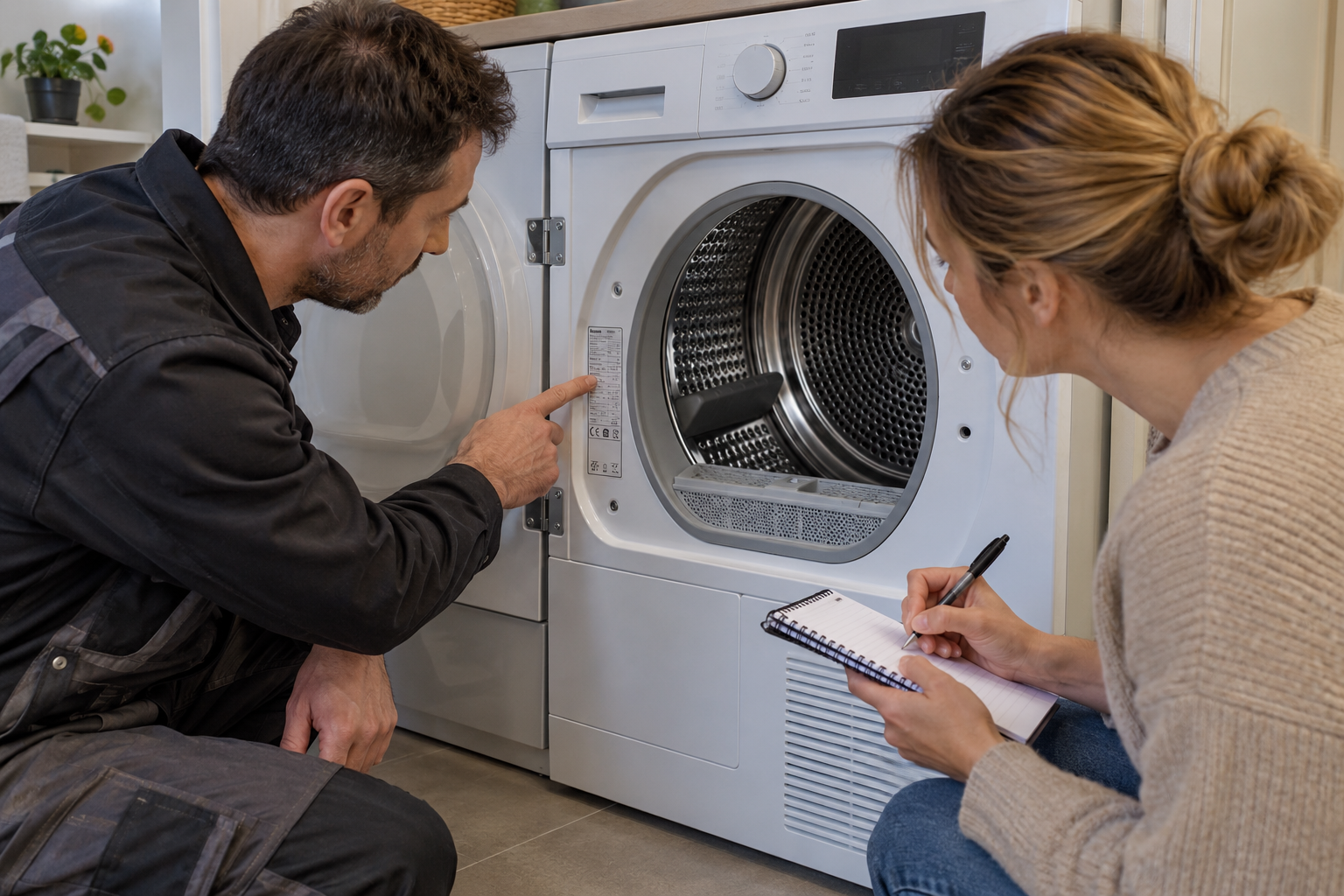
Read the rating plate around the door opening or on the rear and find the full model or product number. The manual or energy label normally identifies the technology. Do not infer it only from the presence of a water tank: both condenser and heat-pump dryers collect condensate.
| Dryer type | How heat is produced | Useful first clues |
|---|---|---|
| Vented electric | Electric resistance heats air exhausted outdoors | External duct must be open; heater and thermal protection are internal |
| Condenser resistance | Electric resistance heats recirculated air; a heat exchanger condenses moisture | Lint filter, condenser, tank, and pump path affect performance |
| Heat pump | Refrigeration circuit moves heat at lower operating temperature | Slow warm-up can be normal; filters, exchanger airflow, compressor, and refrigerant circuit matter |
| Gas dryer | Gas burner heats air while electricity runs controls and motor | A closed gas valve can allow tumbling without heat; gas work is for a qualified professional |
Step-by-step checks without opening the cabinet
- Confirm the program. Select a heated timed program described in the manual, not Air, Cool, Refresh, or a rack cycle that may use different logic. Disable an accidental low-temperature option if the fabric permits.
- Use a reasonable test load. One or two dry items may not contact moisture sensors, while an overloaded drum prevents air circulation. Use the manual’s test guidance or a small, evenly distributed damp load.
- Record the first minutes. Note whether the drum turns steadily, the fan sounds normal, a code appears, and the displayed time changes. Do not repeatedly restart a failing cycle.
- Stop before checking temperature. After the manufacturer’s stated observation period, stop the machine and open the door. Avoid reaching into a moving drum. Compare air and laundry warmth with the behavior described for that technology.
- Check the electrical supply externally. Make sure the plug is fully seated in a sound wall socket and inspect the visible cord. Do not use an extension lead. If protection has tripped, reset it only once after the dryer is unplugged; repeated operation requires an electrician or appliance technician.
- Read the error code before clearing it. Photograph the display and use the model manual or the ElectronixLab error-code finder. A family code such as E60 can indicate a heating-system problem without identifying the exact component.
Restore airflow before suspecting the heater
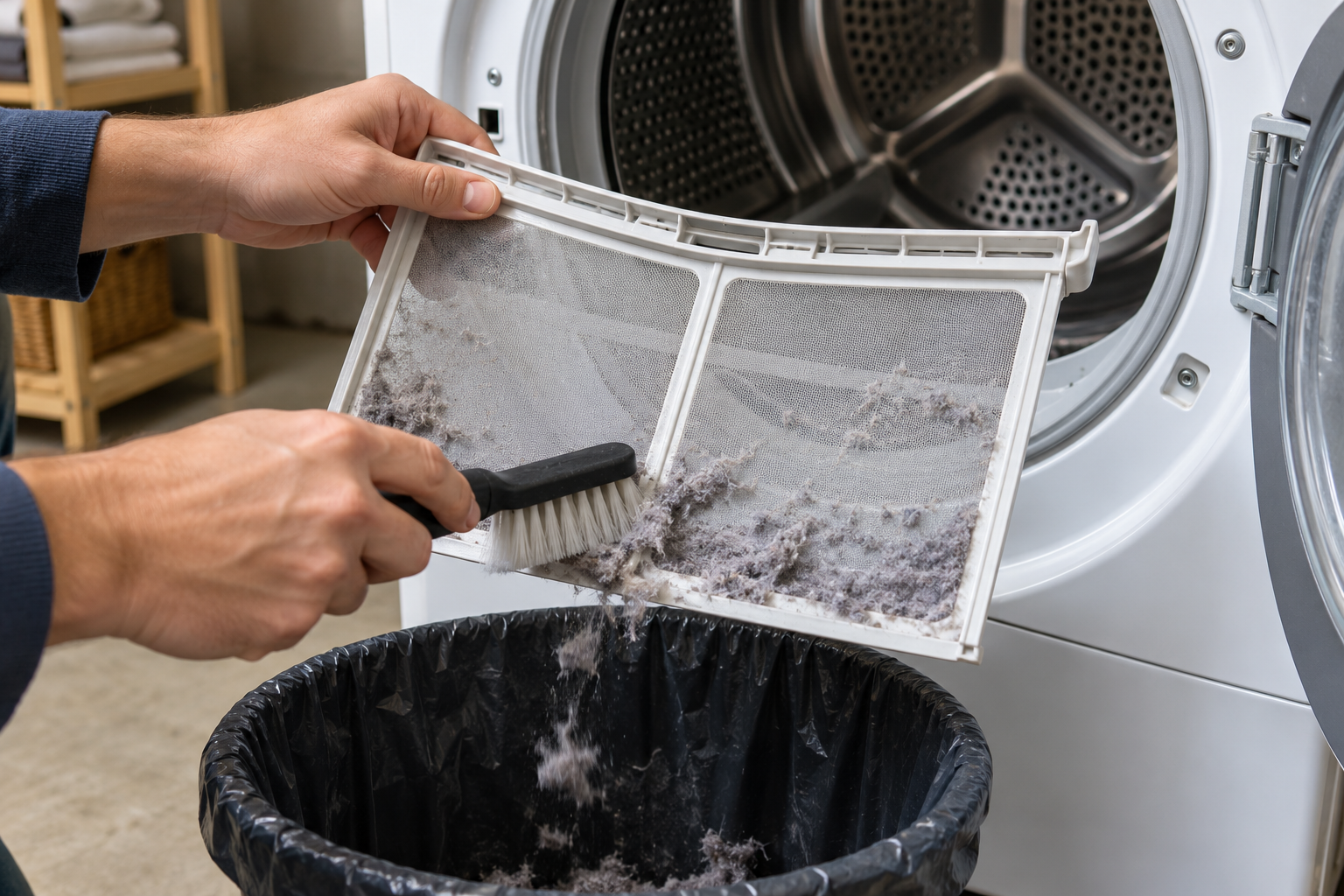
A loaded lint filter reduces airflow. The result can be long drying, abnormal temperature control, or operation of a thermal protection. Remove the filter exactly as the manual shows, clear loose lint, and inspect it against the light. Fabric-softener residue can leave a nearly invisible film. Wash the filter only if the manufacturer permits it, use a soft brush, and refit it completely dry. Also remove accessible lint from the filter seat and door seal without pushing debris deeper into the machine.
On a vented dryer, inspect the visible exhaust hose for crushing and confirm that the outside termination is not blocked. Do not run the dryer disconnected into the room as a normal test: hot humid air and lint need the intended duct. On condenser and heat-pump models, empty the water container and check an accessible drain hose for kinks. A full tank or failed condensate path may stop or alter the program, but it does not by itself prove a heater failure.
Condenser and heat-pump checks
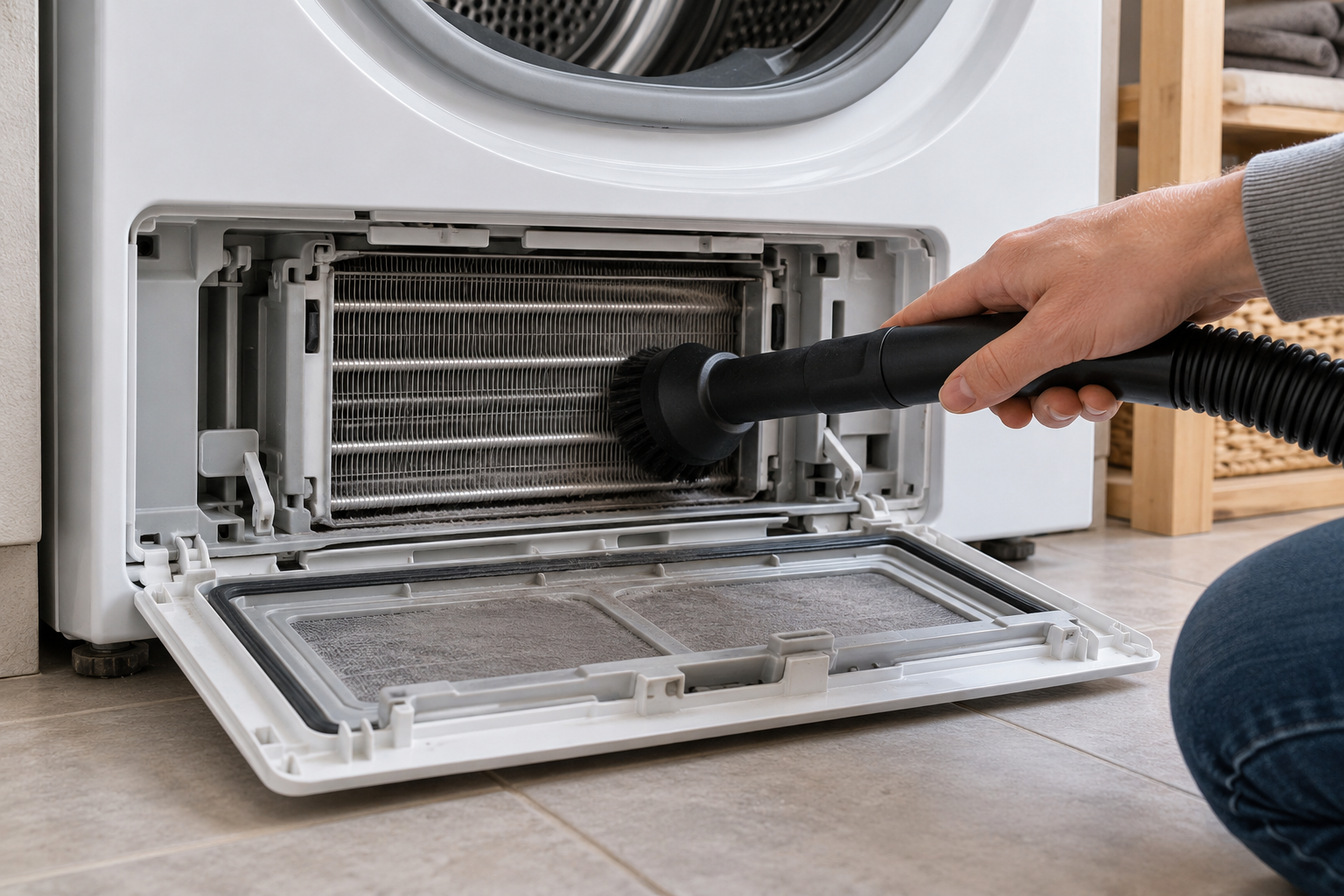
Clean only the condenser, base filter, or exchanger cover specifically described as removable in the model manual. Some heat-pump dryers have delicate fixed fins or self-cleaning systems that users should not dismantle. If access is allowed, remove lint with the stated method and avoid bending fins. Never use a screwdriver, high-pressure air, or a water jet in an electrical compartment.
A heat-pump dryer may need a substantial part of the cycle before the drum feels clearly warm. Electrolux advises judging heat on an appropriate timed program and notes that the final part of many cycles is a cool-down phase. If drying progresses and condensate collects, low but steady warmth can be normal. If the drum remains cold over the manufacturer’s full test interval, no condensate appears, and airflow paths are clean, the compressor, fan, sensors, control, or sealed refrigeration circuit needs model-specific service. Do not add refrigerant or pierce the circuit.
What an internal component fault would mean
Once selections, supply, and user-serviceable airflow paths are excluded, several internal causes remain. A resistance dryer can have an open heating element, thermal cut-out, thermostat, relay, wiring connection, or sensor circuit. A heat-pump dryer adds compressor starting, fan, temperature sensors, control, and sealed-circuit faults. A gas dryer adds the burner, ignition, flame sensing, valves, and gas supply. These are hypotheses, not conclusions from the phrase “it turns but does not heat.”
Dead resistance and continuity tests can help a competent technician, but the expected values and connector isolation procedure come from model-specific service information. A continuity beep alone does not verify insulation to earth, heat regulation, airflow, relay operation, or performance under load. Live voltage tests are not a homeowner step. For a Candy Smart Pro model where the heater assembly is already the justified branch, see the separate heater-assembly diagnostic guide.
Interpret the result and choose the next action
| Result after safe checks | Cautious interpretation | Action |
|---|---|---|
| Heat returns after selecting a warm program | No-heat option or automatic-cycle behavior | Use the program table and monitor the next load |
| Heat returns after filter or exchanger cleaning | Airflow restriction affected operation | Complete a monitored cycle and maintain at the manual interval |
| Warm air but poor drying remains | Moisture removal, load, sensor, duct, or condensate issue | Continue with drying-performance diagnosis, not heater replacement |
| Cold through the full model-specific test | Heating or heat-pump system fault remains plausible | Provide model, code, and observations to a technician |
| Protection trips or burning symptoms occur | Potential unsafe electrical fault | Keep disconnected; do not repeat the test |
Mistakes that obscure the diagnosis
- Judging a heat-pump dryer by the high temperature expected from an older resistance model.
- Testing on Air or Cool and concluding that the heater is open.
- Replacing a thermal fuse without correcting restricted airflow or fan trouble.
- Washing a non-washable filter or reinstalling a wet filter.
- Vacuuming or brushing delicate exchanger fins against the manual’s instructions.
- Clearing an error code before recording it.
- Repeatedly resetting a breaker or operating a hot, discolored plug.
- Ordering parts from the marketing name rather than the full product number.
Prepare useful evidence for service
Record the full model and serial number, dryer type, selected program, load, elapsed time before the check, displayed code, whether the drum and fan run, whether warmth ever appears, and which filters were cleaned. Note whether water reaches the tank or drain on a condenser model. Photographs of the rating plate, display, filters, and visible duct are more useful than guessing that the “resistance is dead.” This information helps a technician select the correct service data and prevents an unnecessary heater order.
Frequently asked questions
Should a heat-pump dryer feel hot?
Usually it feels warm rather than intensely hot and can take longer to reach operating conditions. Drying progress, condensate production, program behavior, and the model manual are better evidence than a quick touch test.
Can a blocked filter cause no heat?
It can restrict airflow, extend drying, alter temperature control, or contribute to a protective shutdown. Cleaning it is necessary, but heat returning afterward does not prove which protective event occurred.
Can I reset a thermal cut-out?
Only if the exact model manual identifies a user-resettable device, which is uncommon. Never bypass one. A one-shot thermal fuse requires replacement and diagnosis of the overheating cause by a competent person.
Why does the drum turn if the heater has no power?
The motor and heating system use different control paths. A functioning motor therefore confirms only part of the appliance. Supply and control arrangements vary by country and model.
When should I call a technician?
When a proper heated program remains cold after permitted cleaning, a code returns, panels must be removed, or any electrical, gas, refrigerant, or overheating symptom is present.
Technical sources
- Whirlpool, Dryer not heating: troubleshooting guide, accessed October 29, 2026.
- Electrolux, Dryer runs but does not seem to heat, accessed October 29, 2026.
- Electrolux France, checking heat and airflow on a dryer, accessed October 29, 2026.
- Siemens, dryer performance and user-serviceable checks, accessed October 29, 2026.
Be the first to leave a comment.