When an induction hob flashes but does not heat, the pan is usually not being detected—not necessarily because the hob is broken. Start with a dry control panel and one known-good induction pan, centered on one zone. A flashing pan symbol, U, or flashing F often points to cookware detection; a steady fault symbol, every zone failing after installation, a tripping breaker, burning smell, or cracked glass requires a different response. Display meanings vary by manufacturer, so record the exact symbol and model before resetting anything.
What the flashing display is telling you
An induction zone creates a changing magnetic field under the glass. Suitable cookware couples with that field and heats at its base. If the zone cannot recognize a usable magnetic load, many hobs flash the selected power level or show a pan-shaped indicator instead of delivering heat. This is why the same zone can appear defective with one saucepan and work normally with another.
| What you observe | Most useful first check | What it does not prove |
|---|---|---|
| Power level, pan symbol, U, or F flashes on one zone | Pan material, base diameter, centering, and a known-good pan | It does not by itself prove that a coil or control board has failed |
| One pan works; another does not | Compare the two bases and minimum-size requirement | A magnet sticking weakly does not guarantee reliable operation |
| All zones refuse cookware after a new installation | Stop and have supply connections checked by a qualified installer | Do not assume four pan sensors failed together |
| Controls beep or change by themselves | Remove objects; clean and completely dry the touch area | This does not automatically identify a bad touch board |
| Known-good pan fails on only one zone | Repeat a controlled zone-to-zone comparison | The result narrows the fault but does not identify an internal part |
| Breaker trips, smell, smoke, arcing, or cracked glass | Switch off the circuit and stop using the hob | A reset is neither safe nor diagnostic here |
Before testing: know when to stop
Do not cook on cracked glass or when liquid may have entered below it. Isolate the hob at its dedicated switch or breaker if you smell overheated insulation, see scorching, hear arcing, or a protective device trips. Do not repeatedly reset a breaker. Induction hobs contain mains-voltage power electronics and capacitors that can retain hazardous energy after switch-off. Removing the glass, measuring live terminals, bypassing interlocks, or testing an exposed power module is professional work.
For ordinary pan-detection symptoms, keep every check external. Let the surface cool, remove jewellery that could scratch the glass, and use a clean, dry pan. If the appliance was just installed or reconnected, treat an all-zone failure as an installation question first.
Step 1: record the exact symptom before a reset
Photograph the display while it is flashing. Note whether it is a letter, number, power level, pan outline, lock, pause symbol, or alternating code. Test no more than one zone at a time. Write down whether the symbol appears immediately, only after selecting a power level, or after the pan has heated for a few minutes. Also record whether one, several, or all zones are affected.
This small record prevents three common mistakes: treating every flashing F as the same fault, confusing a timer display with a zone display, and erasing a useful code with repeated power cycling. AEG, for example, distinguishes a flashing F associated with pan registration from a steady F associated with a connection fault. Other brands may use different symbols, so the model manual remains authoritative.
Step 2: prove that the cookware is induction compatible
Turn the saucepan over when it is cool. Hold an ordinary magnet against the flat cooking area of the base. A firm attraction supports compatibility; no attraction strongly suggests that the pan will not work. Cast iron, enamelled steel, and many magnetic stainless-steel or multilayer pans are commonly suitable. Plain aluminium, copper, brass, glass, ceramic, and porcelain generally need a bonded induction-compatible base.
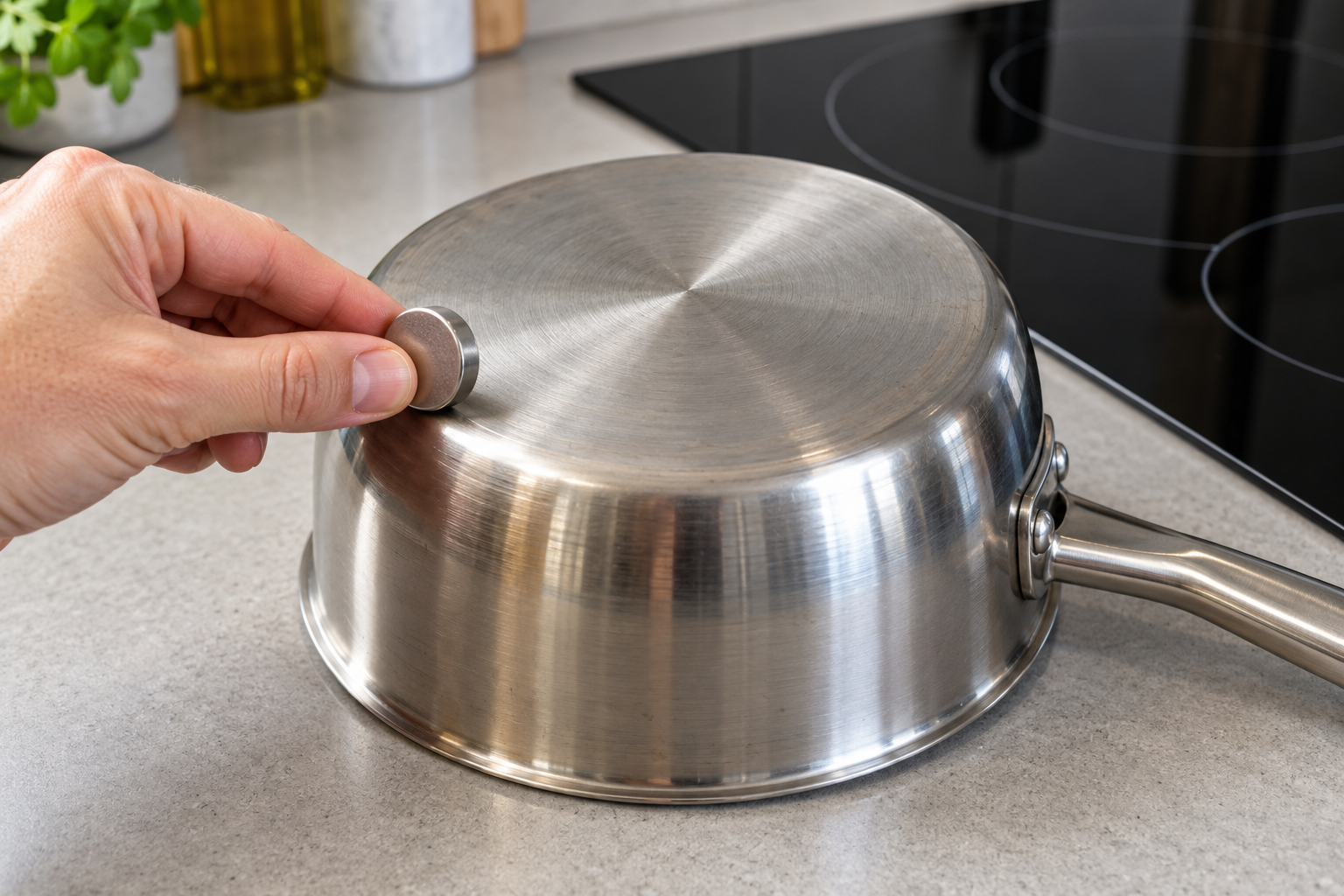
The magnet test is a screening tool, not an absolute certification. A small magnetic insert may attract a magnet yet couple poorly on a large zone. A warped sandwich base can also make intermittent contact with the detection field. Look for the induction-coil symbol or explicit manufacturer approval, then use the hob manual to confirm the allowed base diameter.
Use a genuinely known-good pan
The best comparison pan is one that heats reliably on another induction appliance or on another zone of this hob. Empty the pan only briefly for recognition; do not leave it heating empty. Add a small quantity of water for a controlled test, select a modest power level, and stay beside the appliance. If the known-good pan is detected immediately, the first pan—not the hob—is the leading variable.
Step 3: match pan size and position to the zone
Center the magnetic part of the base over the marked cooking zone. A pan that visually covers the ring can still have a much smaller magnetic insert underneath. Conversely, a tiny coffee pot may fall below the zone’s minimum detectable diameter. Minimum dimensions are model-specific and may differ between the front, rear, flexible, and large zones.
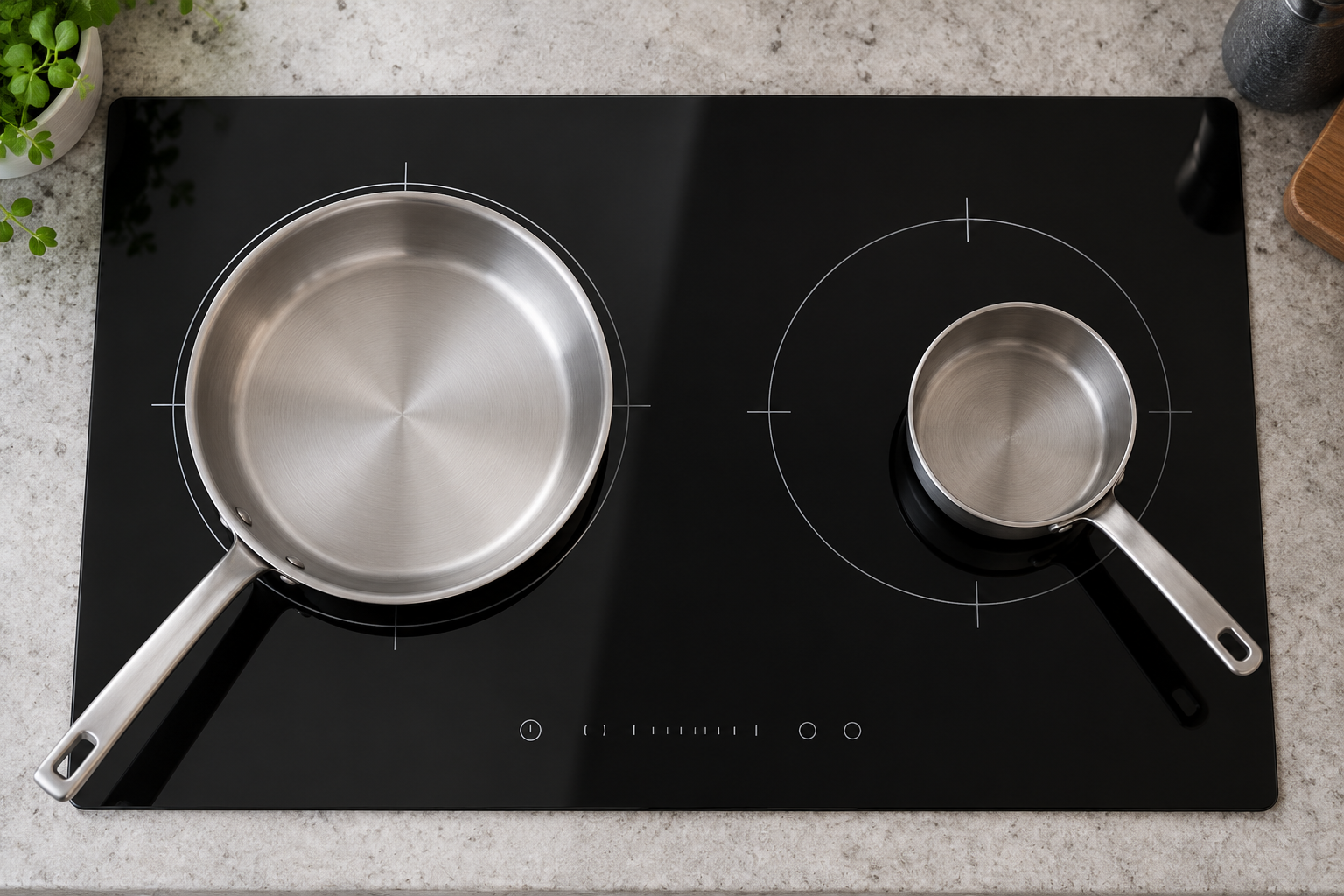
- Lift the cool pan and wipe both the glass and base.
- Place the pan in the center before choosing the power level.
- Try a medium setting rather than boost.
- If it flashes, move the same pan to a zone of similar size.
- Then put the known-good pan on the original zone.
Changing only one variable at a time produces useful evidence. Moving pan and zone simultaneously does not show which change mattered.
Step 4: clean and dry the touch controls
Water, condensation, grease, a dish towel, or a utensil resting across the control strip can make capacitive keys reject commands or signal a persistent touch. Switch the hob off. When cool, remove every object, clean it according to the manufacturer’s care instructions, and dry the touch area completely with a soft cloth. Use a dry fingertip and touch one key at a time.
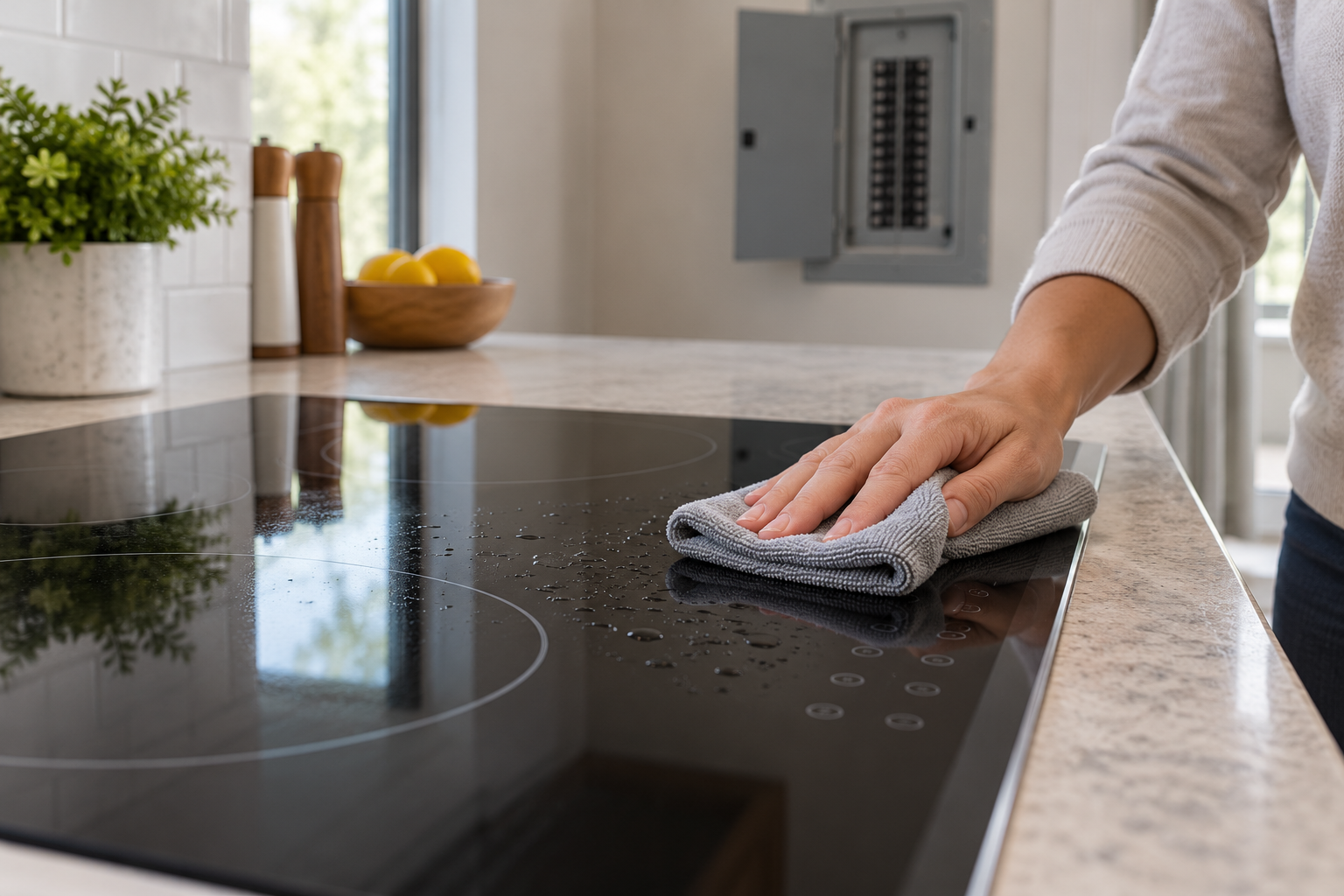
Check for a lock, key, pause, or Stop+Go indicator. Child lock, cleaning lock, pause, and demonstration mode intentionally alter normal operation. Do not guess a long-press combination: it can activate a different function. Use the control diagram in the exact model manual.
Step 5: perform one controlled power reset
If no safety warning is present, the pan and controls are correct, and the manufacturer permits a reset, switch the hob off at its dedicated isolation point for about 30 seconds; AEG uses this interval in its activation guidance. Restore power, wait for the startup display to finish, then make one test with the known-good pan. If the same indication returns, record it and stop repeating resets. A reset can clear a temporary control state, but it cannot repair a weak supply connection, damaged sensor, cooling problem, coil, or power module.
Use a two-by-two comparison to isolate the variable
Label the suspect pan A, the known-good pan B, the suspect zone 1, and a working similar-size zone 2. Test at modest power with a little water, never unattended.
| Comparison result | Evidence-based interpretation | Next step |
|---|---|---|
| Pan A fails on both zones; pan B works on both | Pan A compatibility, size, flatness, or construction is the leading cause | Use approved cookware; do not order hob parts |
| Both pans fail on zone 1 but work on zone 2 | The symptom follows zone 1 | Stop using that zone and request service |
| Both pans fail on every zone | Common control, setting, supply, or installation issue is more plausible | Check lock/demo state; installer or service diagnosis if persistent |
| Pan works only when shifted off center | Magnetic base shape or detection area may not match the marking | Confirm correct cookware diameter and zone layout in the manual |
| Heating starts then stops after several minutes | Not a simple initial pan-detection failure | Let it cool, check unobstructed ventilation, record code, seek service if repeated |
If every zone flashes after installation
A brand-new hob that powers up yet will not heat on any zone deserves an installation check, especially if a steady F or connection message appears. AEG states that a steady F can indicate an incorrect connection or missing phase. Supply arrangements vary by country, model, phase configuration, and terminal-link requirements. The fact that lights work does not prove the high-power supply is correctly configured.
Do not open the terminal cover or copy a wiring diagram from a different model. Give the qualified installer the full product number, installation instructions, display photo, and circuit symptoms. The installer can verify the prescribed supply, protective devices, conductor arrangement, links, torque, and isolation using appropriate instruments.
If only one zone rejects a known-good pan
When two suitable pans work on other equivalent zones but repeatedly fail on the same clean, centered zone, the fault follows that zone. Possible internal areas include cookware detection, temperature sensing, the induction coil connection, cabling, or the associated power-electronics channel. These are possibilities, not a remote diagnosis. The glass gives no safe access to distinguish them.
Stop using the affected zone and book service with the model, serial or product number, code photograph, and comparison results. This evidence is more valuable than ordering a “pan sensor” from a generic parts diagram.
When it heats briefly and then flashes
A hob that recognizes the pan cold and later stops is a different case from immediate non-detection. Let the appliance cool naturally. Confirm that drawers, liners, dust, or stored items are not blocking the ventilation arrangement described in the installation guide. Do not blow compressed air into openings or run the hob with cabinet panels removed. Record the power level, operating time, active zones, pan size, and code. Repeated temperature or cooling-related shutdown needs professional inspection.
What not to replace based on a flashing symbol
Do not buy a control board, induction coil, temperature sensor, or complete hob merely because a power digit flashes. The display is an observation, not a component diagnosis. A compatible-pan comparison and zone matrix cost nothing and separate a cookware variable from a zone-specific or common-system fault. Equally, do not keep using a unit that trips protection or shows heat damage just because a reset temporarily restores it.
Information to prepare for service
- Brand, exact model, product/PNC number, and serial number.
- The precise flashing or steady symbol and a clear photo or short video.
- Whether the problem affects one, several, or all zones.
- Pan-base diameters, magnet-test result, and whether the pans are approved for induction.
- Results of pan A/B and zone 1/2 comparisons.
- Whether it began after installation, cookware change, spill, cleaning, outage, or cabinet work.
- Any breaker trip, smell, unusual fan sound, or heat damage.
Search the ElectronixLab error-code finder using the exact brand and displayed code. For other appliance symptoms, browse the diagnostic tutorials. Model-specific service literature and electrical tests belong with a qualified professional.
Frequently asked questions
Why does the number flash when I place a pan on the hob?
The zone may not detect a suitable magnetic base. Check compatibility, minimum base diameter, flatness, centering, and another proven induction pan before suspecting the hob.
Does a magnet prove that a pan will work?
It is a useful first screen, but not a guarantee. A small or weak magnetic insert can still be below the zone’s recognition threshold. Manufacturer approval and a successful controlled test are stronger evidence.
Can an induction adapter plate solve the problem?
Use one only if both hob and adapter manufacturers explicitly permit it. Adapter plates can alter temperature control, efficiency, and heat transfer; they are not a universal cure for incompatible cookware.
Is flashing F always a fault code?
No. AEG distinguishes flashing F for pan registration from steady F for a connection issue, but other brands use their own conventions. Read the exact model manual.
Can I continue using the other zones?
If there is no crack, smell, scorching, abnormal noise, or protective-device trip and only one zone fails, the remaining zones may be usable according to the manual. When any safety warning exists, isolate the whole appliance.
Should I reset the breaker repeatedly?
No. One controlled reset may be appropriate when the manufacturer permits it and no hazard is present. A breaker that trips again must remain off pending qualified diagnosis.
Technical sources
- AEG France, “La table de cuisson affiche le message F”, accessed October 30, 2026.
- AEG France, suitable cookware for induction zones, accessed October 30, 2026.
- AEG France, hob cannot be activated or does not operate, accessed October 30, 2026.
Be the first to leave a comment.