A dishwasher that “will not start” can mean three different things: the panel is completely dark, the panel responds but the cycle never begins, or the machine starts and then waits without filling. Identify which state you have before ordering a latch, inlet valve or control board. Most safe checks take only a few minutes and do not require removing an electrical panel.
First identify what “not starting” means
| What you observe | First area to check | What it does not prove |
|---|---|---|
| No lights, sounds or response | Power button, wall switch, plug and breaker | A dark panel alone does not prove the control board failed |
| Lights on, buttons ignored | Control lock, sleep mode and wet/dirty touch panel | Unresponsive keys do not automatically mean a bad keypad |
| Cycle selected, Start flashes or beeps | Start sequence, door closure and latch | A beep does not identify the latch as defective |
| Pump runs briefly but washing never begins | Water supply, displayed code and previous cycle state | An initial drain can be a normal program step |
| Starts only when the door is pushed | Obstruction, rack position, alignment and latch | Do not adjust hinges before removing loading interference |
Stop immediately for these warning signs
Do not repeatedly reset a breaker that trips again. Isolate power and arrange electrical service if you smell hot insulation, see scorching, hear arcing, find water near an outlet, or the residual-current device trips. Close the water valve for an active leak. A hardwired dishwasher, damaged supply cord, inaccessible junction box or suspected internal live fault is not a homeowner continuity-test project.
Step 1: when the panel is completely dark
- Use the appliance Power key. Some models require Power before a program can be selected. Wipe a touch panel with a soft damp cloth, dry it and use a dry finger; moisture and grease can prevent capacitive controls from recognizing a touch.
- Check the nearby wall switch. Some kitchens have a switch that looks like a light switch but supplies the dishwasher.
- Check the plug only if it is accessible without moving the appliance. It should be fully seated. Do not use an extension lead or multi-plug adapter.
- Inspect the correct breaker. Move a visibly tripped breaker fully off, then on once. If it trips again, leave it off and call an electrician or appliance technician.
- Separate appliance power from house power. If an accessible outlet is dead, the building circuit needs attention. Do not assume the dishwasher electronics caused it.
Bosch recommends checking the mains connection, outlet and protective devices when the display is dark. Samsung also distinguishes a dishwasher that will not power on from one that powers on but will not run. This distinction prevents an unnecessary control-board diagnosis.
Step 2: clear settings that intentionally block a start
If the panel lights, look for a padlock, key or clock symbol. Control Lock prevents accidental operation; Delay Start deliberately waits until a selected time. Standby or sleep mode can require opening or closing the door or pressing Power/Start. Use the exact button and hold duration in the model manual because key combinations vary.
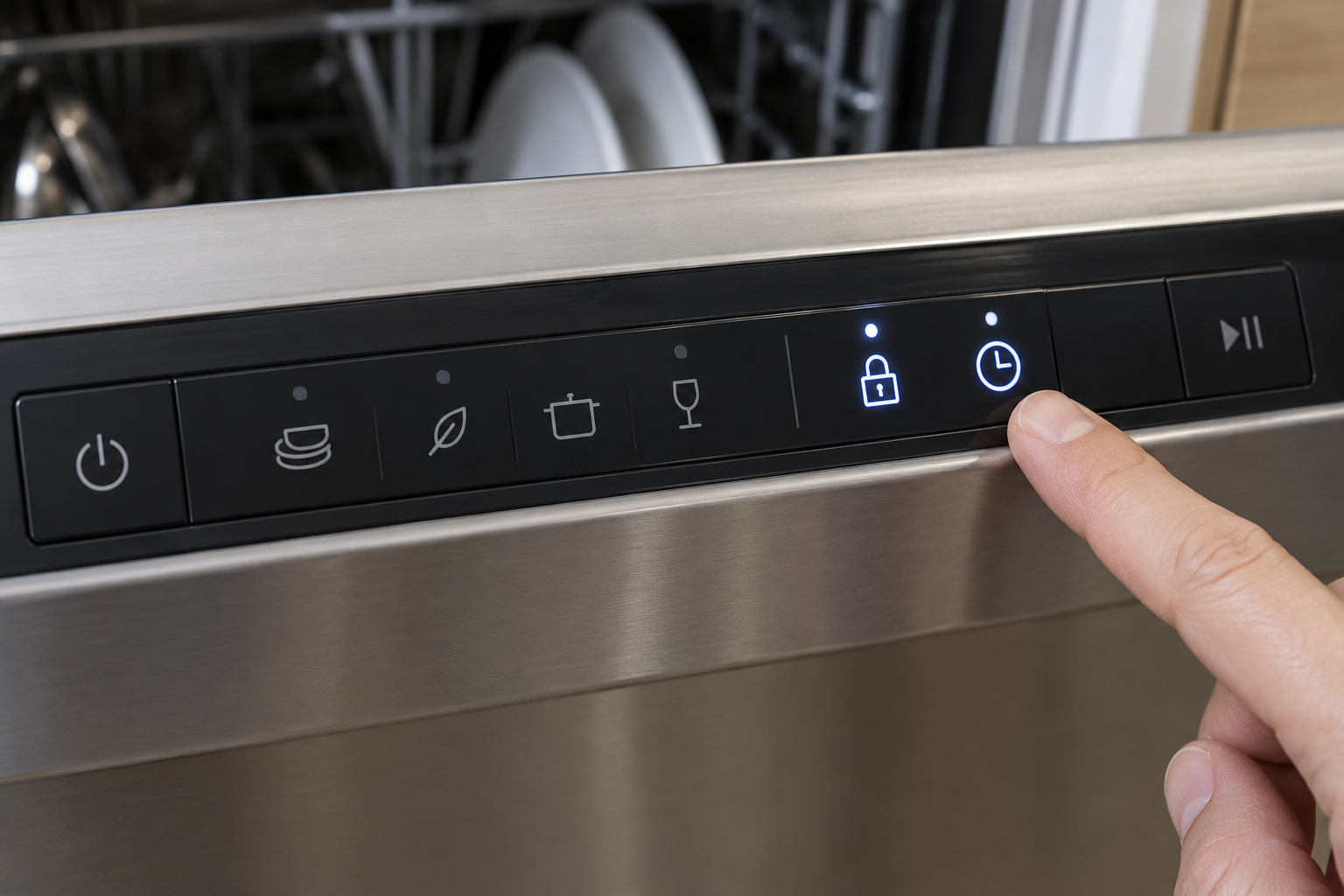
Do not hold every key at random. On some models a long press on Start cancels the cycle rather than starting it. Select a normal program, cancel an unwanted delay according to the manual, then follow the required Start-and-close sequence. Record which indicators flash; a pattern may be a model-specific error rather than a generic refusal to start.
Step 3: prove the door can close before blaming the latch
The dishwasher will not run when its safety system does not recognize a closed door. Remove a pan handle, utensil or cutting board that projects beyond the rack. Push both racks fully home and confirm that an adjustable upper rack sits at the same height on both sides. Check that the detergent dispenser or a tall item is not striking the rack.
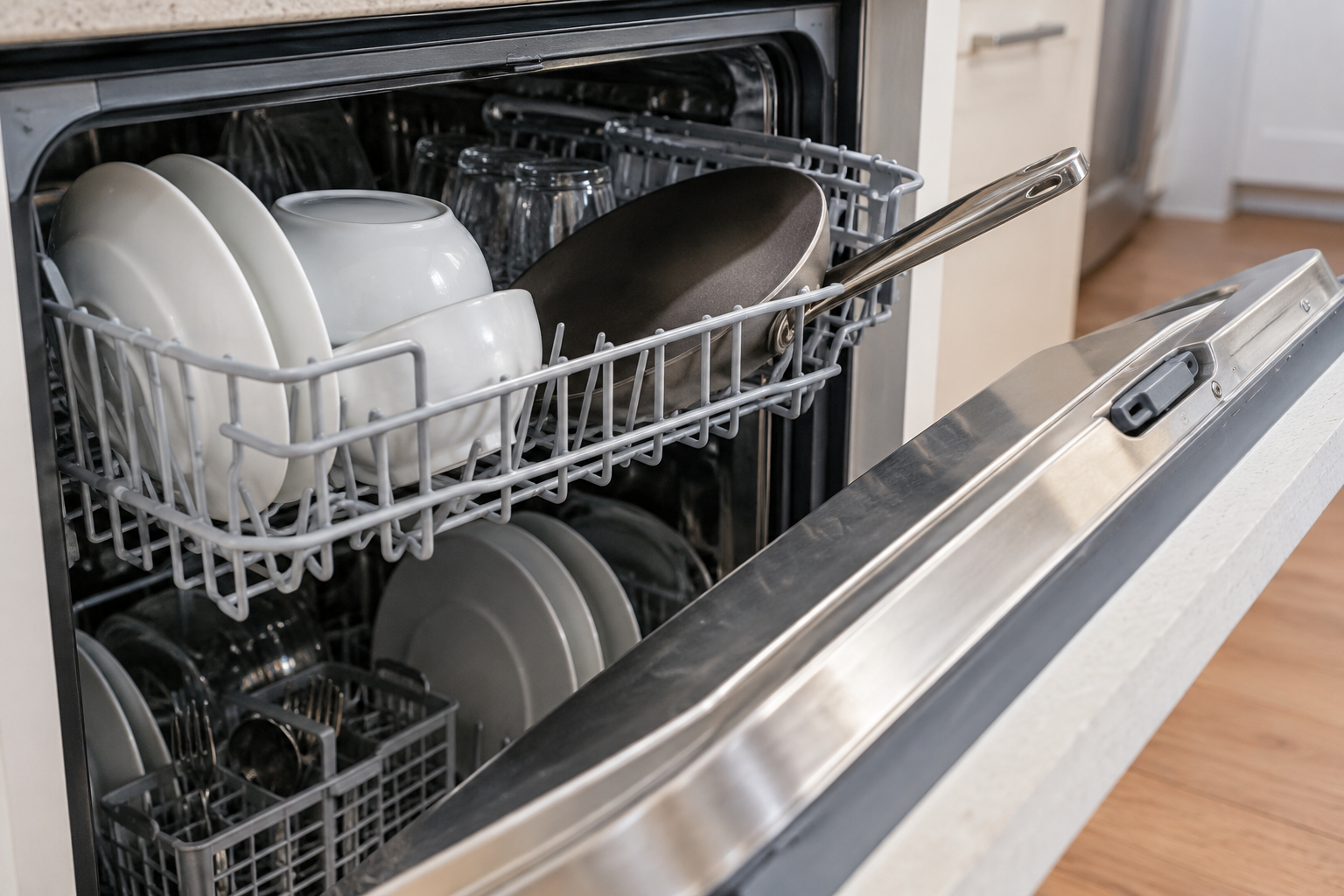
Inspect the latch opening and door seal for food residue, but never force or slam the door. If the machine starts only while pressure is applied, the observation points to closure, alignment, latch or door-sensor recognition; it does not identify which part is faulty. Recent installation strengthens the case for cabinet alignment, mounting or a crushed hose interfering with the chassis. Have the installer correct geometry rather than bending the latch.
Step 4: check the required start sequence
Top-control models often require a sequence such as select cycle, press Start, then close the door within a few seconds. Other models require closing first. After opening a running machine, Start/Resume may need to be pressed again. Follow the owner manual, because the timing and indicator behavior are not universal.
| Result of one start attempt | Interpretation | Next action |
|---|---|---|
| Start indicator becomes steady and cycle begins | Previous sequence or door timing was incomplete | Use the documented sequence |
| Indicator flashes after door closes | Door not recognized or sequence not accepted | Remove obstructions and consult model manual |
| Controls remain locked | Lock was not cleared or keypad is not accepting the command | Verify exact unlock keys and dry panel |
| Error code appears | Controller detected a specific condition | Record code before any reset |
| Breaker trips | Electrical protection operated | Stop; do not retry repeatedly |
Step 5: if it starts but does not fill
A closed water valve can make a dishwasher appear inactive after the first drain. Whirlpool notes that modern machines may require immediate water pressure to begin the wash. Verify that the dedicated supply valve is fully open and the visible inlet hose is not kinked. Do not loosen a pressurized connection merely to “test” it.
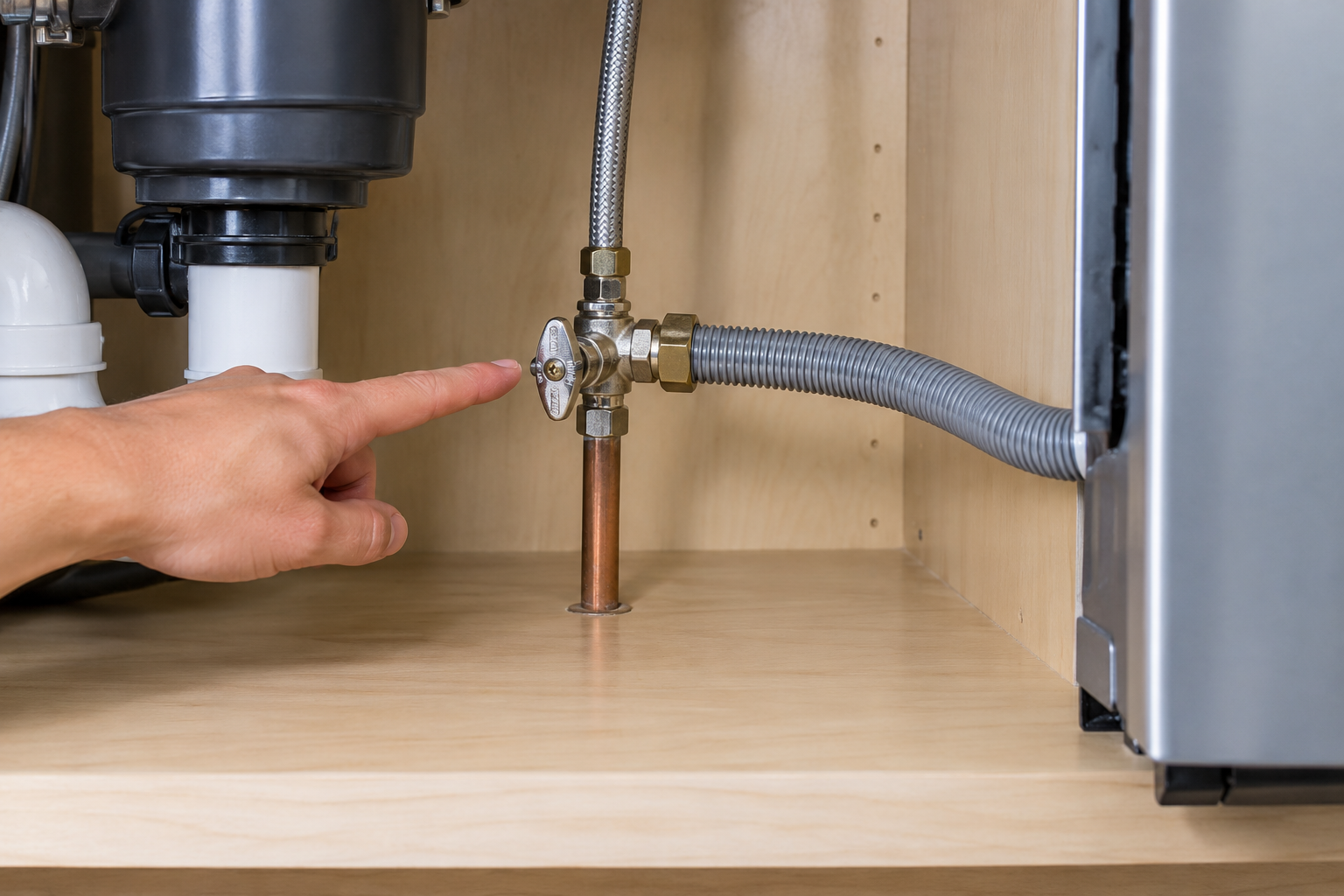
Listen to the first minute. A short drain may be normal. Silence after the start command, a fill hum with no water, or a water-related code are different observations. If the valve is open but no water enters, possibilities include household supply, inlet hose protection, inlet valve, float or sensor, wiring and control. The symptom alone cannot select a replacement part.
A controlled reset is a test, not a repair
First photograph or write down any code. Then cancel the cycle as the manual instructs. If the manufacturer permits a power reset, disconnect the appliance or switch off its dedicated breaker for the stated interval—Whirlpool describes 30 seconds on one support page, while other brands and models specify different times. Restore power and make one normal-cycle attempt.
If the same code or behavior returns, the reset has shown that the condition is persistent. Repeating resets can erase useful context without repairing a door, water or electrical fault. Samsung explicitly warns that resetting without addressing the underlying problem usually allows the code to return.
What a technician needs to know
Record the full model number, whether the panel is dark or lit, every icon or code, the chosen program, the exact response to Start, whether the door clicks, whether the drain pump runs, whether water enters, whether the fault began after installation or a power cut, and whether the breaker trips. A short video of the panel and sound can be more useful than a guessed part name.
Professional diagnosis is justified when power reaches the appliance but the display stays dark, the door is correctly loaded yet never registers closed, a code persists, the inlet remains inactive with confirmed supply, or an internal component or wiring test would be required. Use the error-code finder with the exact brand and model. If the machine runs but leaves water behind, use the separate standing-water guide.
Frequently asked questions
Does a click prove the door latch is good?
No. A mechanical click shows engagement, but the controller must also receive the door-closed signal. Loading, alignment, latch, sensor, wiring or control can affect that signal.
Why does the dishwasher drain when I press Start?
Many programs begin with a brief drain to remove residual water. It becomes diagnostic only when the machine never advances, shows a code or continues draining abnormally.
Should I replace the control board if there are no lights?
No. First establish that the appliance has the correct supply and that the wall switch, plug, breaker and installation are sound. Board replacement without that evidence is guesswork.
Can I bypass the door switch?
No. It is a safety interlock. Bypassing it can allow operation with an open door and exposes moving, hot and electrically energized parts.
Technical sources
- Whirlpool, Not Starting or Operating — Dishwasher, accessed October 29, 2026.
- Bosch, Dishwasher troubleshooting, accessed October 29, 2026.
- Samsung, Dishwasher will not turn on, accessed October 29, 2026.
- Samsung, How to reset your dishwasher, accessed October 29, 2026.
Be the first to leave a comment.