A washing machine that finishes with soaking-wet laundry has not necessarily suffered a motor failure. Many machines suppress or reduce final spin when water has not drained, the selected program limits spin, foam remains in the tub, or the load cannot be balanced. The useful first question is therefore not “which part is broken?” but “what did the machine do immediately before it refused high speed?” A short observation sequence can separate a user-setting or load problem from drainage, drive and control faults without guessing or opening the appliance.
First identify what “not spinning” means
Wait for the program to end and note the display before pressing another button. Look through the door: is water still visible, is the laundry merely wetter than usual, or did the drum never rotate at any stage? These symptoms lead to different branches. A machine may tumble normally during wash yet refuse the high-speed final spin. Another may drain but repeatedly turn the drum slowly while trying to distribute the load. A third may not turn at all because the drive system or motor control has a fault.
| Observation | What it suggests | Next useful check |
|---|---|---|
| Water remains in the drum | Drainage must be resolved before spin | Check filter, hose and drain program |
| Drum tumbles slowly, then stops | Load-balance protection may be active | Redistribute a small mixed load |
| No water, drum turns in wash but not fast | Program, foam, balance or speed feedback | Run a separate spin with a suitable load |
| Drum never turns | Door lock, belt, motor or control path | Stop repeated tests and inspect model-specific drive |
| Grinding, burning smell or violent movement | Mechanical or electrical risk | Disconnect and arrange service |
Safety and stopping criteria
Do not reach into a drum that may restart. Cancel the program according to the manual, wait for the door-lock indicator to clear and unplug the appliance before touching the filter, hose or rear panel. Close the water valve before moving the machine. Water near a socket, a tripped breaker, smoke, an electrical smell, a hot plug, a damaged cable, a grinding bearing noise or a drum striking the cabinet are reasons to leave the appliance disconnected. A locked door with visible water is not a reason to force the latch; use the model’s emergency drain procedure.
Internal voltage measurements are not part of this household-level procedure. Inverter motor drives and control boards can contain hazardous voltages after unplugging. Resistance readings also vary by motor design and cannot be interpreted from a universal number. The safe boundary here is visual inspection of accessible items specifically described in the owner’s manual. Electrical diagnosis belongs to a competent technician with the service information for the exact model.
Diagnosis in the right order
- Record the symptom before resetting. Note the program, selected spin speed, remaining time, displayed code, water level and sounds. A photo of the display is more useful than a vague description after several resets.
- Check the selected program and options. Delicates, wool, rinse-hold, night or no-spin options may intentionally leave laundry wetter or stop before final drain. Consult the exact manual rather than assuming every control panel uses the same symbols.
- Check whether water has drained. If water remains, diagnose drainage first. Most machines will not accelerate a water-filled drum.
- Correct the load. Remove an overloaded mass or add a few compatible items around one heavy towel so the drum can distribute weight.
- Run one controlled test. Use a separate drain/spin or spin program with a small, balanced load. Observe whether the machine drains, attempts distribution and reaches speed.
- Stop if the simple checks fail. Repeated high-speed attempts can worsen a loose belt, worn suspension, bearing fault or electrical problem.
Program and spin-speed settings
Electrolux explicitly recommends checking for a program with no final spin or reduced spin. The selected speed may also have been changed accidentally. Read the displayed speed before the cycle and confirm that it is permitted for the fabric program; the machine may cap it automatically. A lower programmed speed is not a fault. If a separate spin works, the drive system has demonstrated that it can reach speed under that test, but this does not prove every sensor or program condition is healthy.
Balance protection is not a broken motor
Modern machines try to distribute laundry before acceleration. One bath mat, one heavy robe or a waterproof item can remain on one side, so the control repeatedly tumbles and eventually reduces or cancels spin. Electrolux identifies uneven distribution and overloading as common causes of noise and vibration, while Whirlpool notes that imbalance can make an appliance move during spin. Do not test with an empty drum only and declare success: an empty test checks basic rotation, not the machine’s ability to balance a real load.
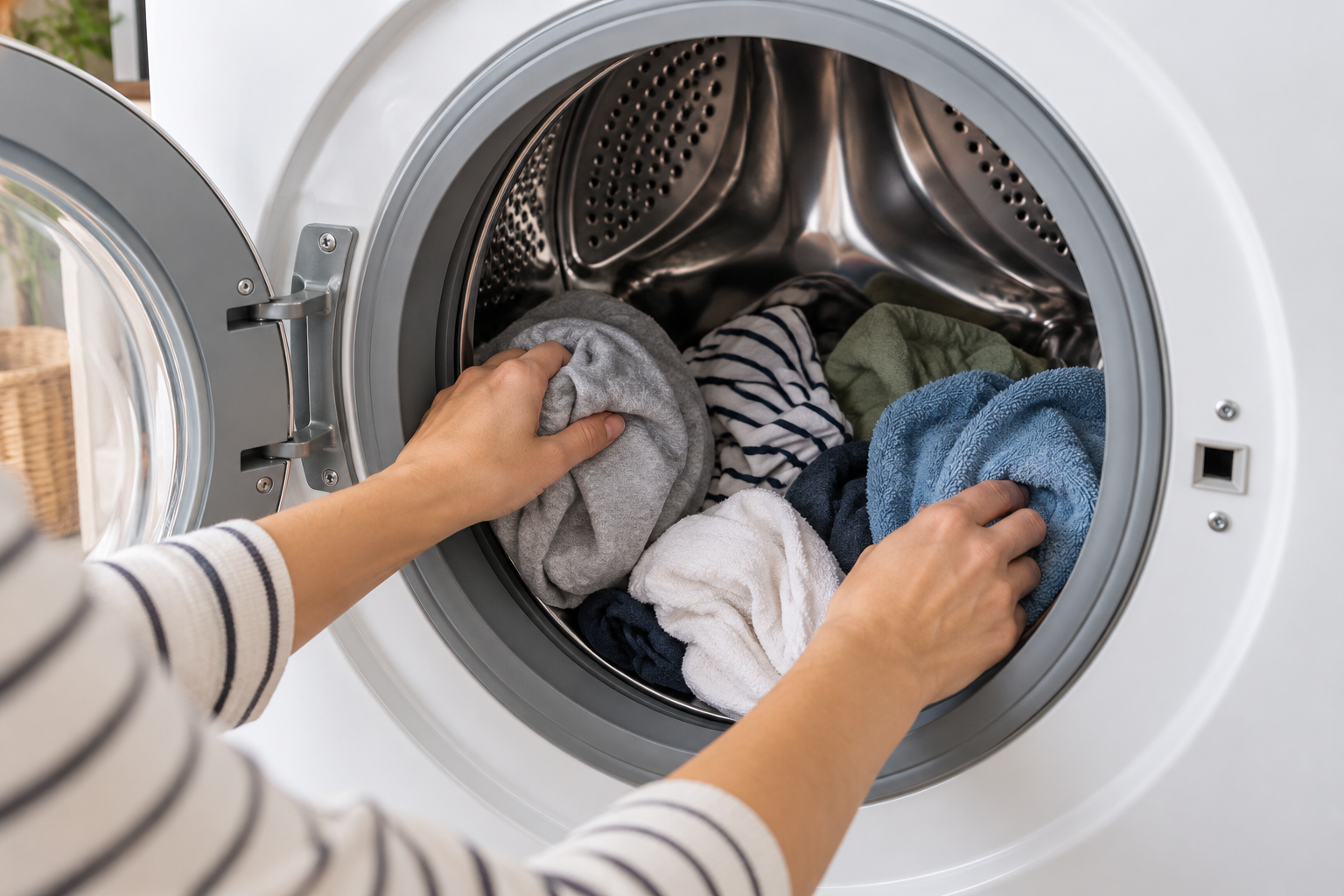
Water remaining means drainage comes first
Bosch and Electrolux both connect spin failure with a blocked pump, filter or drain hose. If water is visible, do not jump to the belt or motor. First check whether the drain hose is kinked or crushed. Follow the manual’s emergency-drain method, because opening a pump filter on a full machine can release many litres of hot, dirty water. Use a shallow tray and towels, work slowly, and keep the disconnected plug dry.
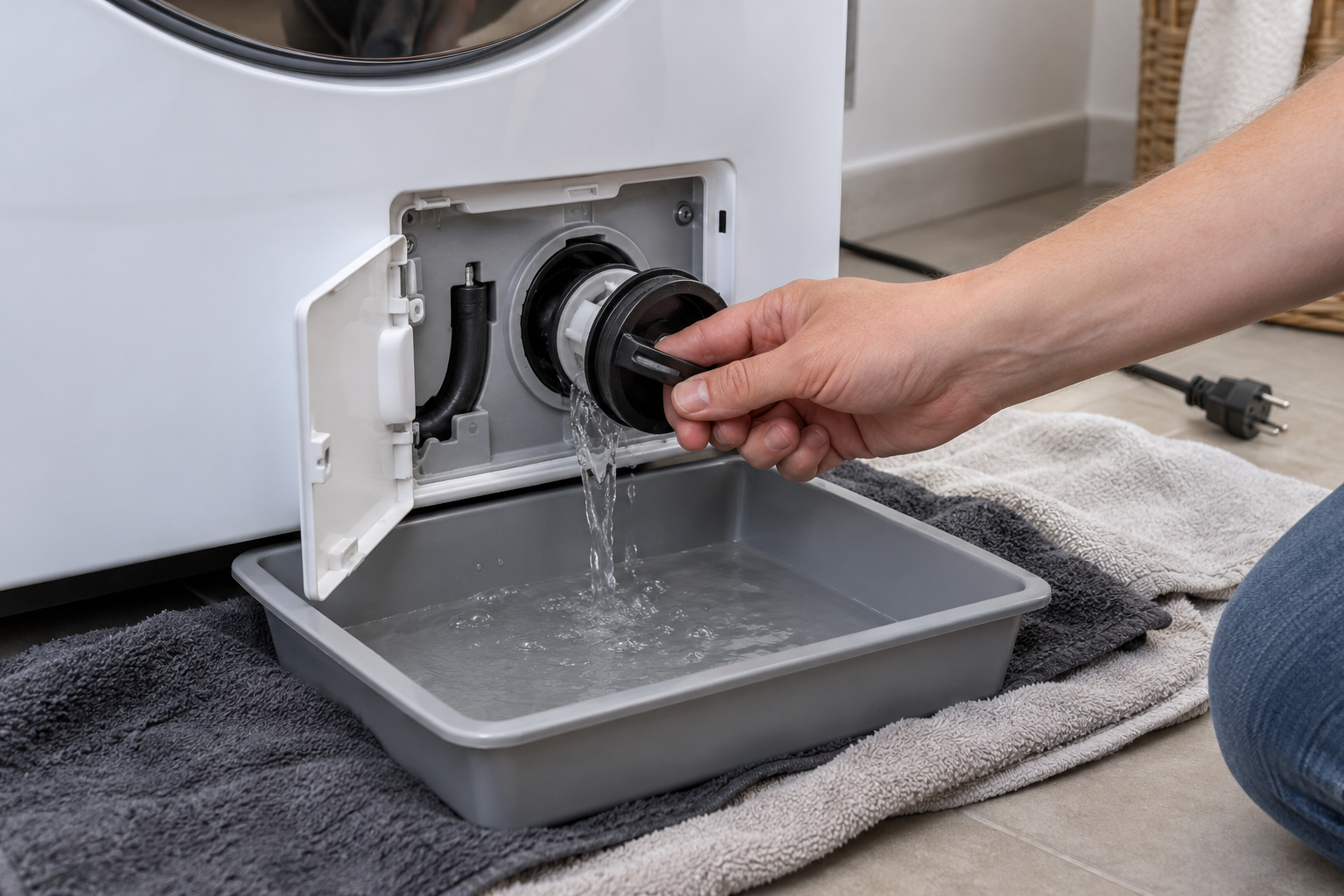
Remove accessible lint, coins, buttons or small objects, then verify that the filter is reinstalled and sealed exactly as specified. Bosch advises cleaning the pump housing so the rotor can move freely, refitting the cover, checking for leakage and then running the drain program. A pump hum with no water movement can indicate a blockage or a pump unable to produce flow; silence can indicate no command, no supply, an open pump or a different program state. Sound alone does not confirm a failed pump.
If drainage remains the main symptom, use the existing washing-machine drain-pump test guide for the next decision. Do not duplicate that electrical procedure here. For a displayed code, record the brand and full model, then consult the ElectronixLab error-code finder and the manufacturer manual. A generic code interpretation can be wrong across product families.
Excess foam can suppress spin
Too much detergent, the wrong product or very soft water can create persistent foam. The machine may extend rinsing or avoid high speed because foam interferes with level sensing and stable rotation. Look for foam against the door glass and a cycle that repeatedly adds water or time. Do not add more detergent or a random chemical “defoamer.” Follow the manufacturer’s recovery instructions, then reduce the dose according to detergent concentration, load size and local water hardness.
What one controlled test can tell you
| Controlled result | Interpretation | Action |
|---|---|---|
| Drains and spins a small balanced load | Original load, option or transient foam likely influenced the cycle | Repeat normal use with corrected loading |
| Drains, redistributes repeatedly, never accelerates | Balance detection, suspension or speed-control issue remains possible | Check installation, then request diagnosis |
| Pump runs but water stays | Drain restriction or pump-flow problem | Stop and follow drainage branch |
| Motor sound but drum does not rotate | Belt or mechanical transmission becomes relevant | Disconnect; inspect only if model permits |
| Drum starts then faults with a code | Speed feedback, motor drive, lock or control may be involved | Record code and use model-specific service data |
Installation and suspension clues
A machine that was recently installed or moved deserves an installation check before parts are suspected. Confirm that transport bolts were removed as instructed, all feet carry weight, the cabinet does not rock and the floor is firm. Electrolux recommends levelling the appliance and notes that loose hoses can strike the cabinet. Excessive movement can cause the control to abort spin even though the motor and belt are functional.
Do not compensate for a weak floor by wedging random cardboard under one foot. Adjust the feet and locking nuts according to the installation manual. If the empty drum has excessive up-and-down play, scraping, rumbling or contact with the door seal, do not run a high-speed test. These observations can indicate suspension, bearing, spider or foreign-object problems that need mechanical assessment.
When the drive belt becomes relevant
If the drum does not rotate during wash or spin, yet a motor sound is heard, a slipped or broken belt is plausible on belt-driven models. Direct-drive machines do not use the same arrangement. With the appliance unplugged and only when the manual or service design permits rear access, a visual check can reveal a belt off the pulley, shredding, oil contamination or obvious misalignment. Do not rotate powered parts by hand and do not run the appliance with a guard removed.
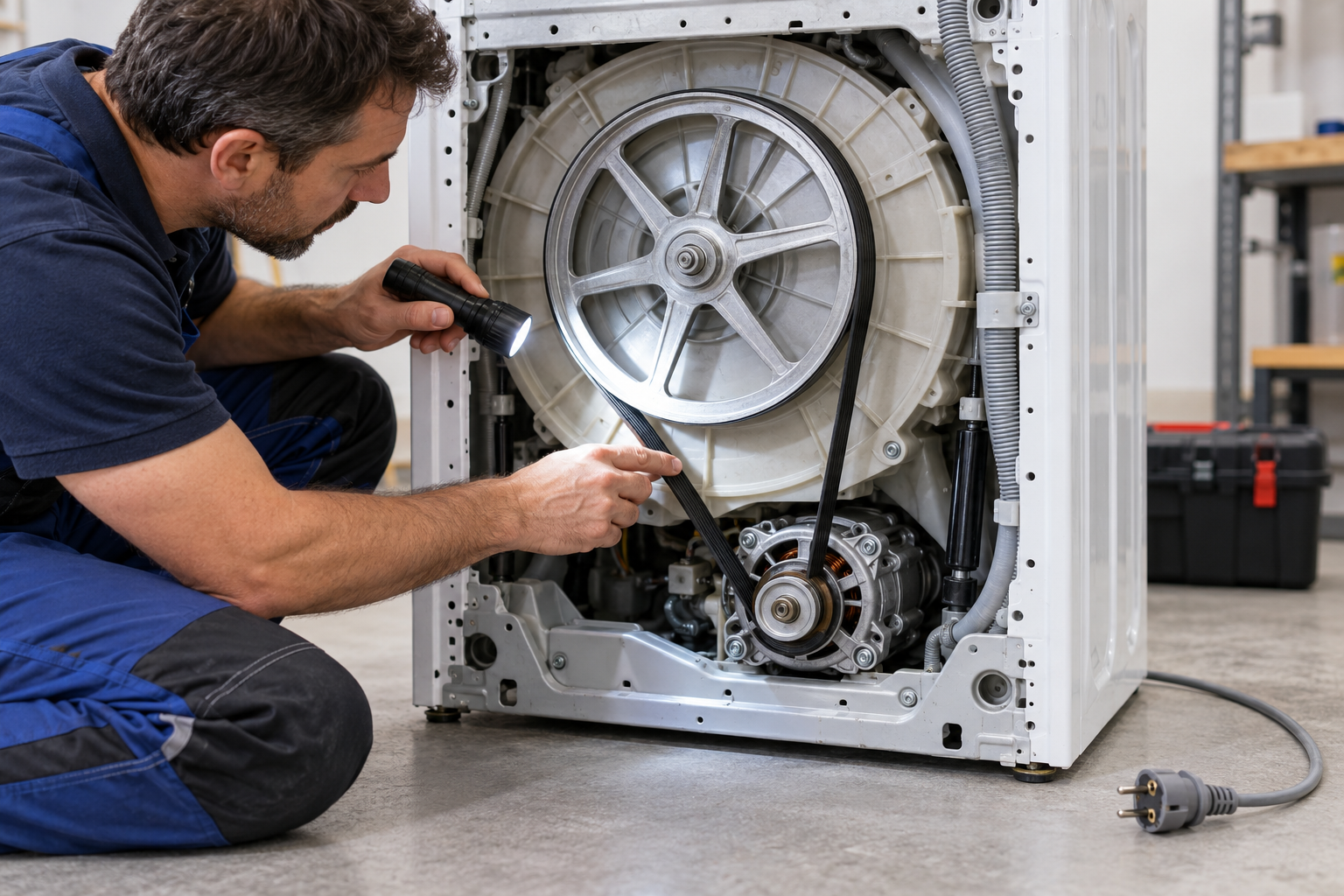
A belt that has come off is not always the root cause. A seized pulley, worn bearings, damaged drum support, incorrect replacement belt or misaligned motor can throw it again. Refit or replacement therefore requires inspection of the pulleys and free mechanical movement. If the drum is hard to turn, scrapes, has marked play or the belt area contains metal debris, stop and seek a technician rather than fitting a new belt blindly.
Motor, brushes, speed sensor and control board
Older universal motors may use carbon brushes; many newer appliances use brushless inverter or direct-drive motors. Advice that says “replace the brushes” is therefore not universal. Worn brushes can cause intermittent rotation, arcing or failure under load, but a technician must also consider the commutator, harness and control. Brushless systems instead rely on power electronics and rotor-position or speed feedback. The correct checks depend on the wiring diagram and fault history.
A speed sensor fault may allow a brief start and then stop because the control cannot verify drum speed. Door-lock feedback, pressure sensing, wiring, motor drive and the main board can produce similar symptoms. Replacing a board before confirming supply, load, drainage, lock and harness conditions is expensive guesswork. Preserve the error code, program stage and observations; these are the evidence that makes professional diagnosis faster.
A practical decision tree
| Question | If yes | If no |
|---|---|---|
| Is water still visible? | Resolve drainage first | Check program and load |
| Was no-spin, rinse-hold or low speed selected? | Correct option and retest once | Continue |
| Does a small balanced load spin? | Correct loading/detergent practice | Continue |
| Does the drum rotate during wash? | Investigate balance, speed feedback and control | Investigate lock, belt, motor and control |
| Any smell, leak, grinding or violent movement? | Disconnect and arrange service | Use model-specific diagnosis |
Common mistakes
- Running repeated spin cycles with a grinding noise or unstable cabinet.
- Opening the pump filter before controlling the water in the tub.
- Testing with one heavy towel and treating another balance rejection as proof of failure.
- Assuming every motor has carbon brushes or every washer has a belt.
- Replacing the pump because it hums, without confirming flow and hose condition.
- Clearing the error history before recording the code and program stage.
Frequently asked questions
Why does the machine wash normally but skip final spin?
The wash tumble uses low speed and modest mechanical demand. Final spin requires successful drainage, a lock confirmation, acceptable foam and balance, then reliable speed feedback. A machine can therefore wash yet refuse acceleration.
Can I test spin with an empty drum?
An empty test can show whether the drum accelerates, but it cannot reproduce load balancing. Follow it, if necessary, with one small mixed load rather than one heavy item. Stop after one controlled attempt if the fault repeats.
Does wet laundry prove the pump is faulty?
No. Wet laundry can result from a low selected speed, balance rejection, foam, drainage restriction or a drive/control fault. Visible water and drain behaviour make the pump branch more relevant.
When should I call a technician?
Call when accessible drainage and loading checks pass but spin still fails, or immediately for electrical smell, tripping, leakage, grinding, severe drum play, a damaged cable, inaccessible internal parts or a persistent model-specific code.
Technical sources consulted
- Bosch France, washing machine does not spin, accessed October 31, 2026.
- Electrolux France, washer does not spin or drain, accessed October 31, 2026.
- Electrolux France, noise and vibration during spin, accessed October 31, 2026.
- Whirlpool France, washer no longer spins, accessed October 31, 2026.
Be the first to leave a comment.