A microwave that lights up and turns the plate without heating has not necessarily lost its magnetron. Confirm that a microwave cooking program is selected, rule out the model's demonstration mode and inspect the door and external ventilation. If the appliance still produces no heat during the manufacturer's permitted check, stop at external diagnosis and request service.
The turntable, lamp, fan and microwave-generation system perform different jobs. Their operation cannot establish that heating power is being delivered. This guide helps separate a setting problem, weak heating and a genuine no-heat complaint. It deliberately keeps the cabinet closed: internal microwave work involves high voltage and safety interlocks, including hazards that unplugging alone does not remove.
Check for a reason to stop immediately
Do not run a diagnostic cycle if the door is bent, the hinges are loose, the latch is damaged or it will not close firmly. Stop for arcing, smoke, a burning smell, a damaged cord, repeated tripping or unusual violent buzzing. If the appliance appears to continue cooking with the door open, discontinue use and contact the manufacturer. Do not investigate by approaching the opening or repeating the event.
Do not remove the outer cover, door assembly or control panel. Never insert an object into the latch openings, bypass an interlock or try to discharge a high-voltage capacitor. Waiting after unplugging is not proof that internal parts are safe. Our general capacitor guide is not a procedure for accessing a microwave's high-voltage section.
Define what is actually operating
Write down the full model and any displayed message. Note whether the display counts normally, whether the turntable moves, whether the fan runs and whether the complaint affects every microwave program. A combination oven can grill or bake using a separate heat source; successful grilling does not prove microwave generation works. Equally, a kitchen countdown timer is not a cooking program.
| Observation | Useful interpretation | Next step |
|---|---|---|
| Countdown only, no cooking behaviour | Kitchen timer or selection issue possible | Read the manual's microwave-start procedure |
| Controls work but appliance is in Demo | Heating may be intentionally disabled | Exit Demo using the exact model procedure |
| Grill works, microwave food stays cold | Separate heating systems give different results | Confirm microwave mode; arrange service if unchanged |
| Food warms slowly | Power setting, quantity or weak heating | Use a documented comparison, not an empty run |
| Door damaged or operation with door open | Safety concern | Discontinue use without another test |
Settings: check the manual rather than random button combinations
Cooking mode and power level
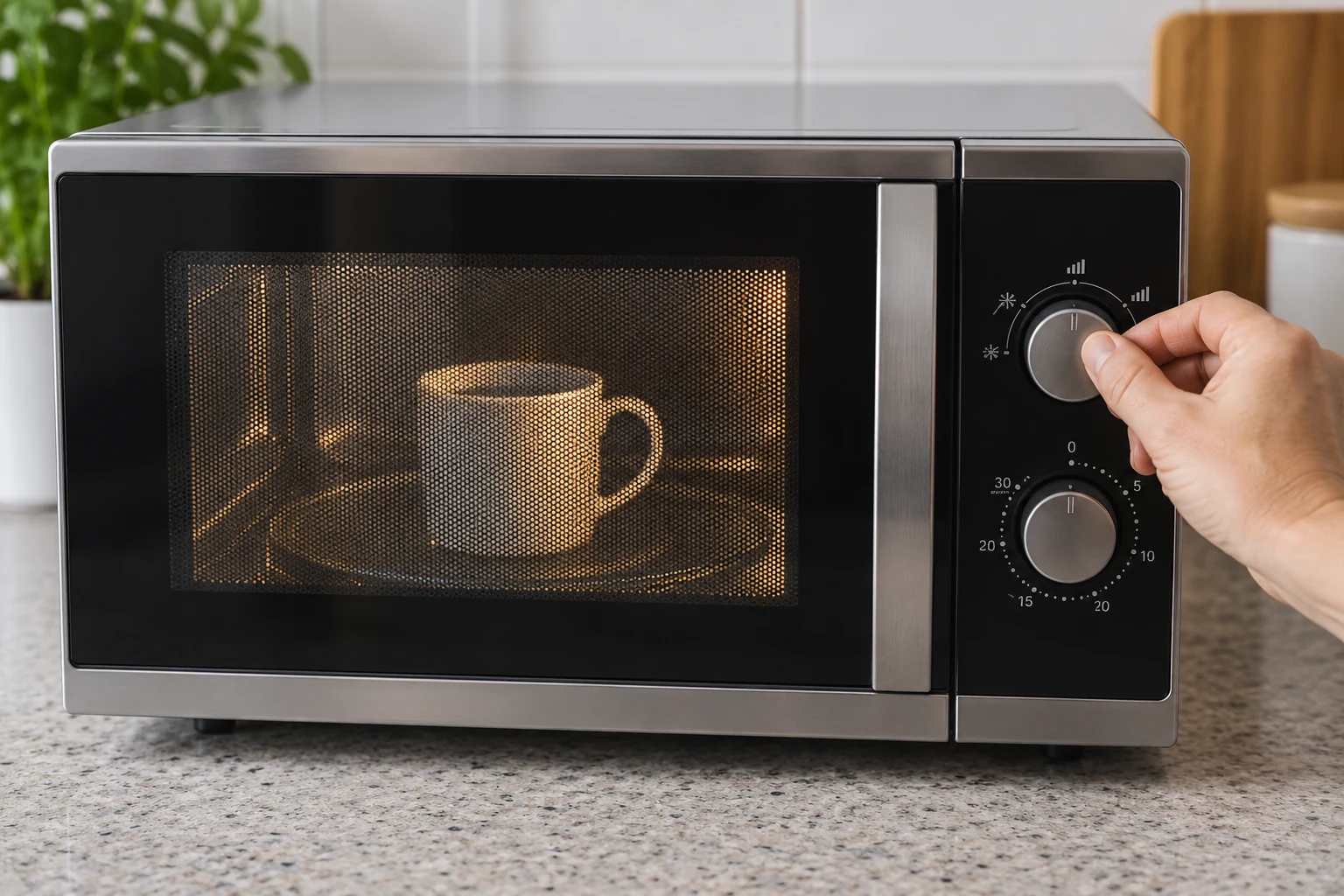
Cancel the current selection. Choose the ordinary microwave cooking function and the power level specified for the intended check. Defrost, keep-warm, grill, convection and a kitchen timer are not interchangeable. A low setting can leave a large cold portion insufficiently heated within a familiar short time even when the appliance is operating normally.
On some conventional designs lower power is delivered through alternating heating and non-heating periods. Other models regulate output differently. Changes in sound during a cycle are therefore not a universal fault indicator. Do not use sound alone to decide whether the magnetron is active, and do not use a phone, radio or improvised radiation detector to assess safety.
Demonstration mode
Some models allow controls to be demonstrated without enabling microwave heating. Samsung describes an unusually fast countdown as one clue on supported models, but this is not a universal test for all brands or model families. Find the exact reference in the manual. Use its procedure once and check the displayed state; do not apply a button combination from a visually similar appliance.
A control lock normally concerns operation of the controls and should not automatically be blamed for a machine that actually completes cooking cycles. Distinguish the symbol and function rather than treating every padlock, clock or unfamiliar icon as Demo. A photo of the display and the selected options is useful if the manual does not resolve the state.
Inspect the door externally
Stop and unplug the microwave before cleaning. Remove only accessible food residue from the door rim and corresponding frame using a soft damp cloth, following the cleaning instructions. Dry the area and inspect the latch hooks without forcing them. Make sure packaging, a misplaced tray or a large dish does not obstruct closure.
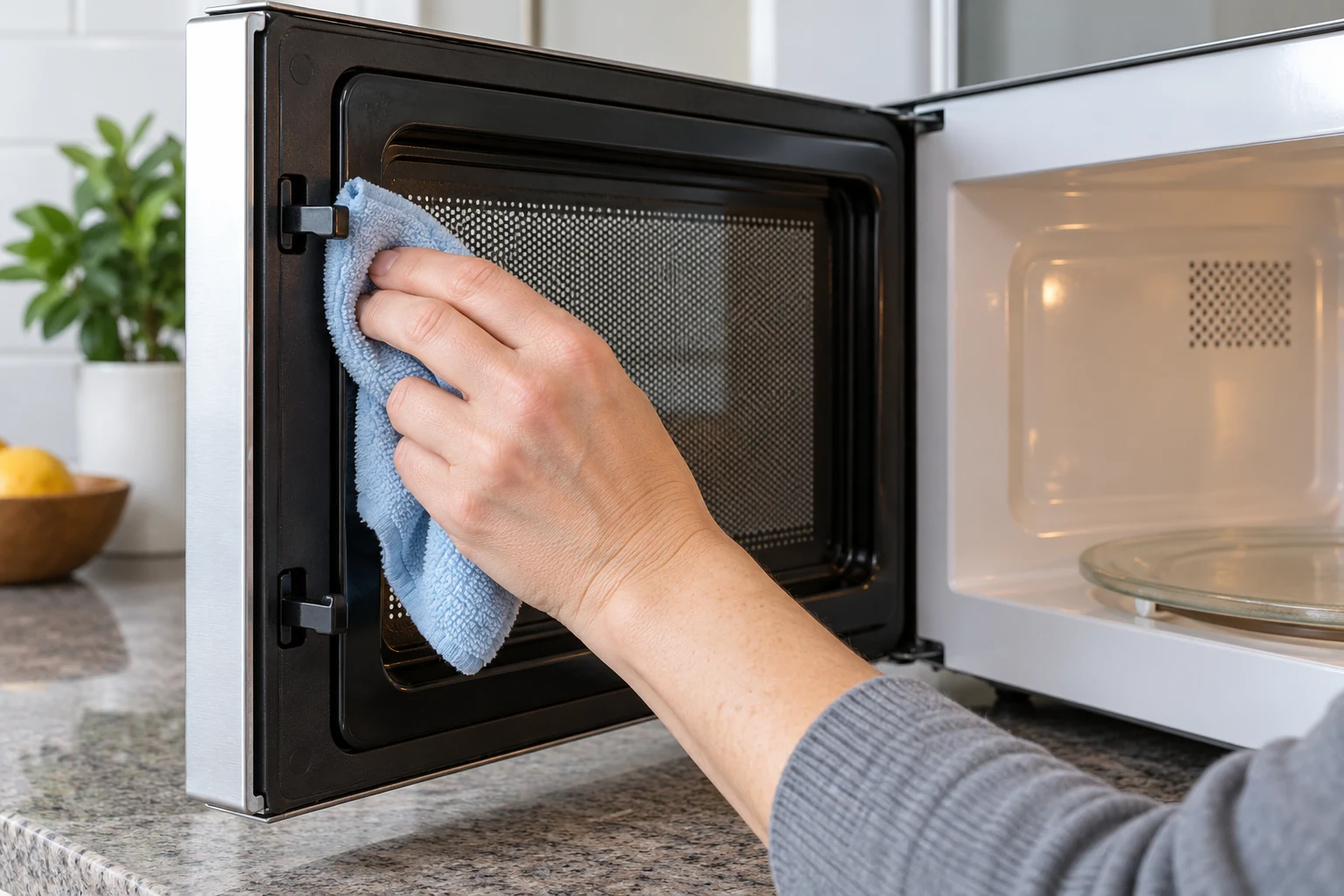
If the door needs lifting, pushing unusually hard or holding in one position to operate, stop using the appliance. Do not bend a hinge, glue a latch or adjust the door to make a test pass. A technician needs to inspect the mechanical and interlock arrangement. Cleaning removes an accessible obstruction; it does not verify the electrical operation of every door switch.
One permitted external heating comparison
Only perform a heating check when the appliance is intact, the door closes normally and there are no stop symptoms. The exact model manual takes precedence. Panasonic's support guidance uses a cup of water as an external no-heat check, but the container, amount, time and power should follow the instructions applicable to your appliance. Do not invent a universal threshold from a different wattage or model.
- Prepare the appliance. Confirm the turntable and roller ring are correctly positioned where fitted. Remove packaging and metal accessories not authorized for microwave mode.
- Use a suitable load. Put the specified quantity of cool water in an open microwave-safe container. Never test empty or use a sealed vessel.
- Select microwave cooking. Use the documented power and short test duration, not grill, defrost or Kitchen Timer. Remain present.
- Stop if anything abnormal occurs. Cancel for sparks, smoke, unusual noise or an electrical smell. Do not continue to reach a nominal test time.
- Allow safe handling. Follow the manual's standing-time instructions. Handle cautiously with suitable protection; heated water and the container can burn, and superheated liquid can erupt.
- Record the outcome. State whether warming was apparent and which settings were used. Do not repeatedly heat the same water to force a result.
- Choose the next action. Persistent no heat after correct selection requires service. A successful comparison shifts attention to normal cooking settings, portion size and technique.
This is a qualitative branching check, not a certified power or leakage measurement. Do not put a metal thermometer inside during operation. A numerical power estimate would need controlled mass, initial and final temperature, timing, losses and a suitable method; none is established by saying that a mug feels warm. It is more honest and more useful to report the actual limited observation.
External ventilation and installation
Check the clearance required around the top, sides and rear in the installation guide. Countertop, built-in and over-the-range models have different arrangements. Do not fit a countertop model into a tight enclosure because it happens to fit physically. Look for objects covering an external grille and remove only accessible surface dust as the manual permits, with power disconnected.
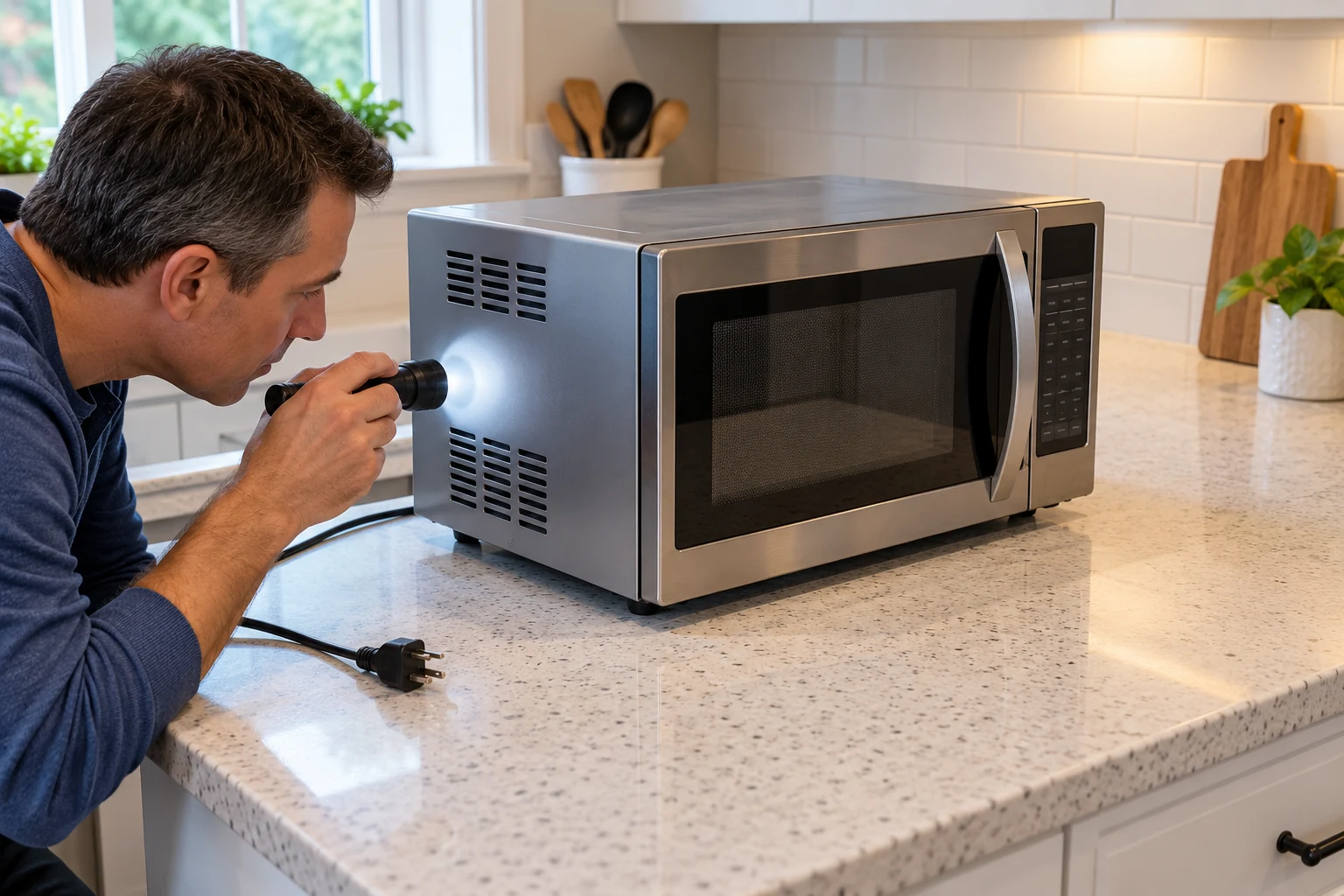
If the microwave stops heating after a period of use and later works again, temperature-related protection is one possible branch, not proof of a faulty thermostat. Record the duration, program and surrounding conditions. Repeatedly waiting and restarting conceals the pattern and may expose the appliance to the same fault. A built-in installation should be inspected by its installer rather than pulled out while connected.
A plug, socket or supply issue may also require professional attention. Lights and controls need less power than the heating system, so their presence does not verify the supply under load. Use the supply arrangement specified by the manufacturer. Stop for discoloration, a hot plug or repeated tripping; do not try a collection of extension leads as a diagnostic method.
Why the symptom does not identify one failed part
After settings, external obstruction and permitted checks are excluded, a no-heat fault can still involve interlocks, control, power conversion, thermal protection or the microwave source. Traditional transformer designs and inverter models do not have identical circuits. A generic list of diode, capacitor and magnetron replacements is not a diagnosis for the exact appliance.
A visible turntable confirms motion, not microwave output. A familiar hum is not an insulation test. A normal display is not proof that a high-voltage section receives a command. These distinctions explain why a professional may need several model-specific checks before naming a component. They also prevent replacing a fuse without determining why it opened.
Use the circumstances to describe the fault accurately
It has never heated since installation
Prioritise Demo, the chosen function, removed transport packaging and installation clearances. Check the actual supply arrangement against the instructions. Preserve the purchase and installation details for the seller or installer. Do not open a new appliance to find a presumed shipping-disconnected wire.
It stopped after cleaning or moving
Look for a dish or tray interfering with the door, a covered external vent or an accidentally changed control setting. If liquid entered the controls, keep the appliance disconnected and request advice. Drying the exterior is not evidence that an internal electrical area is safe.
Some foods warm but others seem unchanged
Different quantities, starting temperatures, shapes and standing times make comparisons unreliable. Follow the food and appliance instructions for stirring, turning and standing. Do not declare the appliance healthy for every use from one successful water check. If heating remains consistently weak on comparable loads and correct settings, report that pattern for service.
A successful check and an unsuccessful check mean different things
Consider an illustrative newly installed combination oven that browns food under the grill but does not warm a drink. After the owner selects ordinary microwave mode using the exact manual, the permitted comparison produces warming. That observation supports a selection problem for the reported use. It does not measure maximum microwave output, certify the door system or validate an unrelated automatic recipe.
Now consider an intact appliance that was previously reliable. The owner confirms the cooking mode, finds no Demo setting active, checks normal door closure and performs the single documented comparison. No warming is apparent and a service code returns. The useful next step is to preserve that code and arrange service, not to extend the cycle until something changes. Repeating the same observation supplies little new information while adding operation in a fault state.
These examples show why the report should contain the test conditions and its limit. “The plate rotates” and “the water warmed on the permitted check” are different pieces of evidence. Neither should be silently converted into “all parts are healthy” or “the magnetron has failed.” Let the remaining question determine the service request.
Repair discussion and useful evidence
Provide the exact model, error code, selected mode and power, when the fault began, door condition, external clearance and the outcome of the one permitted comparison. Say “turntable and fan run; water did not noticeably warm on the documented check” rather than “magnetron dead.” The former describes evidence a repairer can use.
Ask for a diagnosis and quotation before deciding between repair and replacement. This guide cannot supply a universal repair price or identify which part is economical for your model. For a combination oven whose separate conventional-heat mode fails, the electric oven heating guide explains the different symptom; it is not permission to open a microwave cabinet.
Frequently asked questions
Can unplugging reset the fault?
A model's documented reset may clear an accidental state. Record messages first and try it only if the instructions allow. A returning fault needs diagnosis; a reset does not repair an interlock or make the high-voltage interior safe.
Can I keep using the grill?
Do not assume another mode is safe after a heating fault. Ask the manufacturer, especially if there is a code, abnormal sound or door concern. Leave the appliance unused when safety is uncertain.
Is cold food proof of microwave leakage?
No. Heating failure does not establish leakage. Door damage or apparent operation with an open door is a separate reason to stop and obtain professional assessment, without attempting a home leakage test.
Technical references
- Samsung: no heat, Demo, timer, door and clearances.
- Panasonic: external no-heat checks.
- FDA: door damage, abnormal open-door operation and hot-liquid precautions.
Sources consulted 31 October 2026.
Be the first to leave a comment.