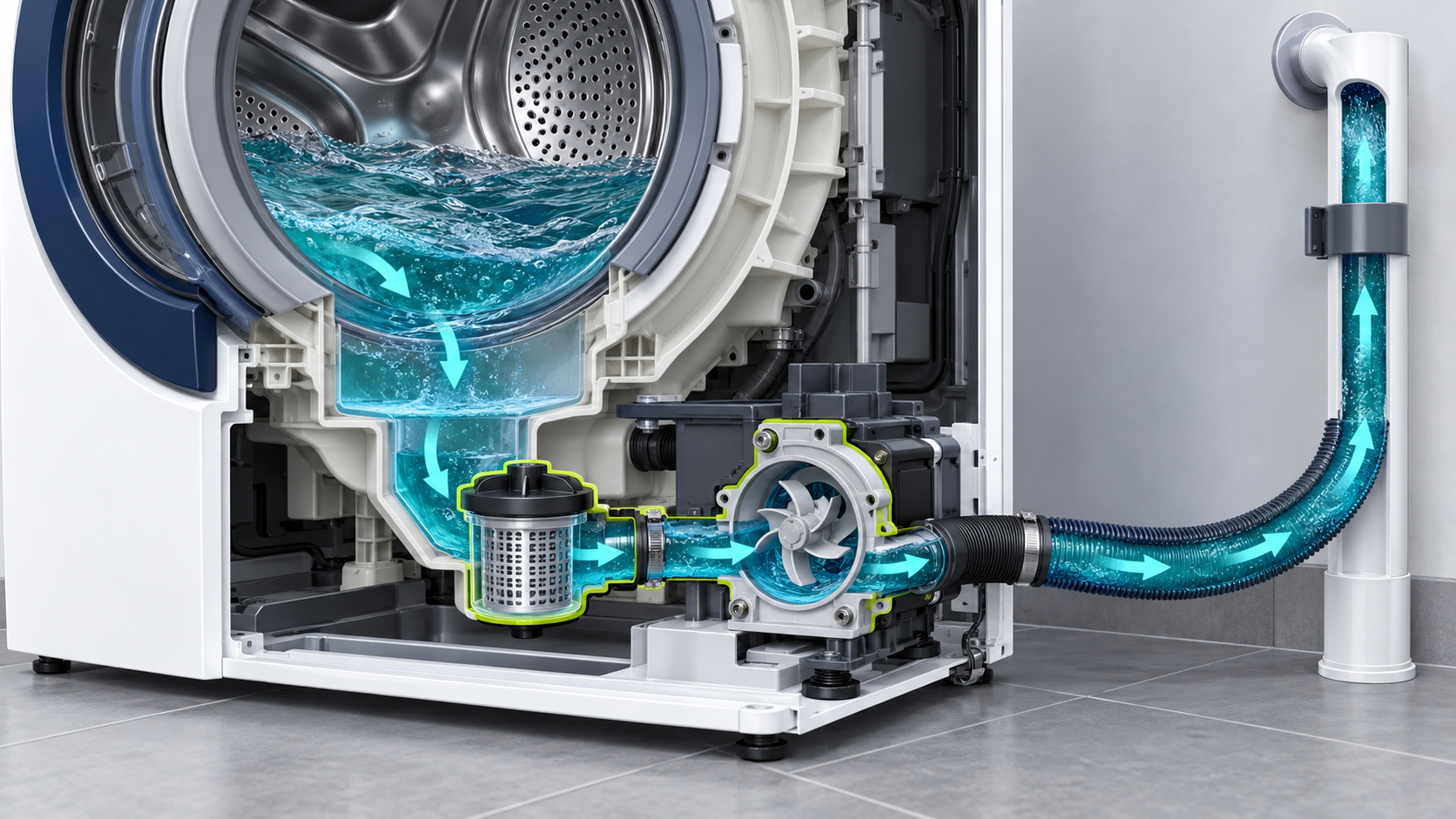
An OE error means an LG washer is not draining within the expected time. If you can hear the pump, do not assume it is healthy: a motor can hum while its impeller is jammed, the hose is restricted, or actual flow is too weak. This procedure follows the complete drain path from the tub to the household standpipe.
Stop the cycle, unplug the washer, and let hot water cool. Close the supply taps if the machine must be moved. Prepare a shallow pan and several towels. Never tip a washer that still contains water and never test an exposed pump with mains power applied.
What the LG OE code really means
OE identifies a drain problem. Common front-load causes include a debris-filled pump filter, a pinched hose, a blocked household drain, excessive suds, or a pump that has lost flow. Top-load models may use different access points and spin procedures, so record the complete model number before disassembly.
Noise proves only that something is being energized. The pump may hum without moving water if the rotor is locked or detached. Silence is not absolute proof of a failed pump either, because the control can pause for a door condition, sequence timing, or protection event.
Fast diagnosis by symptom
| Observation | Likely cause | First check |
|---|---|---|
| Pump hums, water does not move | Blocked filter or impeller | Manual drain and filter cleaning |
| Weak flow into a bucket | Restricted hose or worn pump | Hose and impeller inspection |
| Strong bucket flow, OE when installed | Blocked household drain | Test the standpipe separately |
| Pump remains silent | Pump, wiring, or control | Professional power-off diagnosis |
| OE with heavy suds | Detergent overdose | Empty rinse and lower dosage |
Step 1: inspect the drain hose
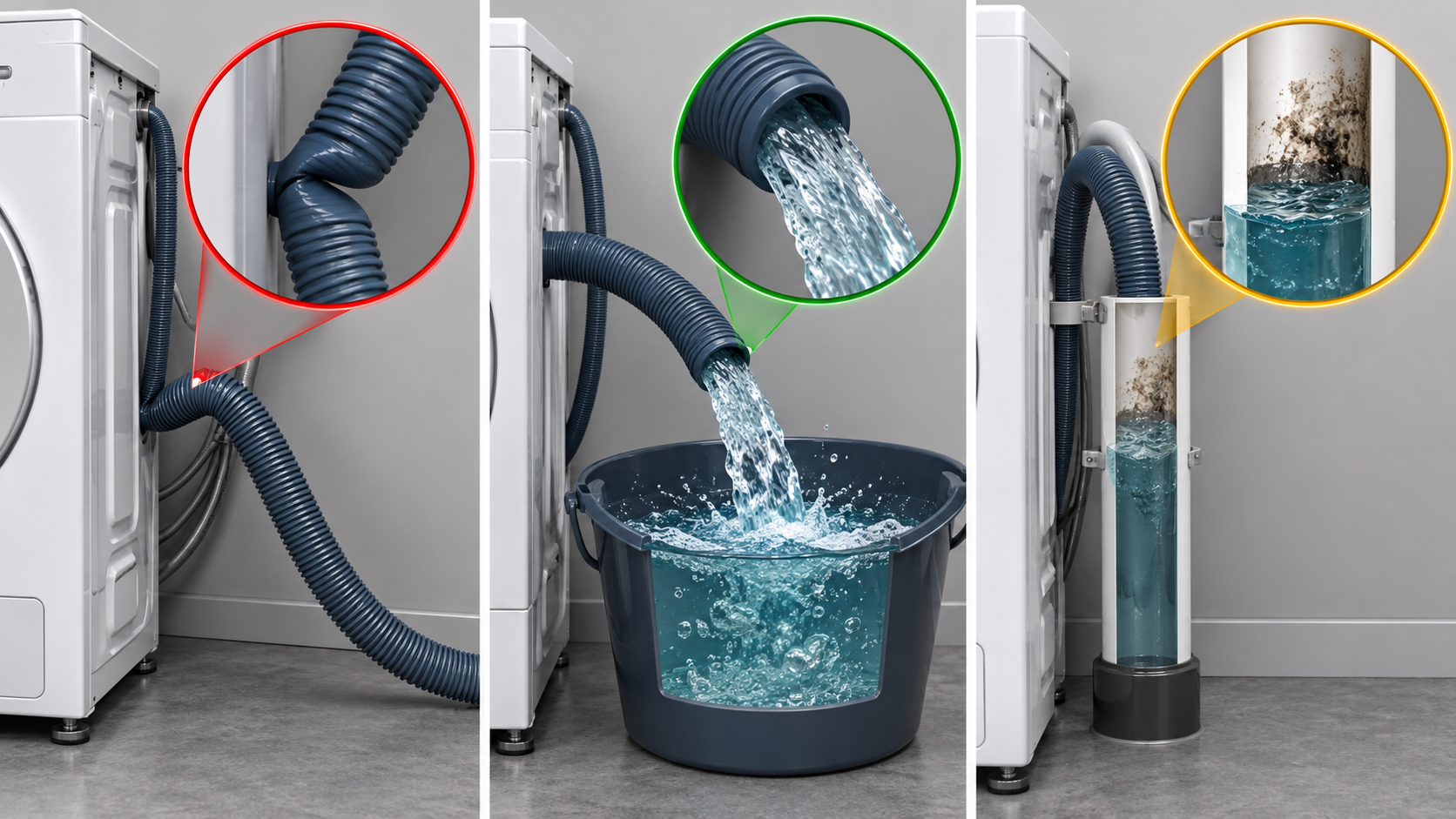
Move the washer away from the wall carefully. The hose must not be crushed, sharply bent, or trapped under a foot. Confirm its height and insertion depth against the model manual. A hose pushed too far into the standpipe may disturb drainage, while an outlet that is too high increases pump load.
Remove the hose from the household drain and place it securely in a large bucket. Reconnect power only to run the LG spin-only or drain function, keeping hands away during the test. A strong stream indicates that the washer can pump and the household pipe deserves attention. An irregular trickle keeps the filter, hose, and pump under suspicion. Unplug again before touching anything.
Step 2: drain safely and clean the filter
Many front-load models have a small lower service door. With power disconnected, place a shallow pan and towel in front of it. Use the emergency drain tube when fitted, removing its cap gradually. The water may be hot and there may be more than one panful, so empty the container repeatedly instead of allowing an overflow.
Turn the filter slowly counterclockwise. Remove lint, coins, buttons, pins, and other debris. Wash the basket with warm water and a soft brush. Illuminate the cavity without inserting a metal tool. The small impeller at the rear should move in magnetic steps. It should not spin as a completely loose wheel or remain solidly locked.
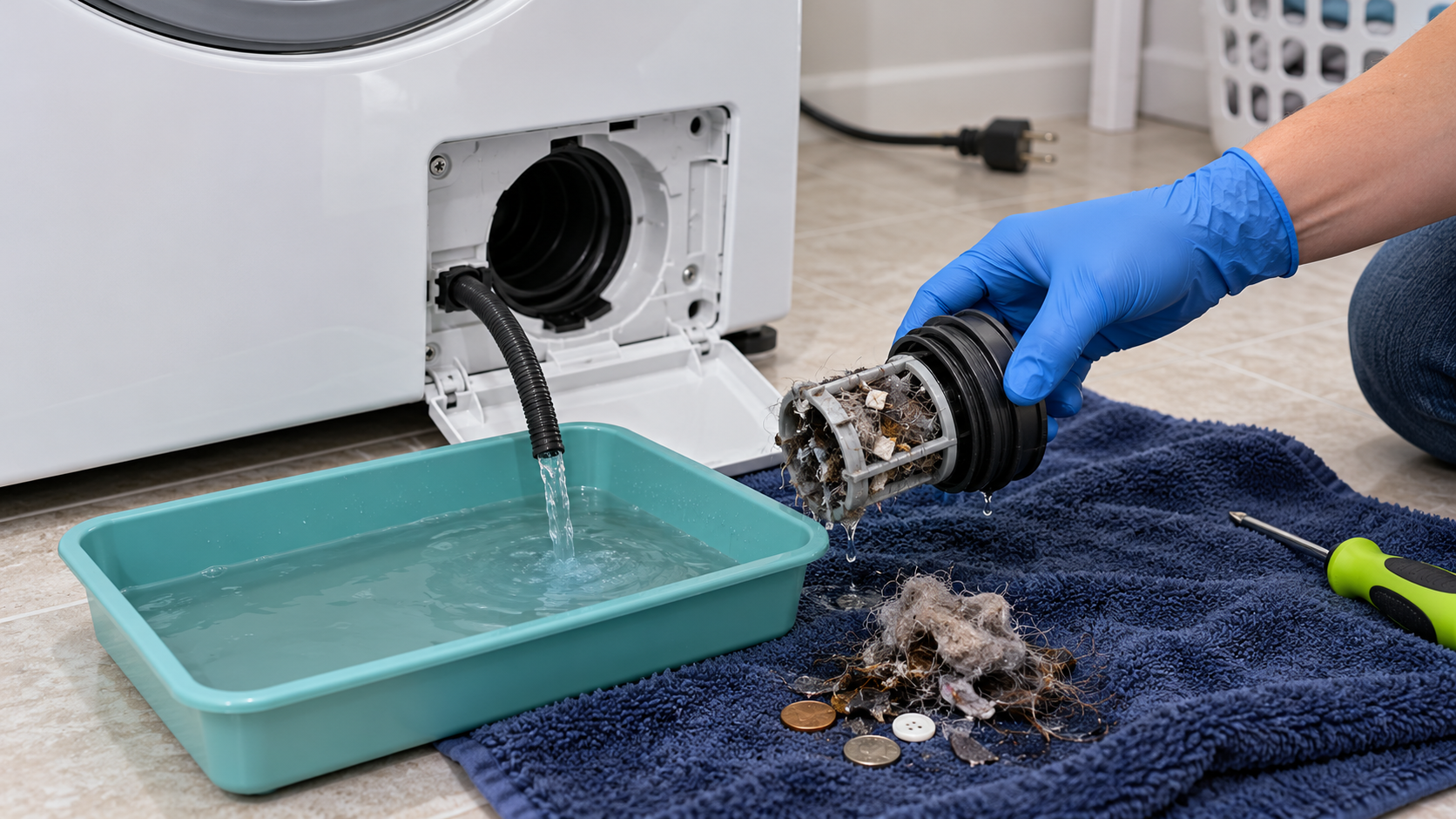
Clean the seal, reinstall the filter to its stop without overtightening, and replace the emergency-hose cap. Incorrect seating can cause a leak. Dry the area, reconnect the washer, and run an empty spin cycle while watching the service door.
Step 3: the pump hums but flow is poor
A continuous hum with standing water suggests a stalled or disconnected impeller. Stop the attempt promptly to avoid overheating. After draining and unplugging, look through the filter opening for elastic bands, thread, or fabric around the rotor. Excessive play, scraping, or a rotor that turns with no magnetic resistance can indicate mechanical wear.
A resistance reading alone cannot certify a pump. Its winding may be electrically continuous while the impeller no longer moves water. Expected resistance varies by part number. Use service information and measure only with power removed and the connector unplugged. An open winding, short circuit, or leakage to the frame requires pump replacement and wiring inspection.
Step 4: less obvious causes
Excessive suds
Incorrect or excessive detergent creates air pockets. The pump can run without moving water effectively. Let suds settle, run an empty rinse, and reduce dosage. Do not add improvised chemicals to the drum.
Tub-to-pump hose
A sock or small item can stop before the filter. Access normally requires panel removal and varies by model. It must be performed with power disconnected and may affect warranty coverage. If the filter is clear but no water reaches it during manual draining, this hose becomes a serious suspect.
Level sensing and wiring
If the tub is demonstrably empty but OE returns, the control may be receiving an incorrect water-level signal. A pinched pressure tube, oxidized connector, or board fault requires documented diagnosis. Do not blow forcefully into an electronic sensor or replace a control board before proving real drain performance.
Practical decision tree
- Hose kinked? Straighten it and retry spin.
- Pump audible? If yes, drain manually and clean filter and impeller.
- Strong flow into a bucket? Inspect the household standpipe.
- Flow still weak? Inspect the hose, sump connection, and pump mechanics.
- Tub empty but OE remains? Have the level sensor, harness, and control checked.
When professional service is appropriate
Request service if the pump stays silent, a breaker trips, water leaks underneath, the filter cannot be opened, or OE returns despite strong external flow. Provide the model number, point in the cycle where OE appears, sound observed, and bucket-test result. This evidence helps prevent random part replacement.
Prevent another OE error
Empty pockets, place small garments in a mesh bag, and clean the filter at the interval stated in the manual. Use HE detergent when required and dose it for load size and water hardness. Leave space behind the washer so the hose cannot be crushed. Watch for gradually slower draining because early restriction is easier to correct than a complete stop.
Frequently asked questions
Is the pump working if I hear it?
It is probably receiving power, but noise does not confirm correct impeller rotation or sufficient flow.
Can I open the filter while water remains?
Only after unplugging and progressively draining through the emergency tube or another method specified by the manual.
Why does OE return after filter cleaning?
The outlet hose, household drain, internal sump hose, pump, or level sensing may still restrict or misreport drainage.
Should I replace a humming pump immediately?
No. First exclude trapped debris, a clogged filter, and a blocked standpipe.
Is the procedure identical on every LG washer?
The general meaning is drainage, but access and control sequences vary. Always check the exact model manual.
Sources and related guides
Continue with our guide to test a washing-machine drain pump or browse more appliance diagnostics.
Be the first to leave a comment.