A washing machine that hums when it should drain may have a blocked filter, an obstructed impeller, a kinked hose, or a pump that cannot start. The sound alone does not prove the pump is defective: a motor can hum while stalled, another component can make a similar sound, and some models delay draining until a control condition is met. Stop the cycle, unplug the machine, and contain the water before opening the filter.
This procedure is for a household washer whose drum retains water and produces a low hum during a drain request. It does not cover a machine that hums during filling or spinning but drains normally. Check the exact model's manual for filter access, emergency drainage and any anti-flood behavior. Never reach into a powered appliance or measure live mains at the pump.
Identify the symptom without taking the washer apart
Record whether the drum contains water, the stage at which the hum begins, and whether an error code appears. Pause the cycle and use the manufacturer's Cancel or Drain procedure. If the water level remains high, avoid opening the door on a front loader until the lock releases and you can control the water. A loud grinding sound, smell of overheating or leaking water is a reason to stop immediately.
| Observation | Possible interpretation | Next safe check |
|---|---|---|
| Water stays in drum; low hum near drain stage | Flow path or pump may be restricted | Unplug and inspect filter and hose |
| Water leaves slowly while hum continues | Partial restriction or weak flow | Inspect hose routing and filter |
| No water in drum, but machine hums | Sound may have another source | Confirm cycle stage and exact model |
| Water leaks under cabinet | Possible hose or seal failure | Disconnect power and water, seek service |
| Filter clear, impeller free, no draining | Pump, wiring or control remains possible | Qualified diagnosis; do not guess a part |
Prepare for a controlled water release
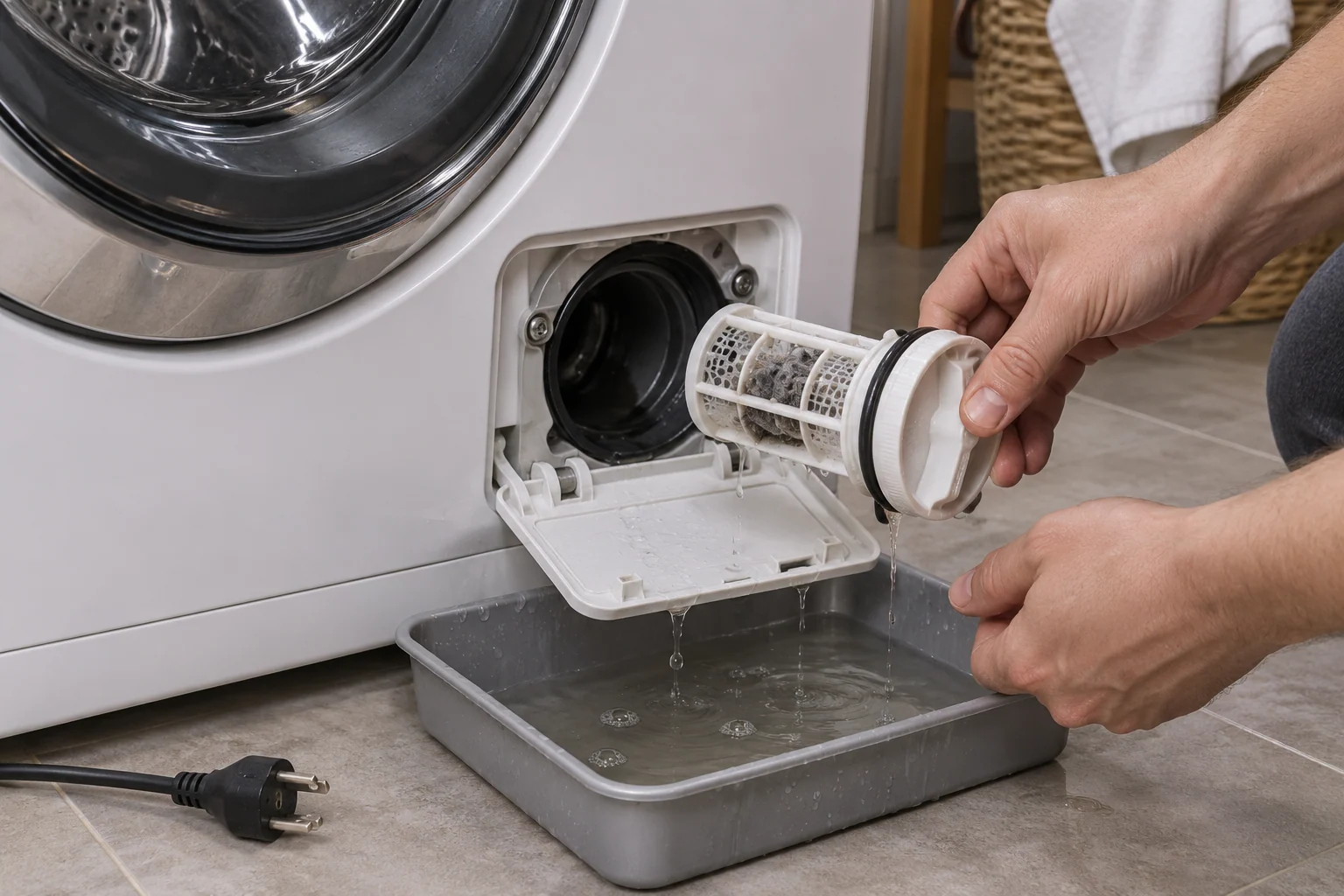
Switch off and unplug the washer. If access to the plug is unsafe because water is present, isolate it at the appropriate breaker without touching wet electrical parts and obtain professional help. Close the water supply when a leak is suspected. Gather towels and a low tray. On models with a small emergency drain hose, use that hose according to the manual before loosening the filter. Do not assume that the front hatch is the correct access point on every brand.
Water trapped in a hot wash can be hot. Allow it to cool. Release the filter slowly, stopping to empty the tray as needed. A full drum can contain much more water than a shallow tray holds. Keep children away from the work area and photograph the filter position before removal so its seal can be reinstalled correctly.
Inspect the filter and pump inlet
Remove visible debris
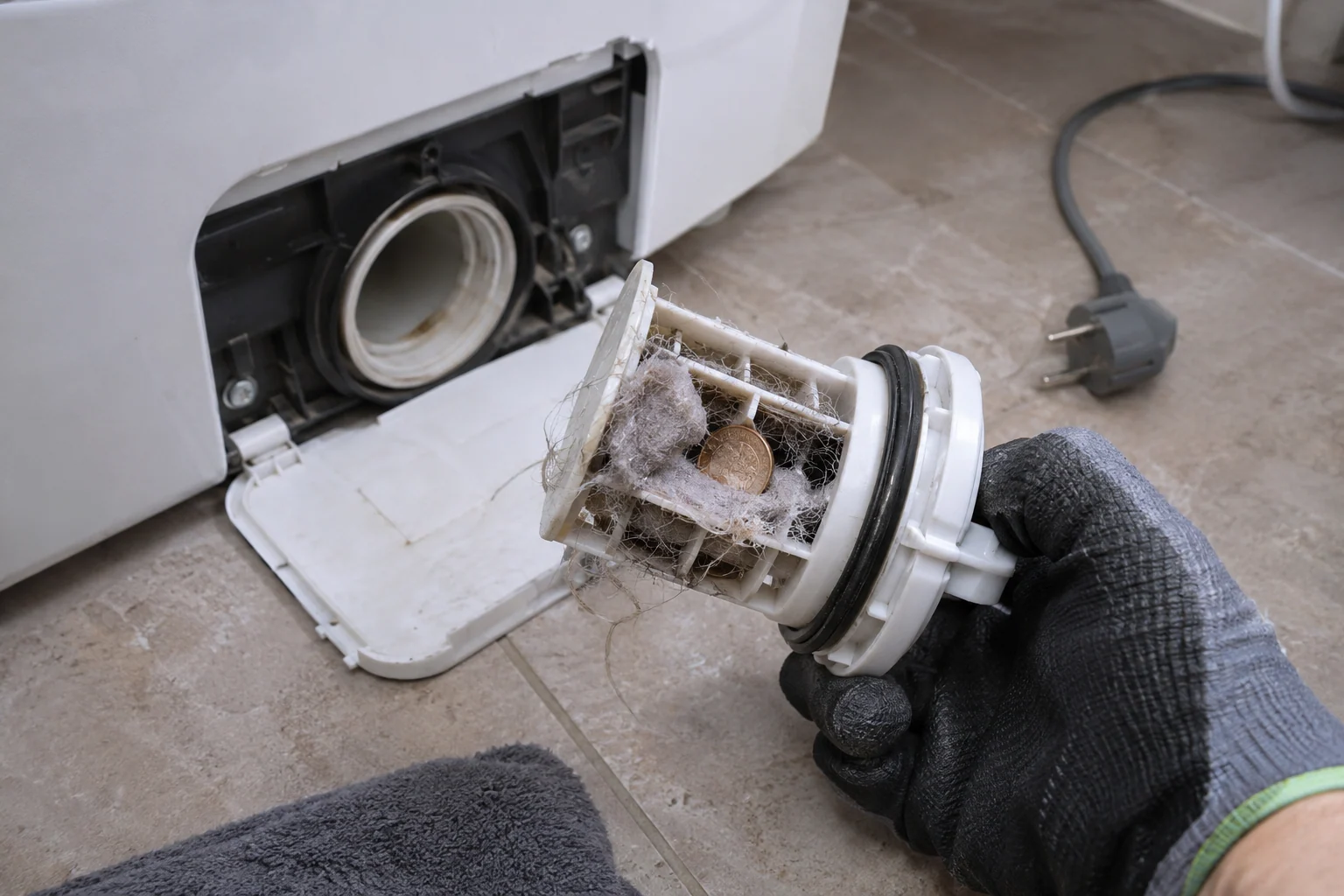
Take out lint, coins, hairpins and fabric carefully. Inspect the filter seal and housing for damage. A blocked filter can prevent water reaching the pump, but finding debris does not prove that it was the only fault. Clean and reinstall the filter fully according to the model instructions before any powered test.
Look at the impeller without forcing it
Where the model permits safe access through the filter opening, look for thread, a small object or a damaged vane. Some impellers turn in small magnetic steps; resistance and free play differ by design. Do not use a screwdriver to force rotation or reach deep into the housing. A loose or broken impeller needs a model-specific repair assessment.
Inspect the external hose
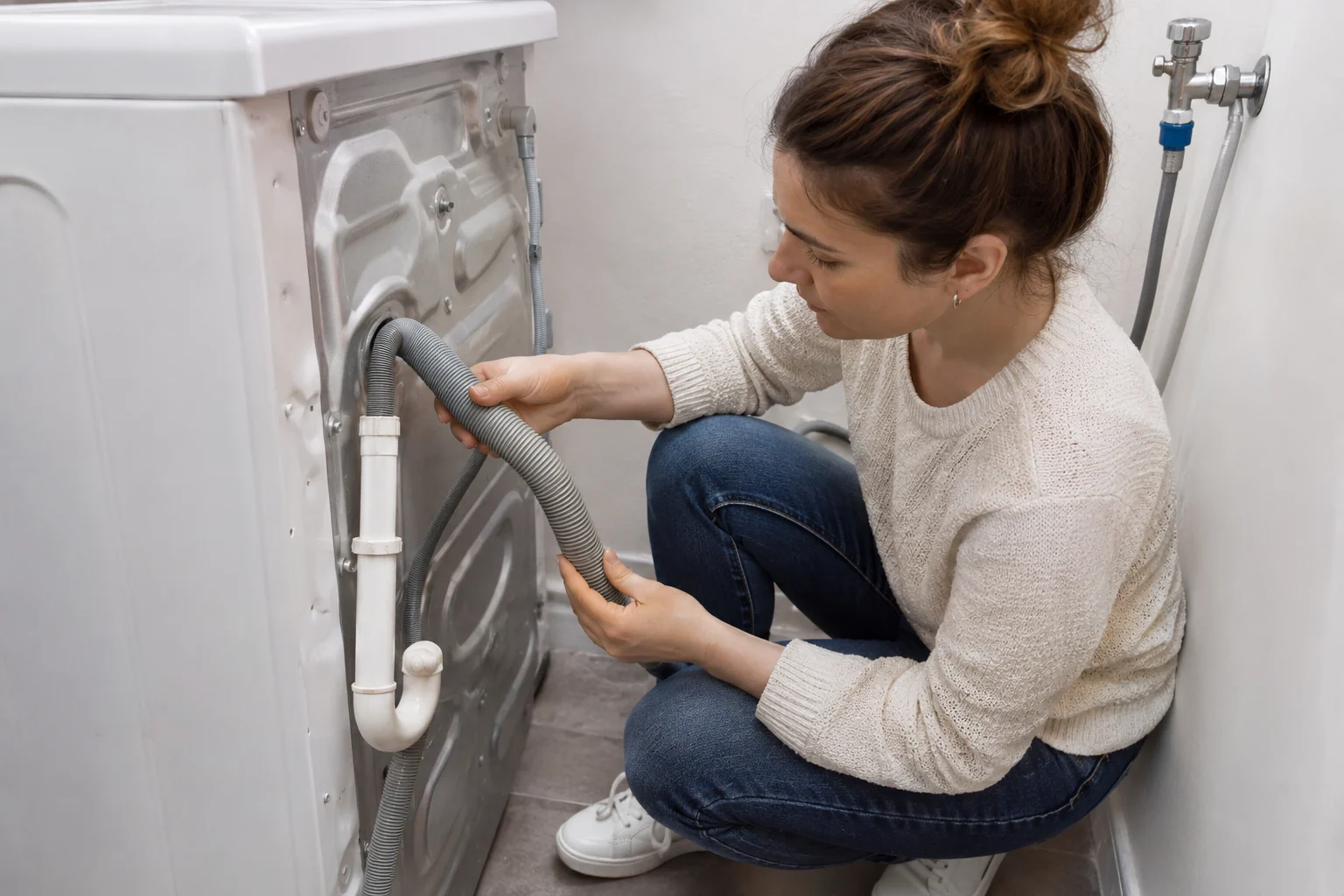
Follow the drain hose from the cabinet to its outlet. Look for a crushed bend, a blocked standpipe, or a hose shoved too far into the drain. Compare installation height and insertion depth with the washer manual; there is no universal dimension for all machines. If the hose can be detached safely with the appliance unplugged, check it for obstruction without blowing debris back into the washer.
Repeat one short drain test
Reinstall the filter and hose securely, dry the floor, and keep the electrical plug and outlet away from water. If the machine is safe to operate and the manual permits, run a short Drain or Spin/Drain cycle while observing externally. Do not leave it unattended. Water should leave through the hose without a leak. If draining resumes after removing a clear obstruction, monitor a later normal cycle; one successful test is encouraging, not proof against an intermittent fault.
If the hum remains and water does not leave, stop. The pump may be jammed internally, its motor may be defective, or it may lack the correct control signal. A multimeter resistance reading with the appliance unplugged can reveal an obvious open or short only when compared with the exact service specification and after isolating the pump. It cannot verify the pump's performance under load. Live voltage probing inside a washer is for qualified technicians with the correct safety equipment.
When the filter is clean
Do not buy a pump solely because the filter is clear. The restriction could be in the tub-to-pump hose, pump outlet or household drain. Some machines use an anti-flood system or control logic that changes pump behavior. Accessing internal hoses usually requires moving the appliance and can release hidden water. If the external checks do not identify the cause, record the model number, code, noise timing and water level for a service technician.
Stop and seek help if the machine leaks near wiring, trips a breaker, has a damaged power cable, or requires dismantling beyond your competence. Do not bypass a door interlock, float switch or thermal protection. If water has reached an electrical outlet, leave the area safe and have it inspected.
Questions that prevent a wrong replacement
Does humming prove the pump receives power?
No. First verify that the sound comes from the drain stage and location. A motor sound can suggest activity but cannot establish correct voltage or current at the pump.
Can I test the pump by running it outside the washer?
Do not connect a loose pump directly to mains as a home test. Model differences and exposed electrical parts make that hazardous. Use a qualified service method.
Why does the machine drain after I clean the filter but fail again?
Residual debris may move into the impeller or hose, the seal may leak, or the fault may be intermittent. Repeat the external inspection and document the conditions rather than replacing parts by guesswork.
Sources consulted
Consulted 4 November 2026: Bosch owner support: washer manuals and model-specific maintenance; Fluke: safe interpretation of resistance measurements. Use the manual for your exact machine before opening a filter or detaching a hose.
Be the first to leave a comment.