A washer that drains slowly without an error code usually needs a flow-path check before a pump replacement. Compare what happens during a normal Drain program: does water leave continuously, arrive in surges, or stop before the drum is empty? Begin with the visible drain hose and household standpipe, then clean the user-accessible filter following the exact model manual. A partial restriction can still let a little water through and may never trigger a displayed fault.
This guide concerns a machine that does remove some water but takes longer than its usual behavior, leaves a small amount behind, or pauses before spin without showing a fault. A machine with no outflow and a distinct hum needs a different branch. Cycle duration alone is weak evidence because load balance, program choice and the machine's sensing logic can change it.
Establish a repeatable observation
Record the model, program, approximate load, whether the issue occurs every time, and the visible water level at the start and end of a Drain or Spin/Drain operation. Use the same program for comparisons. Observe the outlet only where it is safely visible; do not detach a hose while the washer is running. If the machine has a display, note any message even if there is no error code. A slow drain is a symptom, not a pump diagnosis.
| Observation | Possible area | Next action |
|---|---|---|
| Flow starts strong then weakens | Moving debris or a restricted outlet | Inspect filter and hose after unplugging |
| Flow is weak throughout | Partial blockage, poor hose route or pump wear | Check external route and user filter first |
| Water returns to drum after pump stops | Drain installation or backflow | Compare hose height and insertion with manual |
| Household sink or standpipe also drains slowly | Building plumbing restriction | Seek plumbing help before replacing washer parts |
| Flow looks normal but spin is delayed | Load balance or another cycle condition | Check load and program rather than assuming drainage fault |
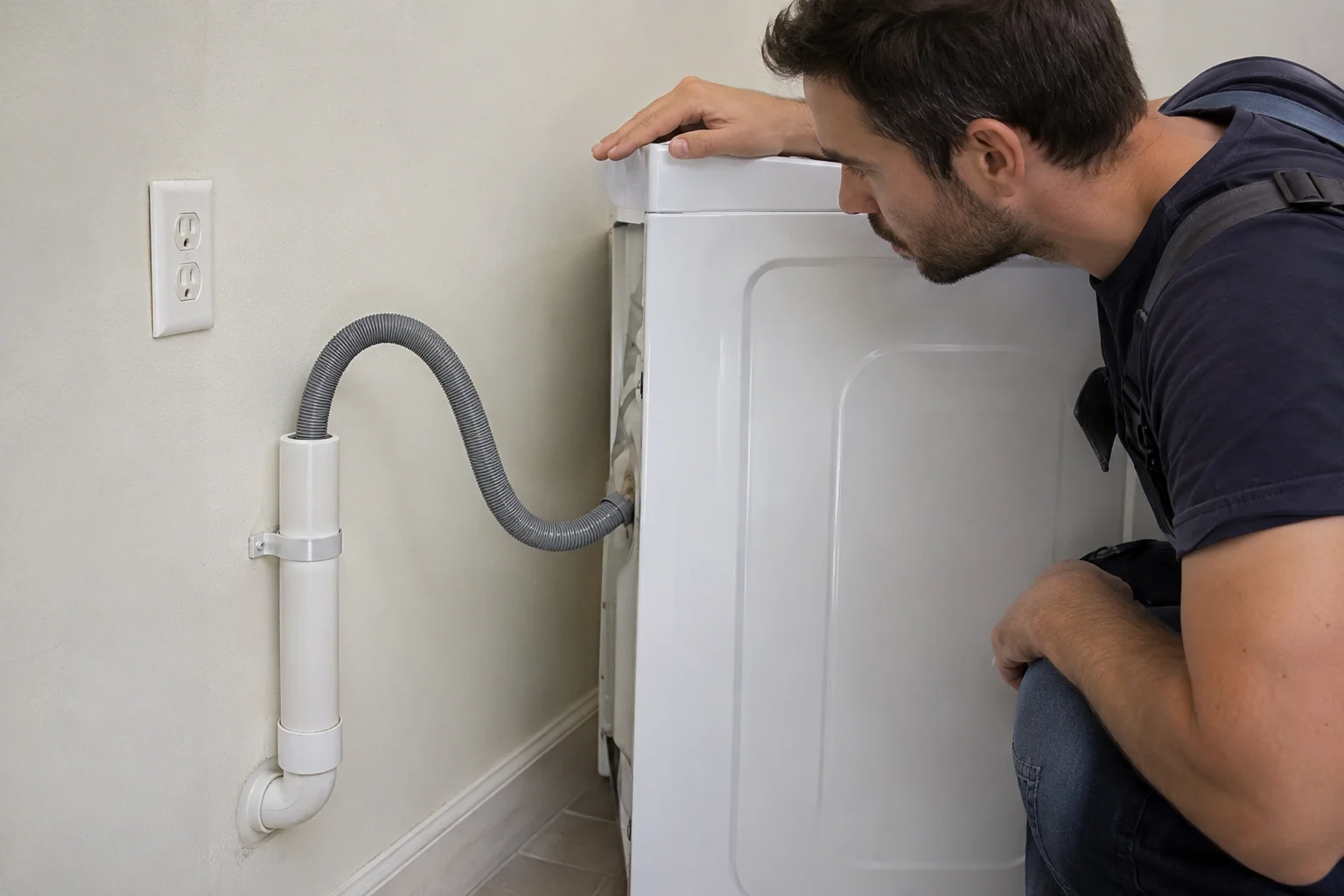
Inspect the visible hose and household drain
Stop the machine, unplug it and move it only with help if heavy. Follow the hose from cabinet to standpipe or sink trap. Look for a crushed section behind the machine, a tight bend, a blocked or submerged end, or an improvised extension. The manufacturer manual sets the permissible drain height, hose depth and routing for the exact model. Too low or poorly sealed installations can cause siphoning or backflow; too high a lift can challenge the pump. Do not apply a generic height number to every washer.
If the household drain is slow independently of the washer, a plumbing restriction may be responsible. Do not pour aggressive drain chemicals into the washer or its hose. If a hose is detached, collect residual water in a tray and resecure the connection before testing. A loose hose can flood the floor when the pump next starts.
Clean the user-accessible filter safely
Prepare the water and temperature
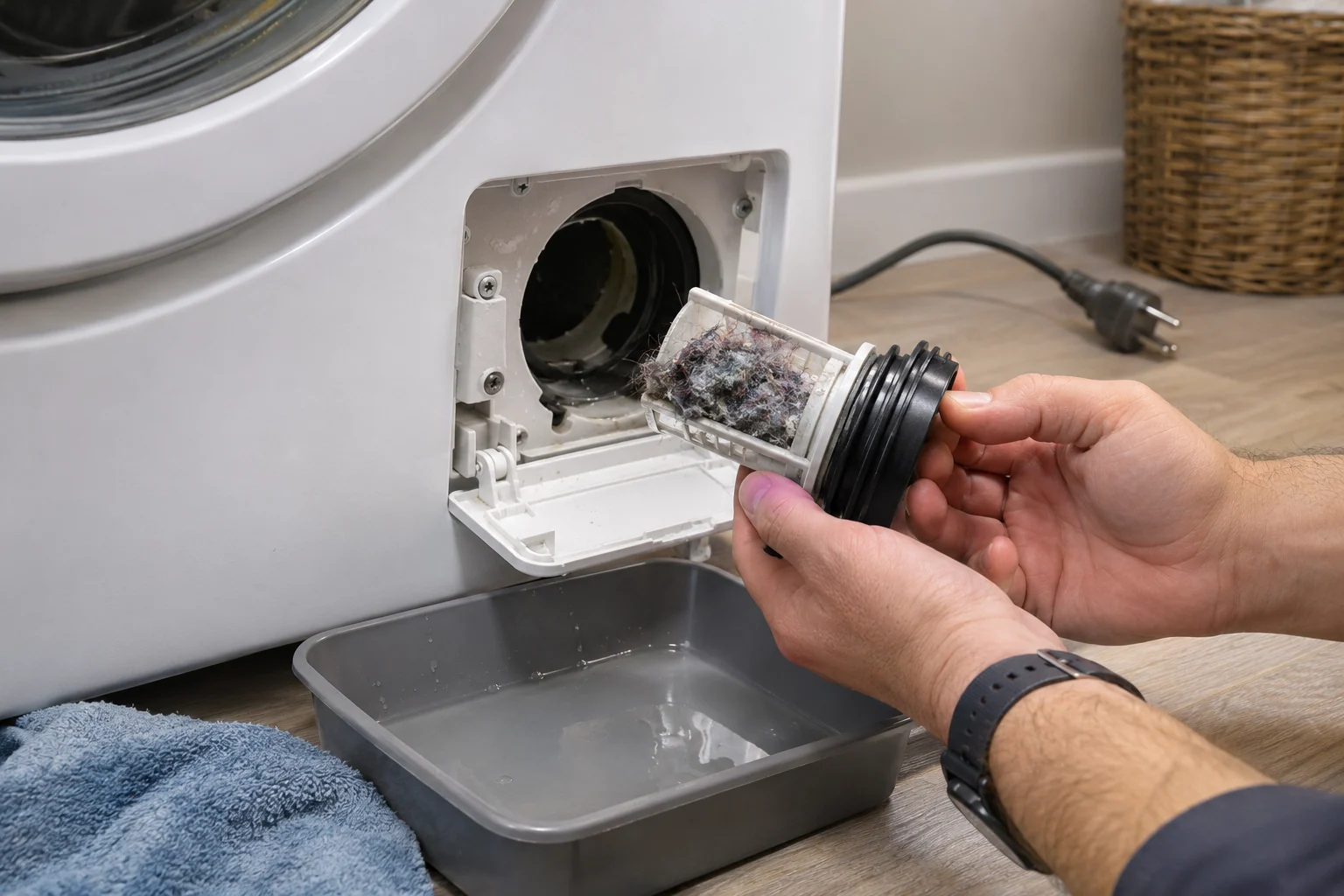
Unplug the appliance and let hot wash water cool. Put a shallow tray and towels beneath the filter. If the model provides a separate emergency drain hose, use it as instructed. Open the filter gradually because even a slow-draining machine can retain more water than the tray holds. If water threatens an outlet or wiring, stop and isolate the area.
Inspect rather than only rinsing
Remove lint, coins, buttons and threads. Look through the opening for visible debris near the impeller only if the manual allows that access. Check the filter seal and seating face. A small object may intermittently obstruct flow without fully blocking it. Do not force the impeller or reach into hidden parts.
Reassemble and compare the same cycle
Reinstall the filter fully, reconnect any emergency hose, dry the area and run the same Drain program with the outlet secured. Observe externally for leakage and compare the outflow pattern with the original observation. If flow improves, monitor a later normal load as confirmation. If unchanged, do not keep repeating cycles: move to the next diagnostic branch.
What a bucket or timing comparison can and cannot show
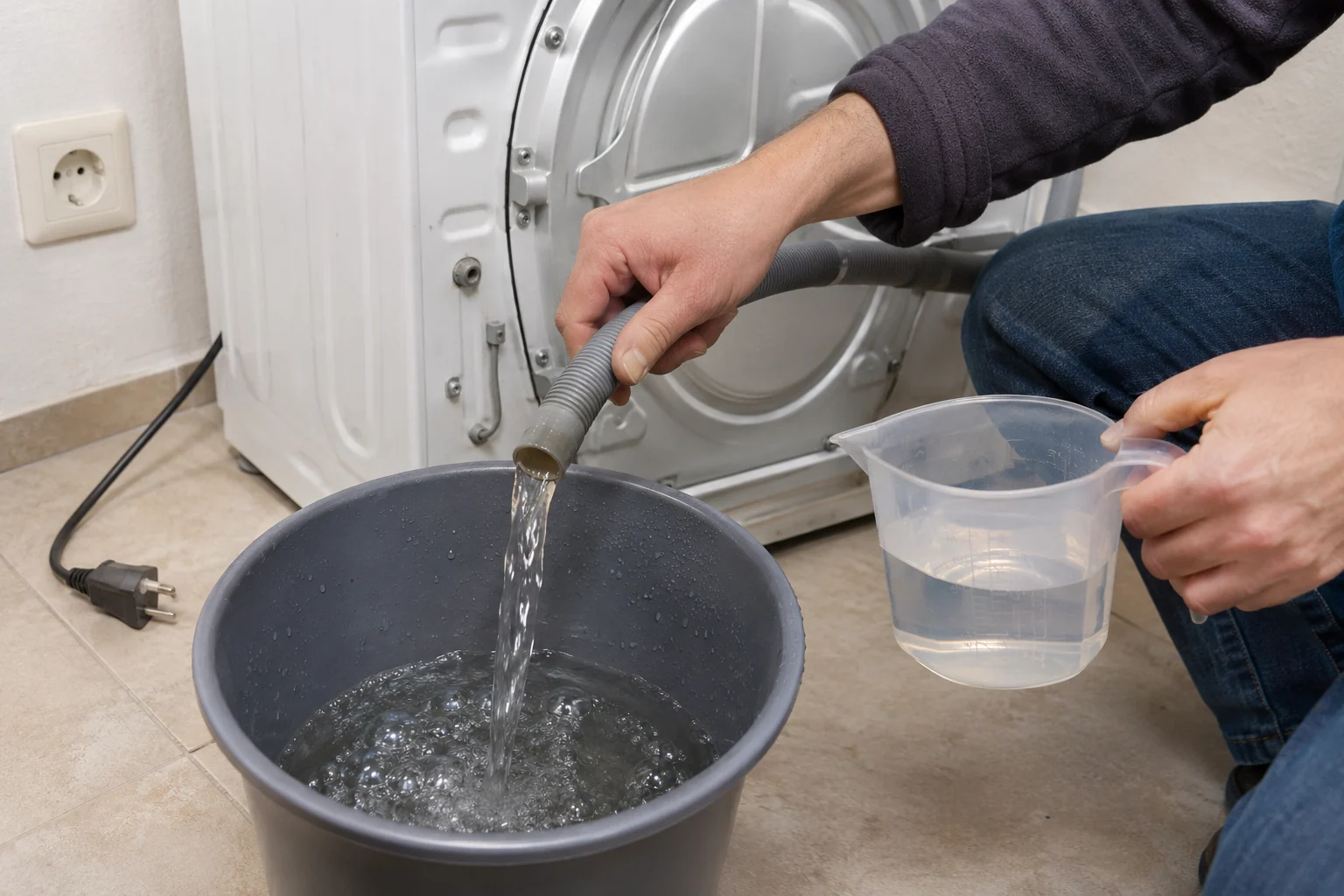
Some service procedures use a securely positioned hose to observe discharge into a suitable container. Follow the exact manufacturer's method and never run the washer with an unsecured outlet or an undersized bucket. A safer home check is to record the flow pattern at the normal standpipe during two comparable drain cycles. Note whether the stream is continuous and whether water remains at the end. Do not invent a universal liters-per-minute target: pump, water level, hose geometry and program differ by model.
With the machine unplugged, a detached hose may release residual water into a tray. That only shows water present in the hose; it is not a live pump-flow test. If a household standpipe backs up while the washer outlet is flowing, address the plumbing rather than assuming the appliance motor is weak.
When external checks are clear
A restriction may remain in the tub-to-pump hose, pump outlet, non-return valve or household pipe. Some designs can also accumulate detergent residue or small textiles. Internal inspection requires moving panels and may release stored water; consult a qualified service technician if you cannot identify components and safely isolate the machine. A pump can rotate but deliver insufficient flow, while an electrical resistance reading alone cannot establish hydraulic performance.
Do not replace the pump because of one long cycle. Ask the technician to document the inlet path, outlet route, pump condition and model-specific control behavior. The absence of an error code does not mean the drainage system is healthy; it simply means the controller has not reported a recognized fault under that program's conditions.
Practical questions
Can too much detergent slow drainage?
Excess foam and residue can complicate washing and leave buildup, but do not assume detergent is the sole cause. Use the dose and type required by the machine, then inspect the physical drain path.
Why does a small load drain normally but a large load does not?
Compare the actual water level and program. Load balance may delay spin even if drainage is adequate. If outflow itself weakens with more water, a partial blockage or hose issue deserves investigation.
Is a little water in the filter housing normal?
Some designs retain residual water in low hose sections. The decisive observation is whether the drum empties and the machine finishes the selected cycle as the manufacturer describes.
Sources consulted
Consulted 4 November 2026: Bosch owner support for model-specific washer instructions; Fluke on the limits and safety of resistance checks. Consult the manual for the exact washer before adjusting the drain installation or opening a service panel.
Be the first to leave a comment.