Bosch dishwasher code E15 means the leakage-protection system has detected water in the appliance base. Bosch instructs users to turn off the water inflow, switch off the appliance, and contact support. The code does not identify the leak source by itself: a seal, fitting, hose, pump, tub, or overflow can all send water into the lower tray.
This procedure is a safe observation method, not an invitation to work live or bypass the float. Do not tilt the appliance to make the code disappear temporarily; water can reach electrical parts while the original leak remains active.
Decision guide
| Observation | Meaning | Action |
|---|---|---|
| E15 with drain pump running | Safety float is raised by water in the base | Close the tap and isolate electrical power |
| E15 after filling | Possible inlet, water matrix, or tub leak | Do not restart; record the exact timing |
| E15 during washing | Hose, pump, tub seal, or spray issue possible | Arrange targeted professional inspection |
| E15 after visible overflow | Foam, door seal, or loading issue possible | Absorb water without returning to service |
Detailed procedure
1. Make the appliance safe
Close the water inlet tap immediately. Stop the dishwasher and unplug it only if the plug is accessible without crossing a wet area. Otherwise isolate the circuit at the panel. Never touch a plug or cable with wet hands.
2. Confirm model and code
Photograph the display and rating plate. Read the manual for the exact model because access procedures differ. E15 indicates active leakage protection; it does not automatically prove that a particular pump or seal has failed.
3. Protect the floor and observe
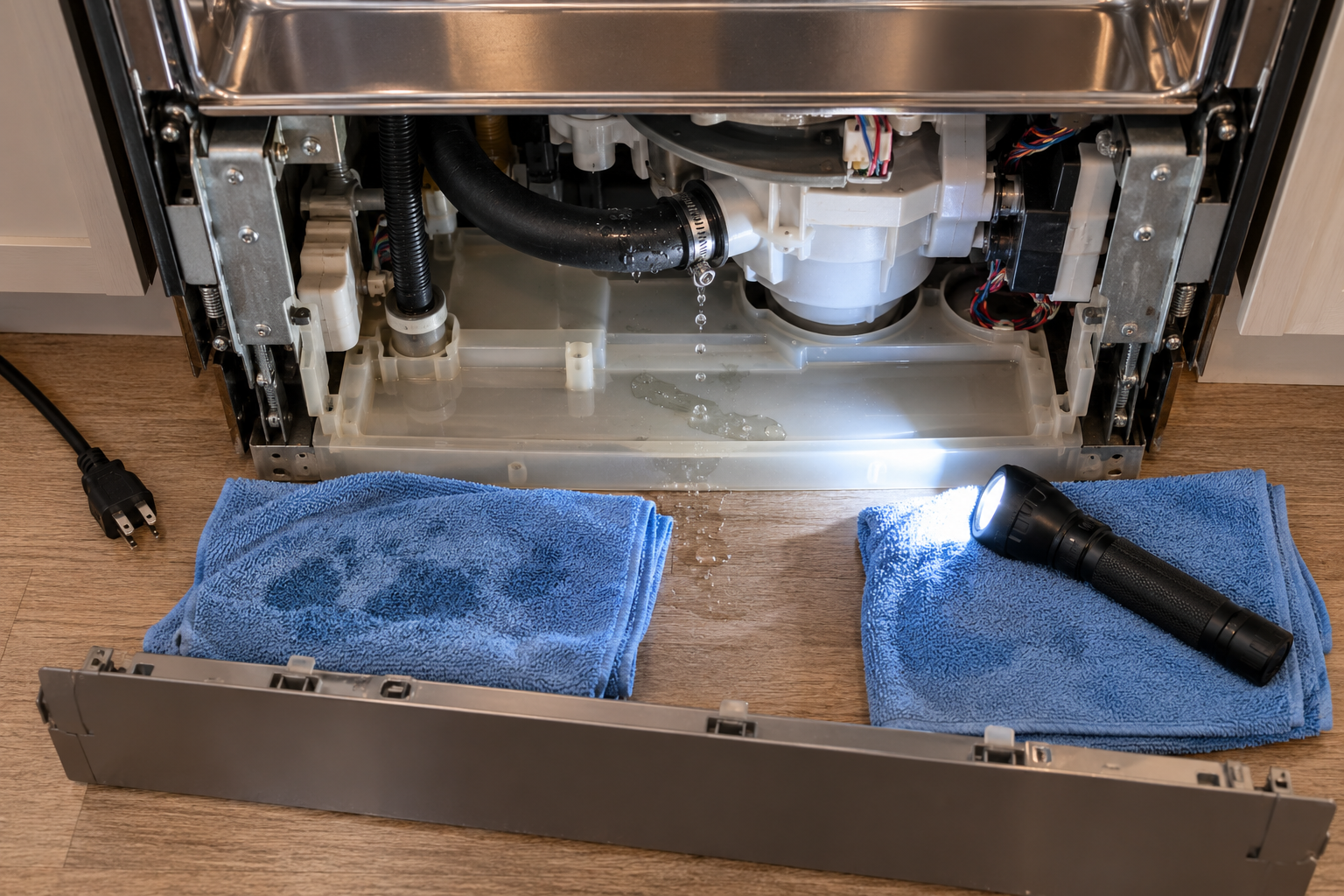
Place towels around the plinth without pushing the appliance. Look for an external leak at the tap, inlet connection, drain hose, or sink trap. A leak outside the cabinet can sometimes be identified without removing a panel.
4. Do not tilt to reset
Tilting can move water away from the float and temporarily clear the code. It does not repair the leak and may send water toward wiring or the floor. Treat a temporary return to normal as misleading rather than successful.
5. Record when the leak appeared
Note whether E15 appeared while idle, filling, washing, draining, or at the end. This timing helps distinguish inlet, circulation, drainage, door-seal, and excessive-foam possibilities. Do not run another cycle merely to collect this information.
6. Check accessible causes
Without opening the machine, inspect the visible door seal, an item preventing closure, spray-arm position, and use of correct detergent. Excess foam can cause overflow, but it should not be assumed without evidence.
7. Understand the base float
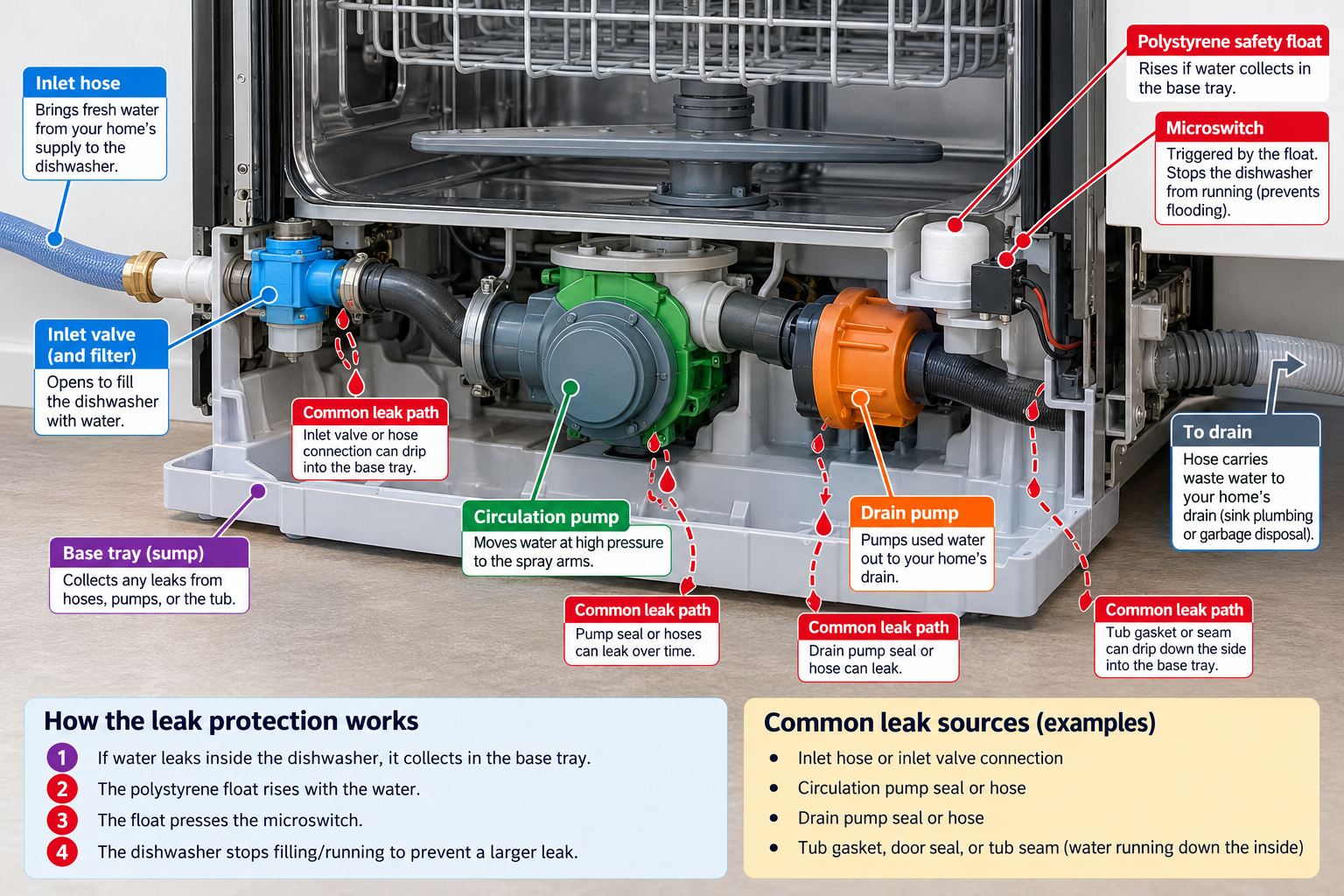
Water in the lower tray generally raises a float that actuates a safety switch. The controller stops filling and may run the drain pump. Drying the tray without eliminating the source silences the protection but does not make the machine safe.
8. Prepare professional service
Provide model, code, timing, photographs, and observations. Request checks of fittings, hoses, circulation pump, drain pump, tub seals, and float mechanism. Internal leak tracing must be performed with power isolated by a competent person.
Possible water sources
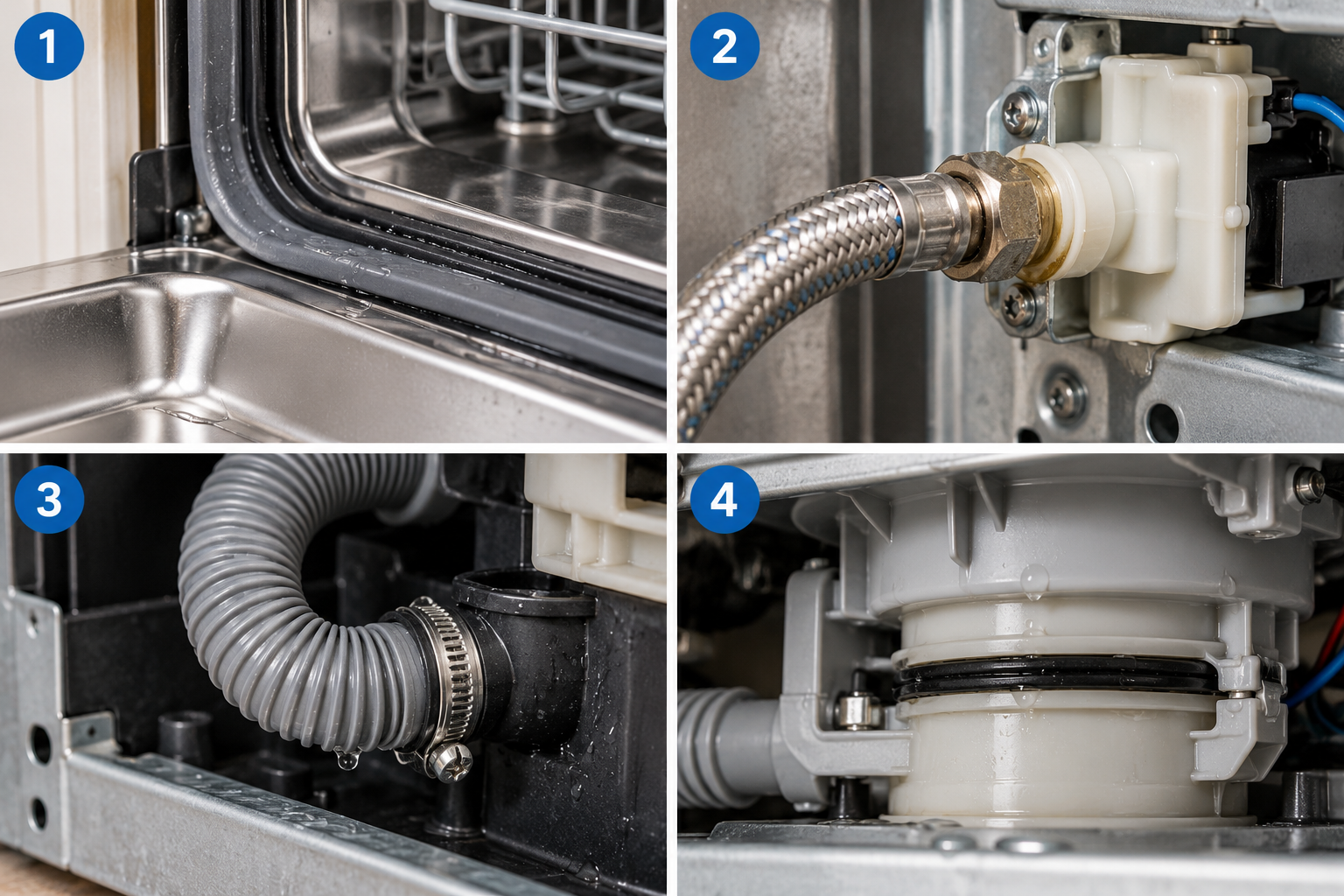
| Area | Possible clue | Action |
|---|---|---|
| Water inlet | Moisture at the connection or during filling | Close tap and inspect fitting and valve |
| Door seal | Track on fascia or lower corners | Check cleanliness, deformation, and closure |
| Hoses and clamps | Drops below tub during circulation | Power-off internal inspection |
| Pump or sump | Water centred below hydraulic assembly | Inspect seals and pump body |
The cutaway image illustrates the general principle rather than the exact geometry of every Bosch model. The manual and exploded view for the appliance E-Nr remain authoritative.
Verification method and traceability
Define the expected result
Before every action, record what you are trying to confirm, the starting condition, and the expected result. This prevents a coincidence from becoming a diagnosis. Photograph the initial state, preserve exact references, and change one parameter at a time. If a measurement conflicts with observed behaviour, repeat it with another comparison point before deciding.
Keep usable evidence
Record values with units, instrument setting, approximate temperature, and corresponding step. A screenshot or photograph should show context rather than an isolated number. These notes make it possible to resume diagnosis, compare results after repair, and give a professional precise information instead of a vague description.
Recognise limitations
A simple check may not reproduce operation under load, at temperature, or after repeated cycles. An intermittent fault can disappear during inspection. A theoretical result depends on tolerances and assumptions. When safety, irreplaceable data, or hazardous voltage is involved, the correct decision may be to stop and hand the next step to a specialist.
Final control
After the intervention, return every guard, cable, and connector to its intended position. Confirm that no tool remains and no safety function has been defeated. Perform a limited supervised test, then compare the outcome with the original symptom. One successful run is not always sufficient evidence that a fault is resolved.
Frequently asked questions
Can I simply dry the base?
Not as a repair. Drying may deactivate the symptom while the source continues leaking.
Why does the pump run continuously?
The protection program may command draining while the float reports water in the base.
Should I remove the plinth?
Follow the manual and local rules. Bosch recommends closing the water and contacting service; panels can expose wiring and sharp edges.
Technical sources
Information that helps the service technician
Provide the complete E-Nr and FD numbers, the displayed code, whether the drain pump continued running, and the stage at which the fault appeared. Mention recent installation work, a moved appliance, a replaced hose, unusual foam, or water observed outside the cabinet. Clear photographs of the floor, visible connections, and the display are more useful than removing panels without a documented procedure.
Do not reconnect the water merely to reproduce the leak. A small seep can become a larger escape under pressure, and repeated operation can expose the pump, wiring, or floor to more water. Keep the tap closed until the appliance is inspected. After repair, the technician should confirm the leak source, dry the base safely, check protective operation, and run a supervised test. Ask what failed and which parts were replaced so a recurring installation or detergent problem is not overlooked.
Be the first to leave a comment.