White glasses after a dishwasher cycle do not all have the same cause. A removable chalky film usually points to mineral scale, salt or detergent residue; a blue-white film that wipes away can indicate too much rinse aid; a uniformly cloudy surface that does not change when cleaned may be permanent glass corrosion. Diagnose the surface before changing every setting. The useful sequence is: compare affected items, perform a gentle wipe test outside the machine, confirm local water hardness, then check salt, rinse aid, detergent, loading, filters and spray arms one variable at a time.
First identify the kind of white mark
| Appearance | Simple observation | Likely branch |
|---|---|---|
| Powdery white spots or rings | Partly wipe away with a damp cloth | Minerals, salt or detergent residue |
| Blue-white streaks | Wipe away; surface feels slick | Rinse-aid setting may be high |
| Even milky haze | Does not change after gentle cleaning | Possible glass corrosion |
| Food film on several items | Texture or particles remain | Loading, filter, spray or program |
Inspect several items under side light. If only one old or delicate glass is cloudy while new dishwasher-safe glasses are clear, the material itself is a stronger clue than a machine-wide fault. If plates, cutlery, the tub and every glass carry the same removable white film, water treatment or dosing becomes more likely. Do not scrape glass with a blade or abrasive pad.
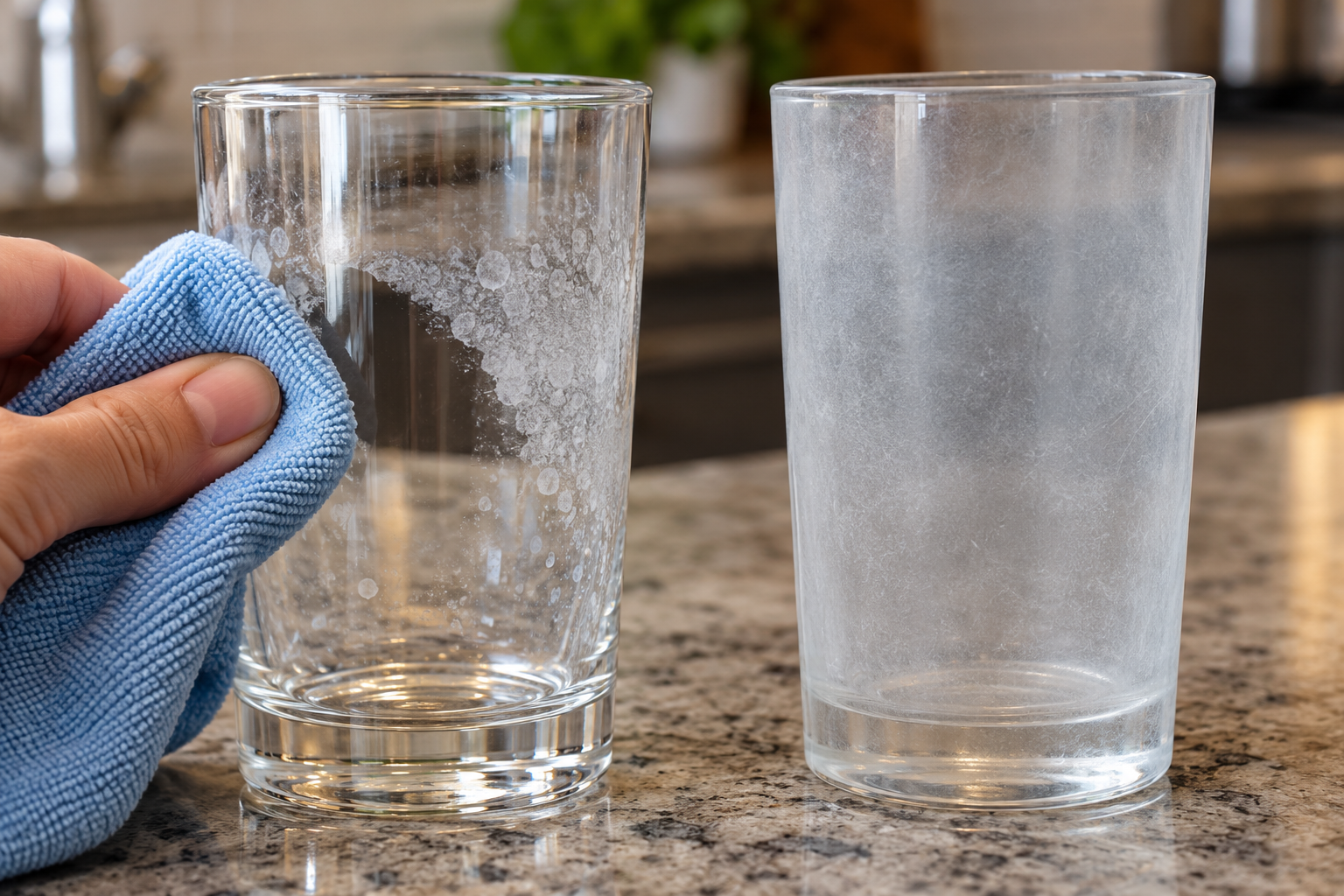
Deposit or irreversible glass corrosion?
Use a clean damp microfiber cloth on a small area of a cool glass outside the dishwasher. If the patch becomes clear, the mark is on the surface. Follow the glass manufacturer’s cleaning advice; do not pour homemade acid mixtures into the dishwasher. Bosch warns that homemade rinse aids such as white vinegar may damage the appliance and affect warranty coverage. If the haze cannot be removed and appears within the glass surface, Miele describes this as glass alteration on items unsuitable for repeated dishwasher washing.
Corrosion cannot be restored by adding more salt or stronger detergent. High temperature, long exposure, very soft water, aggressive detergent and glass composition can contribute. Protect remaining glassware by confirming it is dishwasher-safe, using the model’s glass or low-temperature program, avoiding overdosing and unloading after the cycle. Stop testing valuable crystal in the machine.
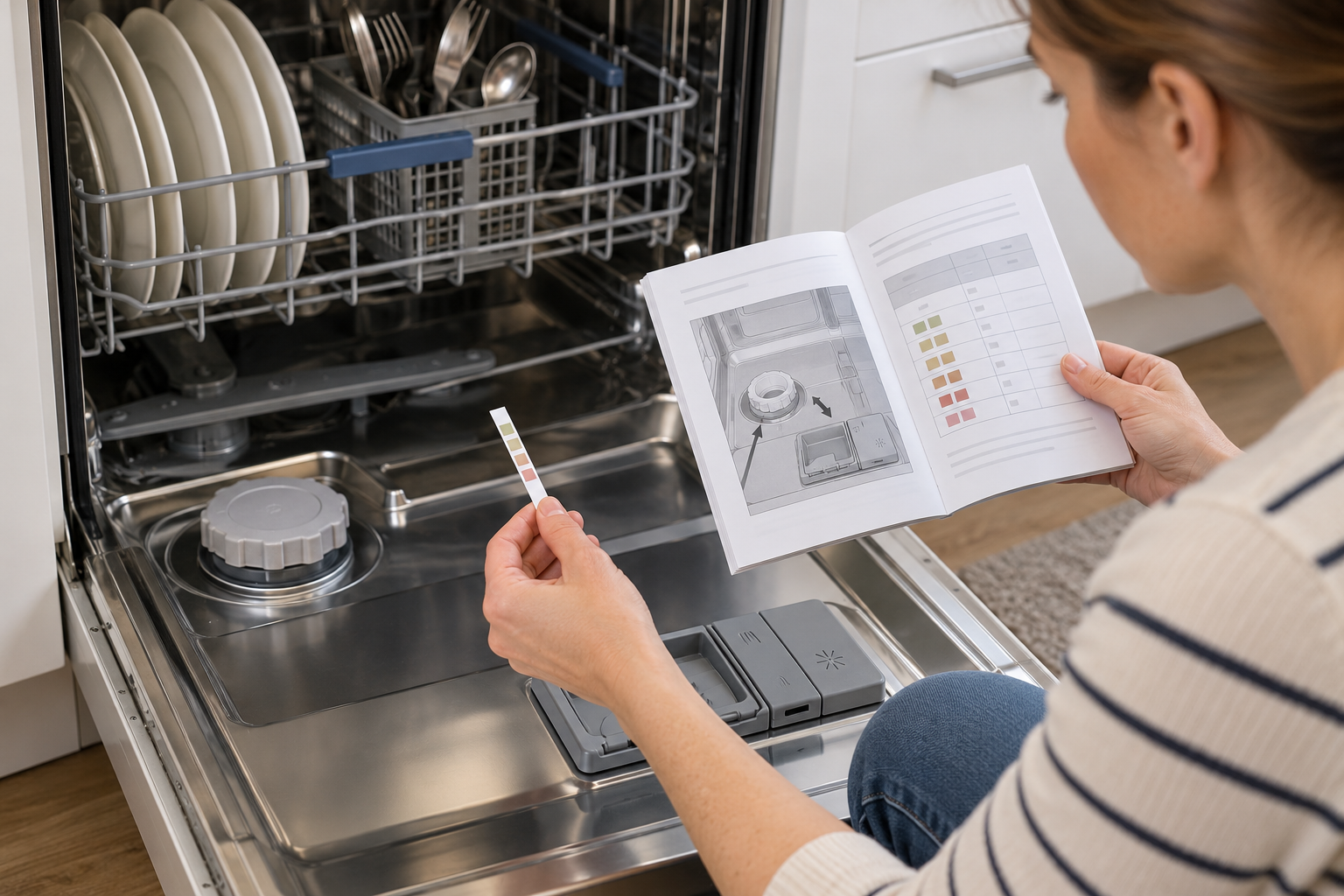
Match the water-hardness setting
The built-in softener must be set to the actual supply hardness. Obtain the value from the water supplier or a suitable test strip, then convert it only with the table in the exact dishwasher manual. Units differ: French degrees (°fH), German degrees (°dH), mmol/L and mg/L as CaCO3 are not interchangeable numbers. A guessed setting can leave scale when too low or waste salt and increase salt carryover when inappropriate.
| Finding | Change | Retest |
|---|---|---|
| Hard water, scale wipes away | Set softener to measured hardness; refill proper dishwasher salt | One normal load with known clear glasses |
| Soft water, persistent residue | Check detergent dose and rinse-aid level | Change one setting only |
| Blue sheen wipes away | Reduce rinse-aid one step if manual permits | Observe drying and streaks |
| Haze never wipes away | Protect glassware; do not chase with chemicals | Test a new dishwasher-safe glass |
Check the salt reservoir correctly
Use only regenerating dishwasher salt, never table salt. Confirm the cap is clean, seated and tightened according to the manual. Crystals or brine spilled into the tub can leave residue or damage metal; follow the manufacturer’s instruction for filling and run the specified rinse or program immediately after a spill. Whirlpool links white film to an incorrect salt-reservoir setting, while Bosch associates surface deposits with hard water, excess detergent or salt in the tub.
An all-in-one tablet does not automatically make the softener irrelevant in every water area. Bosch notes that additional rinse aid or salt may still be needed with hard water. Follow the appliance settings for combination detergent rather than disabling indicators at random. A salt warning that remains on can reflect filling technique, delayed sensing or a model-specific setting—not proof that the softener valve is faulty.
Adjust rinse aid without creating another problem
Rinse aid helps water sheet off the glass and improves drying. Too little can leave droplets and mineral rings; too much can create wipeable bluish or whitish streaks. Miele identifies excessive rinse-aid dosage when glasses and cutlery show a blue reflection and the film can be wiped away. Move only one level at a time and keep detergent, program and load constant for the comparison cycle.
Do not fill the rinse-aid compartment with hand dish liquid, vinegar or an improvised product. Wipe any spill before closing the door. If glasses are dry but streaked, reducing the dose may be justified; if they remain wet with water spots, the opposite branch may apply. The manual’s range and local water hardness take precedence over a universal number.
Detergent dose, program and temperature
More detergent is not necessarily cleaner. Excess powder or a tablet that does not dissolve fully can leave a white film, especially on a short or cool program. Too little detergent in hard water can also allow minerals and soil to redeposit. Use dishwasher detergent, dose for hardness and soil, keep the dispenser dry, and ensure a tall plate does not block its lid. Place tablets in the dispenser, not loose in the basket unless the manual explicitly says otherwise.
Choose a program long enough for the load. Short cycles are designed for particular soil levels and may not dissolve every product well. For delicate glasses, use a glass-care or lower-temperature program when available. Avoid repeatedly washing non-dishwasher-safe crystal at high temperature. Compare one controlled load instead of changing brand, dose, temperature and rinse aid together.
Restore water circulation
White residue mixed with food particles or uneven cleaning can come from weak spray coverage rather than chemistry alone. Switch off the dishwasher, remove and clean filters as the manual describes, check that spray arms rotate freely, and inspect each jet. Rinse a removable arm under water; use only a non-damaging method permitted by the manufacturer. Do not enlarge holes with a drill or metal spike.
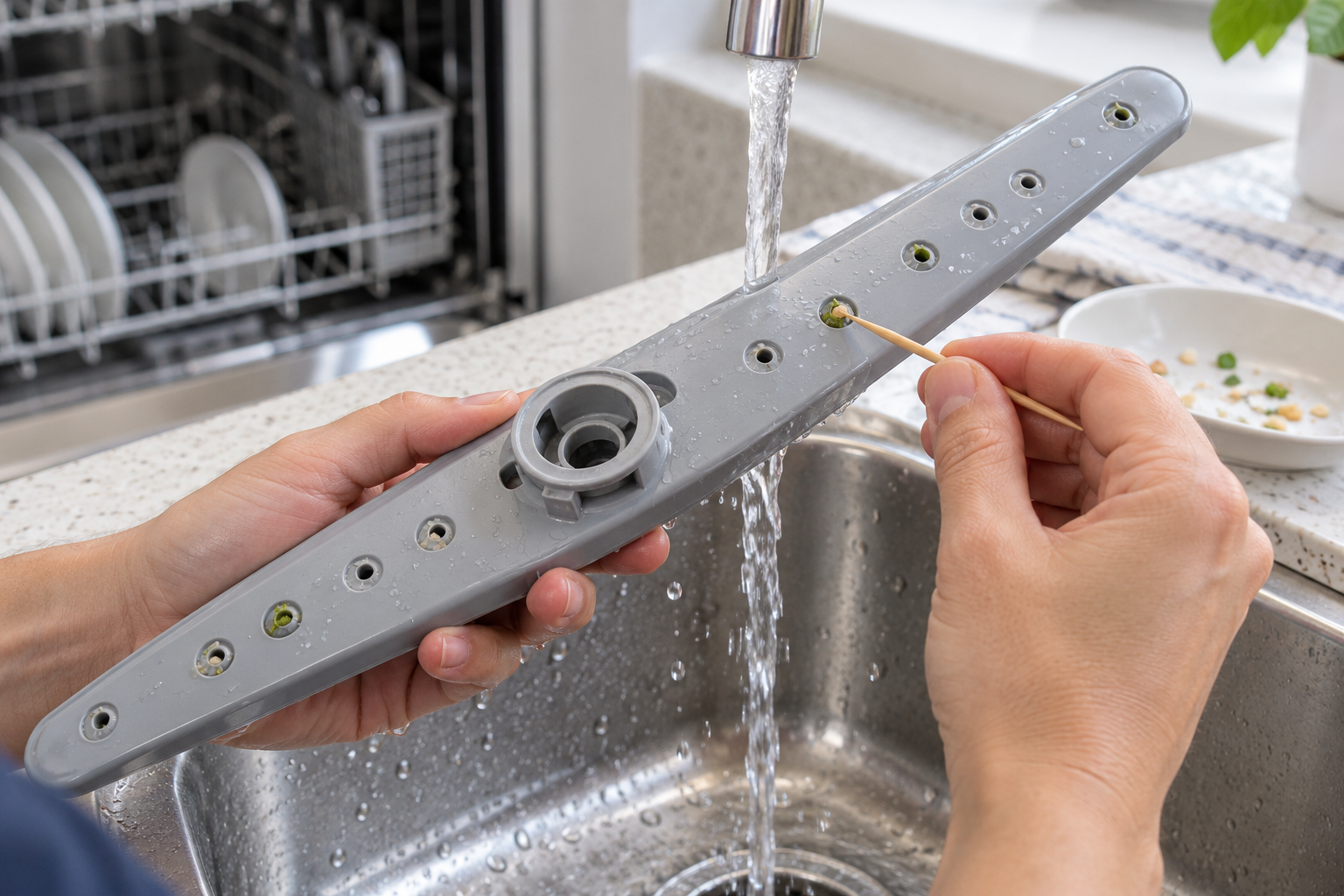
Load glasses so they do not touch, face downward and receive spray without trapping water. Keep tall utensils and plates away from the spray path and dispenser. If one rack cleans and the other does not, check its arm, feed tube and docking connection. If the machine also leaves standing water, follow the separate dishwasher drainage guide before judging wash chemistry.
A one-variable diagnostic cycle
- Photograph the residue and mark two known dishwasher-safe test glasses.
- Perform the gentle wipe test outside the appliance.
- Measure or obtain water hardness and confirm the softener setting.
- Inspect salt cap, rinse-aid level, dispenser, filters and spray arms.
- Load normally with clear spray paths.
- Use the recommended full program and correct detergent dose.
- Compare the two glasses immediately after drying.
If the film improves, keep the successful setting and observe several loads before changing anything else. If all deposits remain removable, revisit hardness, dosing and water circulation. If only previously damaged glasses stay opaque, corrosion is the likely explanation. If new suitable glasses rapidly become permanently hazy despite correct settings, contact manufacturer support with model, hardness, program and product details.
Interpret where the residue appears
Location is evidence. Rings where droplets dried suggest poor sheeting; powder over glasses, plates and the tub suggests a system-wide water or product issue; marks only inside deep glasses suggest trapped rinse water; residue limited to one rack points toward its spray arm, feed connection or loading. Swap two identical test glasses between racks without changing any setting. If the fault follows one glass, its material or previous damage is likely. If it stays with one position, circulation deserves attention.
Inspect the tub before cleaning it. Crust around the salt cap suggests checking its seal and any spill. Undissolved granules near the dispenser suggest a wet compartment, blocked lid or unsuitable short program. A greasy white film that smears rather than powders combines soil and detergent, often with a loaded filter or insufficient program. Photograph the pattern so useful evidence is not lost.
Controlled results and what they mean
| Result | Interpretation | Next action |
|---|---|---|
| New glass clears after wiping | Surface deposit | Correct hardness and dosing |
| Old glass stays hazy; new glass stays clear | Previous glass damage | Protect suitable replacements |
| Both racks show powder | System-wide water/product issue | Check softener, salt cap and dose |
| Upper rack only | Local spray or loading issue | Inspect upper arm and feed dock |
| Blue streaks after higher rinse aid | Likely excess dosage | Return one step and retest |
One cycle cannot certify a failed softener, heater or circulation pump; it narrows the branch. A softener fault requires model-specific checks. Weak heating can also leave greasy soil and poor drying. Weak circulation can result from loading, blocked jets, filter restriction or a pump problem. Escalate with model, measured hardness, exact settings, products and photographs rather than ordering a component from appearance alone.
Prevent recurrence without damaging the appliance
Keep the hardness setting documented, close product caps carefully, wipe spills, store detergent dry, clean filters on the schedule in the manual and verify spray-arm movement after loading. Separate delicate glassware from heavy cookware and keep rims from touching. Choose a glass program for suitable fragile items, and do not leave them for long periods in hot humid air after completion.
Do not treat stronger acid, hotter cycles or more detergent as universal prevention. Manufacturer-approved descaling can help a scaled appliance, but it cannot reverse etched glass and should not be improvised. Recheck hardness after moving house, changing the water supply, installing a household softener or replacing the dishwasher. Those changes can turn a previously correct setting into an excessive or insufficient one.
Common mistakes
- Calling every white mark “limescale” without testing whether it wipes away.
- Increasing salt, rinse aid and detergent simultaneously.
- Using table salt, hand dish liquid or homemade rinse aid.
- Ignoring the unit used for water hardness.
- Trying to remove permanent etching with abrasive products.
- Cleaning jets while the appliance is running or enlarging them with metal tools.
Frequently asked questions
Can cloudy glass become clear again?
A removable deposit can be cleaned and its cause corrected. Permanent etching changes the glass surface and is generally irreversible.
Do all-in-one tablets replace salt and rinse aid?
Not in every water condition or model. Follow the appliance manual and actual hardness; hard water may still require separate products.
Why are only some glasses white?
Glass composition, age, position, spray exposure and dishwasher suitability differ. Compare new dishwasher-safe glasses in different rack positions.
When is service justified?
When settings, products, filters, spray arms and loading are correct but new items rapidly develop deposits, or when softener filling, spray pressure, heating or dosing appears abnormal.
Technical sources consulted
- Bosch France, dishwasher residues, accessed October 31, 2026.
- Electrolux France, white residue, accessed October 31, 2026.
- Miele France, irreversible cloudy glass, accessed October 31, 2026.
- Miele France, wipeable blue-white film, accessed October 31, 2026.
- Whirlpool France, white film on glasses, accessed October 31, 2026.
Be the first to leave a comment.