A dishwasher error code is not a universal diagnosis. The same letters or flashing pattern can mean different things across brands, product families and even revisions of one model. Without the paper manual, the safest method is to preserve the exact display, identify the appliance from its rating plate, retrieve the model-specific documentation, and only then interpret the code. This guide shows how to do that without guessing, clearing useful evidence or opening live electrical compartments.
Answer first: what to record before touching Reset
Photograph the complete control panel while the code is visible. Copy every character exactly, including a colon, dash, leading zero and suffix: E:24, i20, F6 E1 and six flashes are not interchangeable notations. Note whether the display alternates between two values, which LEDs flash, whether an acoustic signal repeats, and the program stage when the fault appeared. Do not convert a symbol into the code you think it resembles.
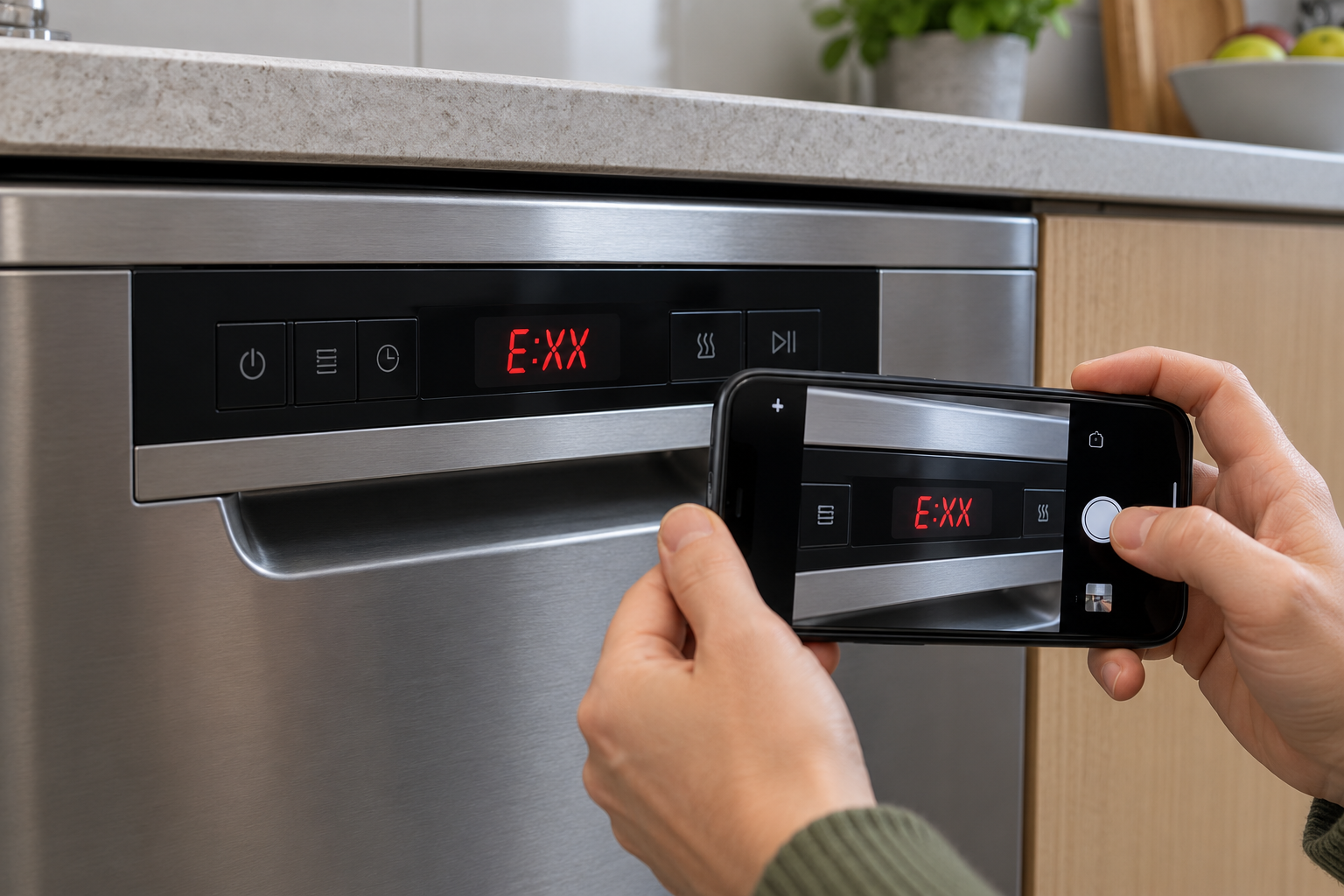
Also record the observable symptom: water still in the tub, no filling sound, pump running continuously, leak on the floor, heating smell, or a cycle that stops after a specific number of minutes. A code is one clue generated by the control; the symptom and timing help test whether the interpretation fits. A code alone does not prove that the named pump, heater, sensor or board is defective.
Safety and immediate stop conditions
Leave the dishwasher switched off and unplugged if there is smoke, a hot plug, an electrical smell, repeated breaker operation, water near the socket, a damaged cable, or visible leakage beneath the cabinet. Close the water supply if a leak continues. Do not lie in standing water to reach the plug. If the appliance is hard-wired, isolation and verification belong to a competent person.
A reset is not a repair for an active leak, insulation fault or overheating. Internal measurements are outside this identification procedure: dishwashers combine mains voltage, heating loads, sharp sheet metal and retained water. Removing the plinth or side panels can also disturb leak protection and expose live parts. The safe scope here is observation, model identification, manufacturer-document retrieval and simple external checks expressly permitted by that manual.
Find the appliance identity, not just the logo
Open the door after the appliance has stopped and look along the door edge or frame. Bosch states that its E-Nr identifies the model and that the complete suffix after the slash matters for documents and parts. Electrolux uses a product number or PNC, commonly an 11-digit Prod.No.; its support page places the dishwasher label on the right edge of the door frame. Whirlpool documentation search uses the commercial code or 12NC, while other brands may use model, service number, product code or serial number.
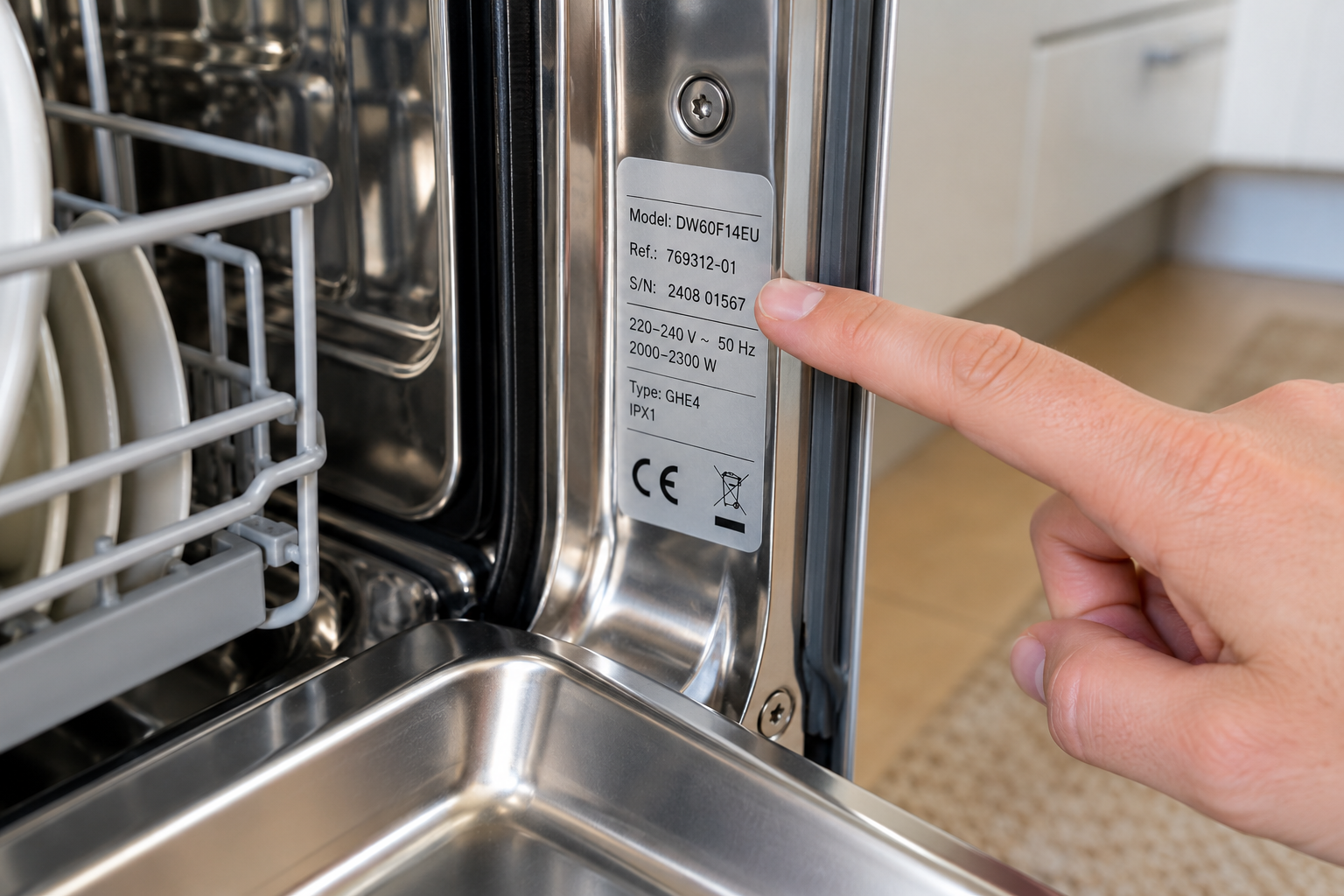
Take one sharp photograph of the whole label before copying values. Preserve spaces, slashes and final digits. Do not publish the serial number in a public forum; it identifies your individual appliance and is rarely required for a general code lookup. A sales name from an invoice may describe a range rather than the exact technical variant.
| Label field | Typical use | Common mistake |
|---|---|---|
| Model / E-Nr | Selects product family and documents | Omitting revision after a slash |
| PNC / Prod.No. / 12NC | Identifies the technical configuration | Copying a short marketing name instead |
| Serial number | Individual unit and production trace | Sharing it publicly as if it were the model |
| FD / production code | Build date or revision context | Treating it as the error code |
Retrieve the correct manual without the paper copy
- Go to the official support or manual-search page for the brand and country where the appliance was sold.
- Enter the complete model or product number from the label, not the code on the display.
- Confirm that the product photo, control layout and document model match your appliance.
- Download the operating manual and, when available, the installation or service-support document.
- Search inside the manual for the exact code, “troubleshooting,” “alarm,” “fault,” or the matching indicator pattern.
- Save the document with the full model reference so it is not confused with another manual later.
Bosch provides a manual finder based on E-Nr. Whirlpool asks for the first digits of the commercial code or 12NC. Electrolux support and product documents use the PNC. Prefer these manufacturer sources over anonymous code lists: a third-party table may combine several generations and remove the conditions, allowed user actions and stop criteria that make an interpretation safe.
Why identical-looking codes can disagree
Error-code namespaces belong to manufacturers and platforms, not to the appliance category as a whole. An “E1” may describe filling on one design, leakage protection on another, or a temperature-related condition elsewhere. Even within a brand, a compact dishwasher, full-size platform and rebadged product can use different electronics. Flash counts can also represent a stored sequence rather than the number printed in a table.
| Evidence level | What it supports | What it cannot prove |
|---|---|---|
| Code only | A condition detected by the controller | The failed component |
| Code + exact model | Correct manufacturer definition | Root cause without checks |
| Code + model + symptom | A justified diagnostic branch | That every item in the branch is faulty |
| Model-specific test result | Evidence for the next action | A safe repair beyond the test scope |
Translate the manufacturer definition into a system, not a part order. “Drain fault” can involve a blocked filter, kinked hose, siphon connection, pump obstruction, wiring, level sensing or control. “Water inlet fault” can involve a closed tap, low flow, inlet hose, valve, flow sensing or wiring. “Leak detected” may be a real leak, residual water in a base tray or a sensor circuit. Each definition starts a branch.
Use the symptom to choose the safe branch
If water remains in the tub, do not keep restarting. Photograph the level, switch off, and follow the model manual for filter access and emergency draining. The Electronix guide on water left in the bottom of a dishwasher explains the difference between normal sump water and failed drainage. For a Bosch E15 specifically, use the dedicated Bosch dishwasher E15 guide; do not generalize it to another brand.
If the pump runs continuously immediately after power-up, leak protection may be active, but the model definition must confirm that branch. If no water enters, verify only the external tap, visible hose condition and household supply permitted by the manual. If heating smell, steam in an abnormal place or breaker operation occurs, stop rather than running a diagnostic cycle.
Build a useful evidence sheet
A short evidence sheet prevents contradictory advice and helps support identify the correct procedure. Record brand, complete model/product number, code exactly as shown, cycle and elapsed time, water state, sounds, leak evidence, actions already attempted and their results. Include only observations, not conclusions such as “pump dead.”
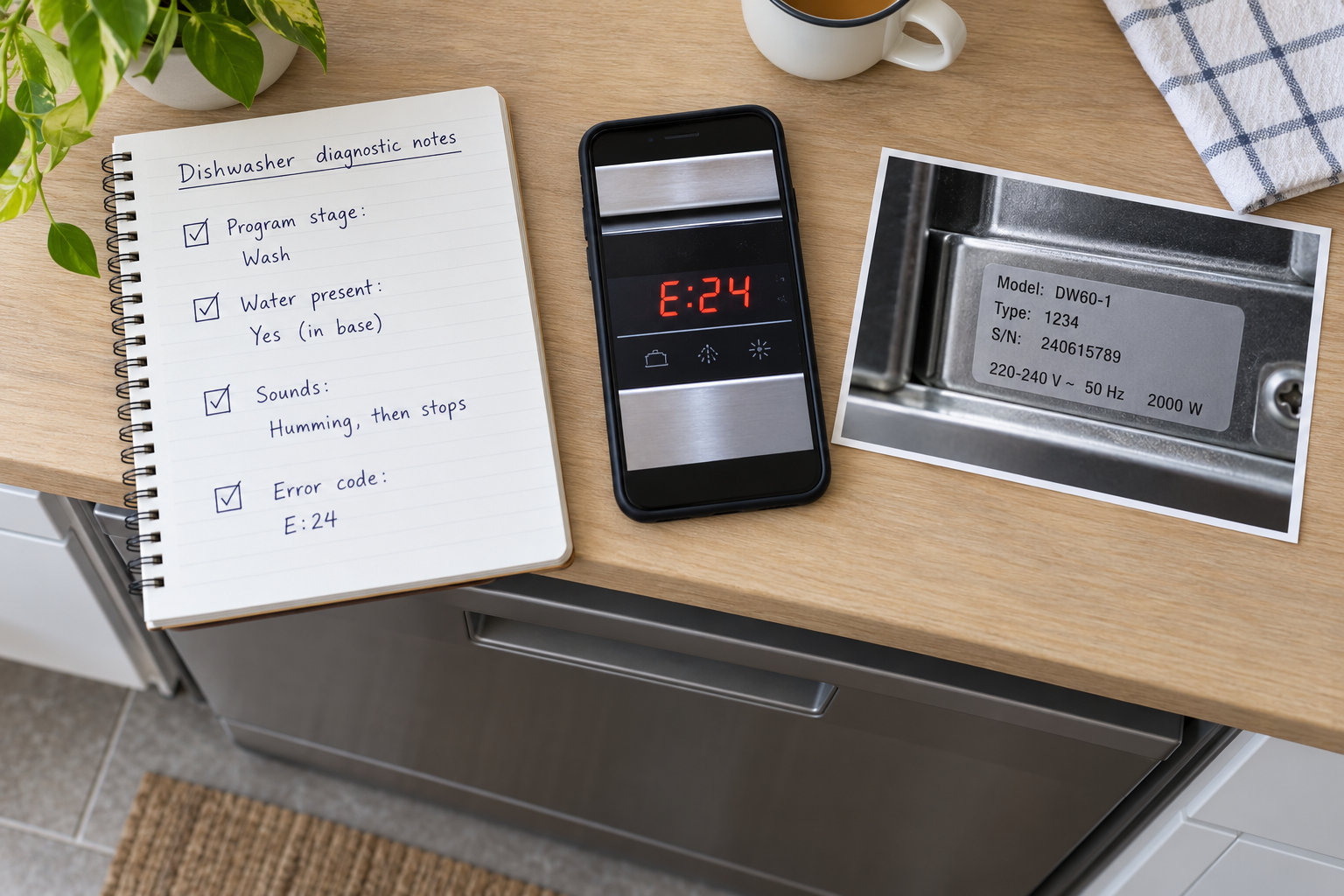
| Observation | Useful wording | Avoid |
|---|---|---|
| Display | “E:24 alternates with -00” | “It says drain error” |
| Timing | “Stops 3 minutes after Start” | “Stops quickly” |
| Water | “Water covers the filter handle” | “Pump broken” |
| Sound | “Low hum for 20 seconds, no flow at sink” | “Motor bad” |
| Reset | “Code returned during same stage” | “Reset did nothing” |
Reset only when the manual allows it
A controlled reset can clear a transient state after an external cause has been corrected, but button sequences differ. Use the sequence printed in the exact manual. Before resetting, preserve the code and any secondary indication. Afterward, run only the manufacturer-recommended check or a short observable program; stop if leakage, overheating, abnormal noise or the same code returns.
Power cycling repeatedly can erase timing clues while leaving the fault unchanged. It may also cause a pump or heater to retry under bad conditions. A code that returns at the same program stage is useful evidence. Record it and move to the documented branch or service, rather than expanding the parts list.
When the display is only lights or beeps
Some dishwashers project a floor light, flash Start/End LEDs or repeat beeps instead of showing letters. Record a continuous video covering at least two complete cycles of the pattern. Count flashes and pauses, identify the exact LED labels, and note whether the sequence restarts. Do not count a normal “program finished” indication as a fault merely because the machine will not start a new cycle.
Then find the model manual’s indicator table. The location of each LED matters: two panels can look similar while assigning different functions. If the pattern is not documented, send the video, model/product number and symptom sheet to authorized support. Whirlpool explicitly recommends service for an unlisted dishwasher code; Electrolux manuals likewise direct users to authorized service for alarm codes absent from their table.
User fault code versus service or diagnostic mode
A code shown during an interrupted normal program is not necessarily the same as a value exposed in a technician diagnostic mode. Service modes can display stored history, component-test steps or software identifiers whose meaning depends on a service document and entry sequence. Do not enter a sequence copied from another model: it may operate valves, pumps or heaters without normal program context, clear history, or change settings. This article does not use hidden key combinations because model identification must come first and the operating manual is the appropriate source for user actions.
Check the context in which the characters appeared. A remaining-time display such as 1:30, a delay-start value, salt or rinse-aid symbol, Wi-Fi pairing code or program number may be mistaken for a fault. The manual’s control-panel diagram should match the physical icon and position. If the display appears only after a long press or unusual button combination, record exactly what was pressed and leave that mode using the documented method. Avoid cycling through menus experimentally.
When support provides a definition, ask them to repeat the complete appliance reference and code before accepting the answer. A useful response should name the detected system, safe user checks, conditions that require disconnection, and the next step if the code returns. It should not jump directly from a two-character display to a parts quotation. Keep the case number and document link with your evidence sheet; this creates a model-specific trail without pretending that a remote interpretation confirms a failed component.
Common mistakes that produce a false diagnosis
- Searching the display code without the complete model reference.
- Using a washing-machine code table for a dishwasher from the same brand.
- Assuming a component named in a search result is electrically defective.
- Resetting before photographing alternating codes or flash patterns.
- Ordering a part from a marketing model name without the revision or product number.
- Opening panels while the dishwasher remains connected to mains and water.
- Ignoring the actual symptom because a generic table suggests another branch.
Decision path
- Hazard present? Disconnect safely, close water when relevant, and arrange service.
- Preserve evidence. Photograph the entire display and record timing, water, sounds and leakage.
- Identify the exact appliance. Photograph model, E-Nr, PNC, Prod.No. or 12NC from the rating plate.
- Retrieve official documentation. Confirm the model and control panel before using its code table.
- Match definition to symptom. Choose the relevant external or user-serviceable checks only.
- Test once if permitted. Record whether the code returns and at what stage.
- Escalate with evidence. Provide the model, code photograph and observation sheet instead of a guessed part.
Frequently asked questions
Can I use a universal dishwasher error-code list?
Only as a clue that must be confirmed. It cannot replace the exact model manual because code meaning, format and permitted actions vary by platform.
Is the serial number the same as the model?
No. The model or product number selects documentation; the serial number identifies an individual unit. Photograph the complete label but avoid posting the serial publicly.
Does clearing the code prove the dishwasher is repaired?
No. It proves only that the controller left the stored state. A return during the same stage, a leak or an abnormal sound requires the documented branch or service.
What should I send to technical support?
Brand, full model/product number, exact code photo or flash video, program stage, water state, sounds, leak evidence and the result of only those checks permitted by the manual.
Technical sources consulted
- Bosch France, locating the rating plate and using E-Nr/FD, accessed October 31, 2026.
- Bosch France, manual search by E-Nr, accessed October 31, 2026.
- Electrolux France, locating model and PNC, accessed October 31, 2026.
- Whirlpool France, manual search using commercial code or 12NC, accessed October 31, 2026.
- Whirlpool France, unlisted dishwasher codes, accessed October 31, 2026.
Be the first to leave a comment.