A sump pump battery backup is judged by the water it can move at your home’s actual lift and by how long it can keep doing so. A large amp-hour number alone does not tell you that. Pump load, battery discharge conditions, water inflow, pump cycling and the controller’s low-voltage cutoff all affect the result.
Use a published runtime as a model-specific reference, then check the assumptions behind it. The steps below help compare systems and produce a rough estimate; they are not a guarantee that a basement will stay dry during a particular outage.
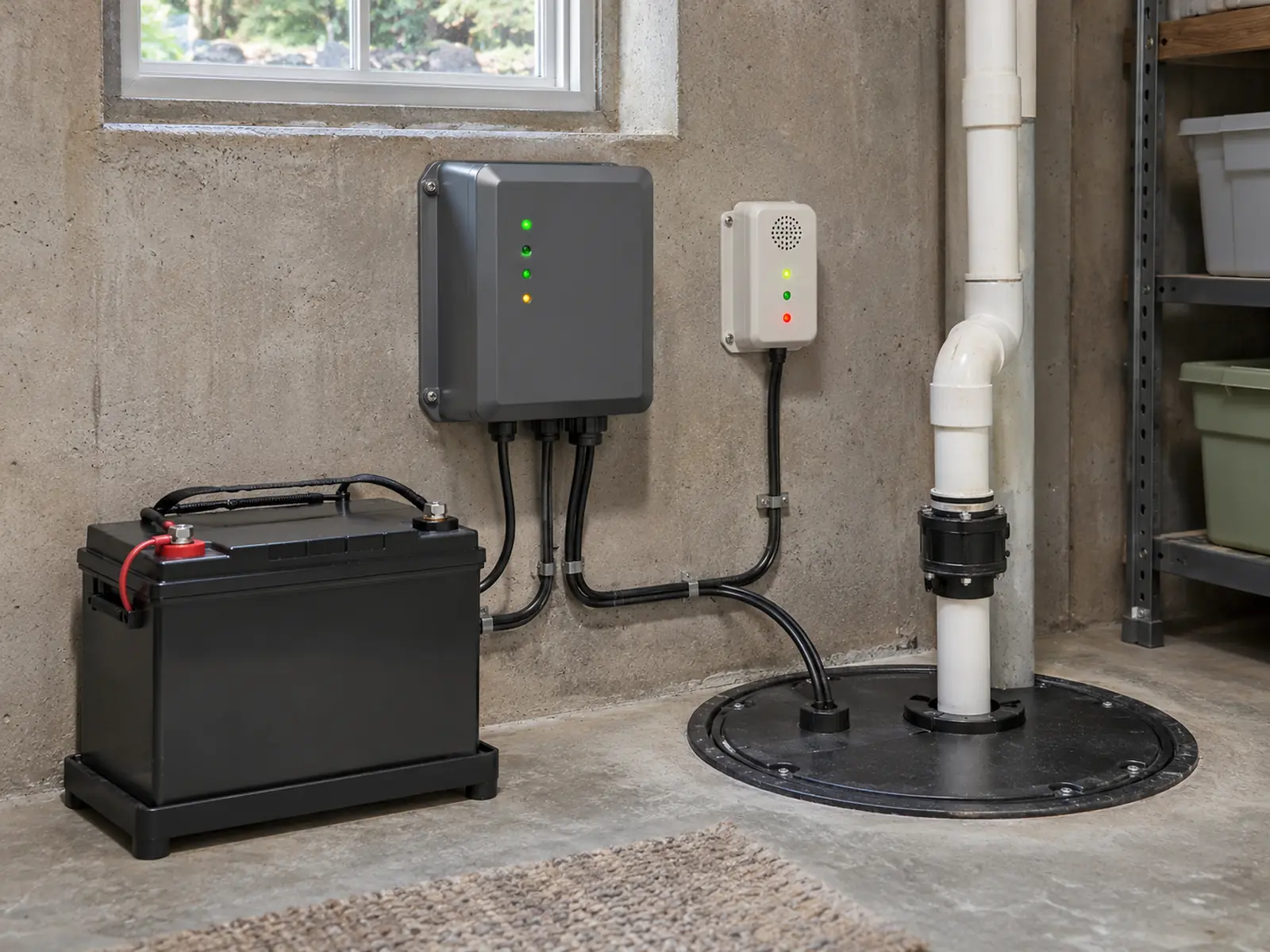
Start with the right backup system
A battery backup is normally a secondary pump paired with the primary AC sump pump. It may help when power fails or the primary pump cannot run, depending on the system design. It does not make the primary pump, its float switch, the pit or the discharge line irrelevant. Compare the complete arrangement: backup pump, battery, charger/controller, float switch, alarm, check valve, discharge connection and fit in the pit.
Confirm what liquid the pump is rated to handle. U.S. basement sump pumps commonly handle groundwater collected in a pit. “Sump pump battery backup” does not automatically mean a system suitable for sewage, wastewater containing solids, or a French sanitary lifting station. Match the liquid, solids-handling rating and intended use to the exact pump documentation.
What determines runtime?
Runtime is the total time the backup pump is actually running, not necessarily the number of hours the battery can protect the home. A system may cycle for short periods as water enters the pit. A manufacturer’s “two days of backup” example can therefore describe intermittent operation, not continuous pumping for 48 hours.
For a first-pass electrical estimate, use the battery’s usable capacity at the relevant discharge conditions and the pump’s average operating draw:
Approximate continuous runtime (hours) ≈ usable battery capacity (Ah) ÷ average pump current (A)
This rough relationship only makes sense when voltage, capacity rating and load conditions are compatible. If the pump specification is in watts, battery energy can be estimated as voltage × amp-hours in watt-hours, then compared with average watts. Neither calculation captures the full behavior of a motor, controller or lead-acid battery. Use the pump and battery manufacturers’ data for the model, and treat a simple calculator result as a screening estimate.
Battery capacity is tied to test conditions
Amp-hours are not a universal bucket of energy. Battery makers state the discharge rate used for a capacity rating; the U.S. Department of Energy’s lead-acid battery handbook explains that available capacity changes with discharge rate. A battery rated at one current and duration may provide less capacity when a pump draws current more quickly. Temperature, age, state of charge, battery chemistry and controller cutoff also matter.
Check the backup system’s required battery type, voltage, reserve capacity or amp-hour rating, maximum physical size and approved chemistry. Do not assume any automotive starting battery or a higher-capacity battery is compatible. Some systems specify a deep-cycle battery and a minimum reserve-capacity rating; follow the current instructions for the exact controller and battery combination.
Pump load changes with lift and flow
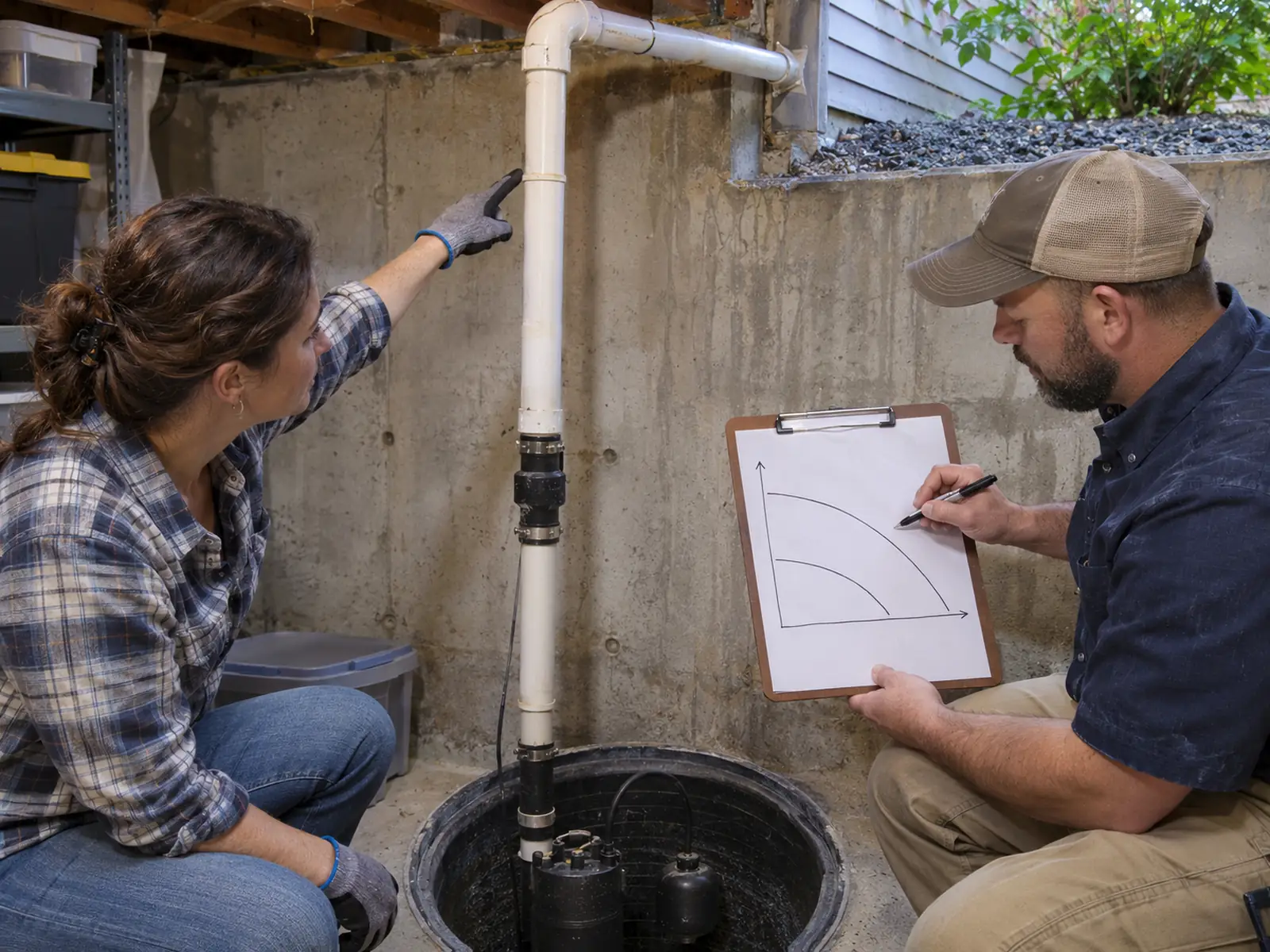
The pump does not deliver the same flow at every discharge height. Total dynamic head includes the vertical lift and resistance in the discharge route, including pipe and fittings. Compare the pump curve at the head your system must overcome, not only the pump’s maximum flow or shutoff head. Actual inflow to the pit then determines how often the backup must run.
Worked example: continuous runtime and outage time
Suppose a compatible DC system has 60 Ah of usable capacity at the pump's discharge conditions, and the running pump draws 10 A. These are illustrative inputs, not measured values or a product specification. The simple continuous estimate is 60 ÷ 10 = 6 hours.
| Duty cycle | Running time each hour | Ideal elapsed time |
|---|---|---|
| 100% | 60 minutes | 6 hours |
| 25% | 15 minutes | 24 hours |
| 10% | 6 minutes | 60 hours |
Elapsed time here equals continuous runtime divided by duty cycle. The 60-hour result is an arithmetic illustration, not an alternative to a manufacturer's tested rating. It excludes controller standby consumption, changing inflow, discharge-rate effects, battery aging and temperature. Do not size flood protection from this table alone.
Using an inverter with an AC pump
An AC pump on an inverter needs a separate compatibility check: the inverter must support the motor's starting demand as well as its running load, and conversion losses reduce usable energy. The Victron inverter manual describes overload protection triggered by motor or pump starting current. A dedicated 12 V backup pump’s current or runtime cannot be transferred to that AC setup. Ask the pump and inverter manufacturers to confirm the complete combination.
Read a manufacturer example without overgeneralizing
Zoeller’s current Aquanot Spin 508 page describes a 12-volt backup system and gives an “up to 6 hours” continuous runtime example, with about 48 hours or more at a 10% duty cycle. Its September 2025 FM3165 technical sheet gives an estimated 5.5 hours of continuous pumping for a fully charged battery with a 175-minute reserve capacity. The same sheet says the pump performance data uses a fully charged 12-volt deep-cycle battery with a 200-minute reserve capacity, in good condition and less than two years old. Those are product-specific assumptions, not a generic promise for every 12-volt pump.
| Model 508 detail in the 2025 sheet | Published value | How to use it |
|---|---|---|
| Battery requirement | 12 V deep-cycle; minimum size 27 and 175-minute reserve capacity | Check exact model compatibility and battery dimensions. |
| Flow at 5 ft total dynamic head | 39 gallons per minute at 12.1 V | Use only if your actual system head is close to this point. |
| Flow at 10 ft total dynamic head | 30 gallons per minute at 12.1 V | Compare the row matching your estimated head. |
| Flow at 15 ft total dynamic head | 20 gallons per minute at 12.1 V | Notice how flow decreases as head rises. |
| Continuous runtime estimate | Approximately 5.5 hours under the listed battery assumption | Do not convert this into a guaranteed outage duration. |
A second manufacturer example shows why headline claims need context. WAYNE’s ESP25n listing says it can move up to 10,000 gallons on one battery charge and publishes a flow table from 2,700 gallons per hour at 0 ft head to 660 gallons per hour at 15 ft. The page is dated October 3, 2018, and the displayed charge claim does not specify a matching battery capacity or duty-cycle test. Treat it as a model maker’s claim to investigate, not a directly comparable runtime result. Review the WAYNE ESP25n specifications and ask for the battery assumptions for the exact package.
The product page and technical sheet give different continuous-run figures; they do not establish that rounding is the reason. That is a reason to read the current model-specific data, not to choose whichever number sounds larger. The sheet also identifies controller alerts for power outage, battery fault, pump fault and switch fault; the optional high-water sensor is a separate feature. Verify which alarm functions are included in the specific package you are considering.
Compare backup systems with the same checklist
- Identify the water and installation. Record whether the pit handles groundwater or another liquid, the pit dimensions, the primary pump and float, discharge route and the highest point the water must reach. Ask a qualified installer to confirm the system head and whether a second pump fits the basin.
- Match the pump to the required flow. Use the manufacturer’s performance curve at the estimated total dynamic head. Compare expected flow there with the inflow and the primary system’s role. Do not compare one model’s free-flow number with another model’s rated flow at a lift.
- Match the battery and charger. Record voltage, battery chemistry, capacity or reserve rating, age assumptions, charger output, charging behavior and whether the battery is included. Confirm that the controller supports the proposed battery before comparing a larger capacity.
- Translate duty cycle into a scenario. Ask how much water enters during a typical outage and how frequently the pump may cycle. “Continuous hours,” “hours at 10% duty” and “gallons per charge” describe different conditions. Do not compare them as if they were the same runtime test.
- Compare alarms and service. Check audible alarm, visible status, high-water sensing, battery or switch fault alerts, self-test behavior, warranty and battery replacement guidance. Decide how someone will notice an alarm during an outage.
- Write down the limits. Keep the model numbers, battery assumption, head/flow point, duty cycle, included accessories and test date beside each quote. Ask the installer to explain any assumption that is missing.
Common comparison mistakes
- Choosing by amp-hours alone. Capacity needs the right discharge rating, usable range and compatible controller.
- Treating “two days” as continuous pumping. Ask for the duty cycle and whether the statement is based on one battery, a particular inflow or a particular pump load.
- Ignoring head. The discharge height and route can change delivered flow. Look up the curve rather than relying on a zero-lift figure.
- Assuming the battery is included. Product pages may list a battery separately. Confirm the exact battery, case, charger and alarms in the quote.
- Confusing an alarm circuit with a complete backup. A low-battery light or high-water alarm does not itself move water. Confirm the package includes the pump and required controls.
For a basic calculation, try our battery runtime calculator and battery energy calculator, then compare the result with the pump’s model-specific curve and battery instructions. Our guide to a 12 V low-voltage indicator circuit covers a separate electronics project; it is not a substitute for a sump controller or its alarms.
Frequently asked questions
How long will a sump pump battery backup run?
It depends on the exact pump, battery, total dynamic head, water inflow and duty cycle. A manufacturer’s continuous-runtime example is not the same as a longer intermittent backup estimate. Check the current model sheet and its battery assumptions.
Does a larger amp-hour battery always give longer runtime?
Not automatically. The battery must be compatible with the controller, and available capacity depends on discharge rate, battery condition, temperature and the controller’s cutoff. Compare manufacturer-approved batteries under the same rating conditions.
What does a 10% duty cycle mean?
It means the pump is operating for about one tenth of the stated period under the manufacturer’s scenario, not running continuously. Real cycling depends on the water entering the pit, pump flow and float settings.
Why does pump lift height matter?
A pump’s flow changes as the total dynamic head rises. Use the model’s curve at the estimated head for the discharge route; maximum flow at little or no lift can overstate the flow available in the installed system.
Can I use a sump pump backup for a sewage lift station?
Do not assume so. A basement groundwater sump pump and a wastewater lifting pump may be designed for different liquids and solids. Match the pump type to the intended fluid and ask the manufacturer or a qualified installer about a compatible backup arrangement.
Sources and update note
- Zoeller: Aquanot Spin 508 (manufacturer’s current model overview and runtime example).
- Zoeller: FM3165 Technical Data, Aquanot Spin 508 (September 2025 model specifications, battery assumptions, curve and alerts).
- U.S. Department of Energy: Primer on Lead-Acid Storage Batteries (capacity ratings and discharge-rate dependence).
- WAYNE: ESP25n (manufacturer product listing and head/flow table; page dated October 3, 2018).
Last updated: November 22, 2026. Runtime estimates are model- and condition-specific; consult the current manuals and a qualified installer for your system.
Be the first to leave a comment.